Does Garage Door Size Affect Installation Cost? Here’s What Okanagan Homeowners Need to Know
Does garage door size affect installation cost — and the short answer is yes, significantly. The larger the door, the more materials, hardware, and labor are required to install it properly and safely.
Here’s a quick breakdown of how size drives installation complexity:
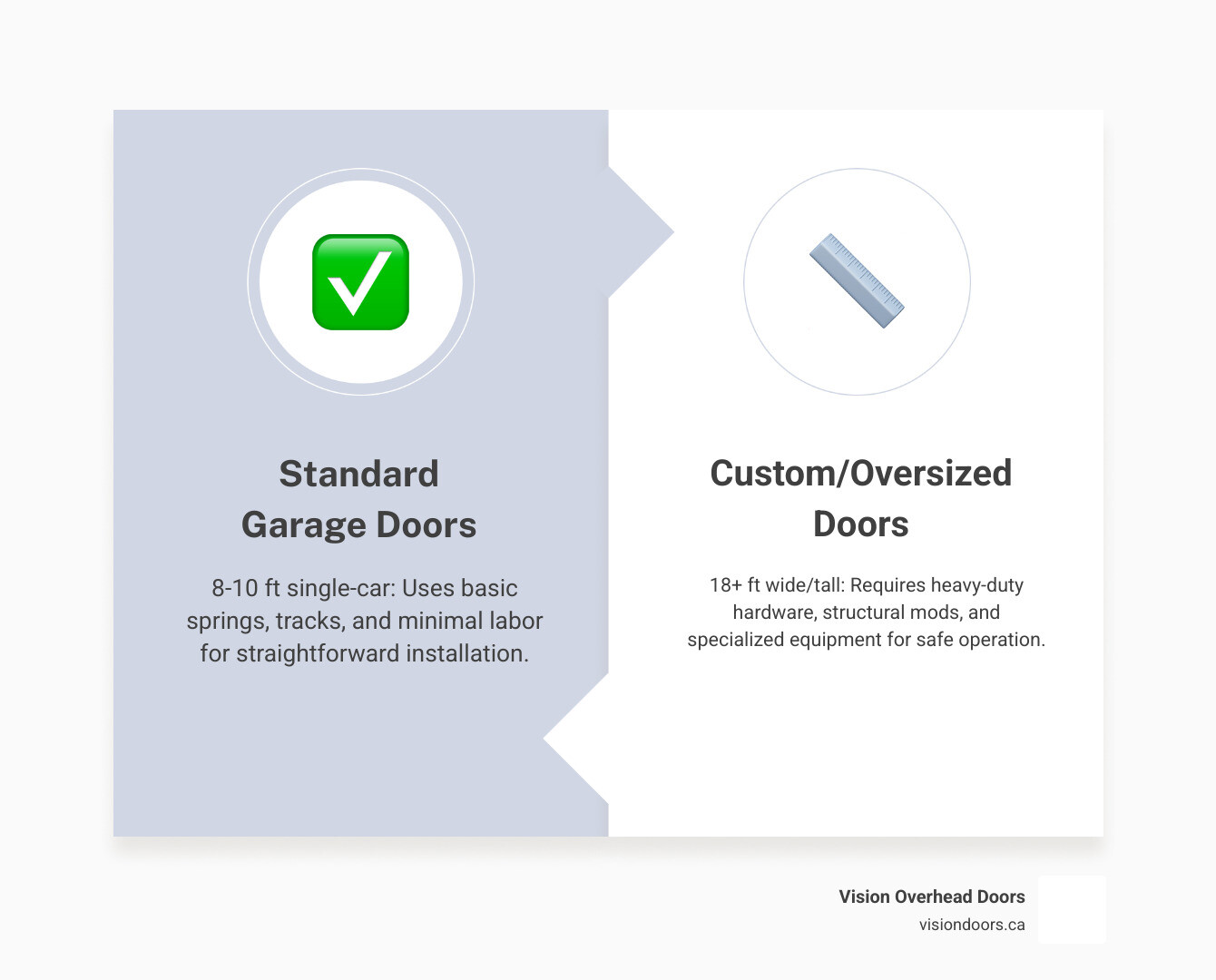
| Door Type | Typical Width | Key Cost Drivers |
|---|---|---|
| Single-car | 8-10 ft | Standard springs, basic tracks, minimal labor |
| Double-car | 16-18 ft | Heavier hardware, dual-spring systems, longer install time |
| Oversized / Custom | 18+ ft | Structural modifications, specialized equipment, custom components |
Why size matters beyond just the door itself:
- Larger doors require heavier-duty torsion springs, tracks, and rollers
- Wider or taller openings often need framing or header modifications
- Bigger panels take longer to align, balance, and secure safely
- More powerful openers may be needed to handle the added weight
- Installation crews may need an additional technician for large or heavy doors
It’s not just about buying more door — it’s about everything that has to scale up with it.
I’m Daryl Rands, owner of Vision Overhead Doors, and after 26 years of installing and servicing garage doors across the Okanagan Valley, I’ve seen how door sizing decisions shape the full scope and complexity of an installation project. Understanding does garage door size affect installation cost is something I walk homeowners through every day, and the sections below will give you a clear, practical picture of what to expect before you commit to a size.
Understanding How Does Garage Door Size Affect Installation Cost in Vancouver
While our primary focus is serving neighbors in the Okanagan Valley—from the lakeside homes in Kelowna to the quiet streets of Salmon Arm—the technical principles of garage door physics remain the same everywhere. When we talk about how does garage door size affect installation cost, we have to look at the volume of material first.
A standard single-car door is relatively manageable. However, as the square footage of the door increases, so does the weight and the demand on every single component. We aren’t just talking about a few extra pounds of steel or wood; we are talking about a massive increase in “dead weight” that must be balanced by a high-tension spring system.
Material Volume and Component Weight
When you move from a single-car door to a double-car door, you aren’t just doubling the width; you are often increasing the structural requirements exponentially. Larger Garage Doors require thicker gauge steel to prevent the panels from sagging or “smiling” in the middle. If a door is too thin for its width, the center will eventually dip, leading to mechanical failure. This need for reinforced panels naturally increases the resources required for the build.
Structural Reinforcement and Track Gauge
The tracks that hold your door in place aren’t one-size-fits-all. For smaller residential doors, a standard 2-inch track is common. But for those massive architectural doors we see on modern builds in Predator Ridge or Lake Country, we often move to a heavier-duty track gauge. This ensures the door doesn’t vibrate out of alignment or warp the tracks under its own weight.
Torsion Spring Tension
This is where things get serious. The springs are the “muscles” of your garage door. A larger door requires much larger torsion springs to offset the weight. These aren’t just bigger versions of small springs; they often involve dual-spring systems that require precise calibration. If the springs aren’t perfectly matched to the door’s weight, your opener will burn out in months, or worse, the door could become a safety hazard.
Standard Dimensions vs. Oversized Architectural Solutions
In the Okanagan, we see a wide variety of garage needs. Some homeowners in Vernon just need a simple spot for a sedan, while others in West Kelowna are building “toy boxes” for boats, lifted trucks, and RVs. The size of these openings dictates the entire installation strategy.
Single-Car Openings
Standard single-car doors usually measure 8×7 or 9×7 feet. These are the “bread and butter” of residential Garage Door Installation. Because these sizes are so common, the parts are standardized and the labor is straightforward. Usually, a single technician can handle much of the assembly, making it a very efficient process.
Double-Car Configurations
A double-car door (usually 16×7 or 18×7 feet) is where we see the first major jump in installation requirements. These doors are heavy enough that they almost always require a two-person crew for safety and precision. Aligning a 16-foot panel so that it sits perfectly level across the entire floor is much more time-consuming than leveling an 8-foot panel.
RV and Oversized Bays
For those who need Commercial Overhead Doors performance in a residential setting, oversized bays are the answer. These doors can be 10, 12, or even 14 feet tall. Installing these requires specialized lifting equipment—sometimes even a forklift or a scissor lift—to get the panels into place safely. This added equipment and the specialized labor required for high-altitude work are major factors in the overall resource allocation.
Does garage door size affect installation cost for double-car configurations?
When you opt for a 16×7 or 18×8 double door, you are moving into a different tier of hardware. We often have to install dual-spring systems to handle the load. If one spring breaks on a double door, the other spring helps prevent the door from crashing down, but the weight is still immense.
Panel alignment is also trickier. On a 16-foot span, even a tiny fraction of an inch of “out-of-square” framing can cause the door to bind in the tracks. We spend a significant amount of time during Garage Door Spring Repair and installation ensuring that the tension is perfectly distributed so the door doesn’t cock to one side.
Does garage door size affect installation cost when choosing custom heights?
Height is often overlooked, but it’s a massive factor. Moving from a 7-foot to an 8-foot door might seem minor, but it changes the “high-lift” requirements. If you have a tall SUV or a truck with a roof rack, you need that extra foot. However, that extra height means the tracks have to go further up the wall, often requiring more “backroom” and “headroom.”
This often necessitates more advanced Garage Door Openers with higher horsepower or specialized rail extensions. If your garage has a vaulted ceiling, we might even suggest a vertical lift system, which keeps the door moving straight up the wall rather than curving back over your head. This is a premium solution that requires expert engineering.
Technical Requirements for Large-Scale Door Systems
Installing a large-scale door system isn’t a DIY job—and I say that as someone who loves a good weekend project. The sheer physics involved can be dangerous. When we install a heavy, insulated double door in a place like Coldstream or Lavington, we follow strict safety protocols.
Labor Intensity and Multi-Person Crews
A standard single door might take a few hours for a pro. A large, custom-sized door can take a full day or more. This isn’t just because there are more screws to turn; it’s because every panel must be reinforced with “struts”—long metal bars that prevent the door from bowing when it’s in the open position. These struts add weight, which in turn requires more spring tension. It’s a cycle of reinforcement that demands more hands on deck.
Precision Balancing
A door that isn’t balanced is a door that is waiting to break. We use a technique where we “hot-balance” the door, ensuring that it can stay open halfway without moving. On a large door, achieving this “sweet spot” is an art form. It requires fine-tuning the torsion springs to within a quarter-turn of perfection. This level of Garage Door Repair expertise is what keeps your door running smoothly for decades rather than years.
Structural Impacts: Headroom, Side Room, and Framing
Before we even bring the door to your house in Armstrong or Enderby, we have to look at your garage’s “bones.” The size of the door dictates the structural support needed in your walls and ceiling.
Header Modifications
The “header” is the beam that runs across the top of your garage opening. It carries the weight of the wall above the door. If you are widening an opening—say, converting two single doors into one large double door—you will likely need a new, much beefier header. This structural framing work is a separate but necessary part of the installation process.
Headroom and Side Room
- Headroom: This is the space between the top of the door opening and the ceiling. Larger doors, especially those with heavy-duty springs, need more room for the hardware to “breathe.” If you have limited space, we may need to install a “low-headroom kit,” which uses a double-track system to allow the door to turn the corner in a tighter radius.
- Side Room: We need a few inches on either side of the opening to mount the vertical tracks and the spring shaft. Larger doors often require wider brackets, meaning you need more clear space on the “shoulders” of the opening.
Weatherstripping Volume
It sounds small, but a 16-foot door has a lot more perimeter to seal than an 8-foot door. Ensuring a weather-tight seal in the Okanagan—where we get everything from blistering summer heat in Kelowna to freezing winters in Silver Star—requires high-quality, heavy-duty perimeter seals. The larger the door, the more material we use to ensure your garage stays energy-efficient. This is a key part of a professional Garage Door Installation.
Frequently Asked Questions about Sizing and Installation
How do I measure my garage opening accurately to avoid sizing errors?
To get a ballpark idea, measure the width and height of the “rough opening”—this is the inside frame of the door. However, you also need to measure the “headroom” (space above the opening), “side room” (space to the left and right), and “backroom” (the distance from the opening to the back wall). We always perform a professional site check before ordering because even an inch of error can lead to a door that doesn’t fit or tracks that hit a structural beam.
Is it more resource-intensive to install two single doors or one large double door?
Typically, two single doors are more resource-intensive. Why? Because you are doubling the hardware. You need two sets of tracks, two sets of springs, two openers, and double the labor for the mechanical setup. While a single large door is heavier and requires more structural support, the “per-unit” labor of setting up two separate systems usually makes the two-door option a bigger investment.
Does the size of the door impact the type of opener required for safe operation?
Absolutely. A standard 1/2 horsepower (HP) opener might struggle with a heavy, carriage-style double door or a tall RV door. We often recommend 3/4 HP or even 1 1/4 HP motors for larger systems. Furthermore, we might suggest a “wall-mount” (jackshaft) opener for high-lift or oversized doors to keep the ceiling clear and provide more lifting torque.
Conclusion
At the end of the day, your garage door is likely the largest moving part of your home. Whether you are looking for a sleek, modern glass door for a new build in Kelowna or a rugged, insulated solution for a workshop in Sicamous, the size you choose will dictate the complexity of the project.
At Vision Overhead Doors, we pride ourselves on providing the Okanagan Valley with local expertise and premium craftsmanship. We don’t just “slap a door on the wall.” We analyze your framing, calculate the perfect spring tension, and ensure that your installation is safe, quiet, and built to last.
If you’re ready to upgrade your home’s curb appeal and functionality, we’re here to help. From Salmon Arm to Kelowna and everywhere in between, we provide the custom architectural solutions your home deserves.
Ready to find the perfect fit for your home? Contact us today for a professional Garage Door Installation consultation!