Why the Quietest Garage Door Opener Type Matters More Than You Think
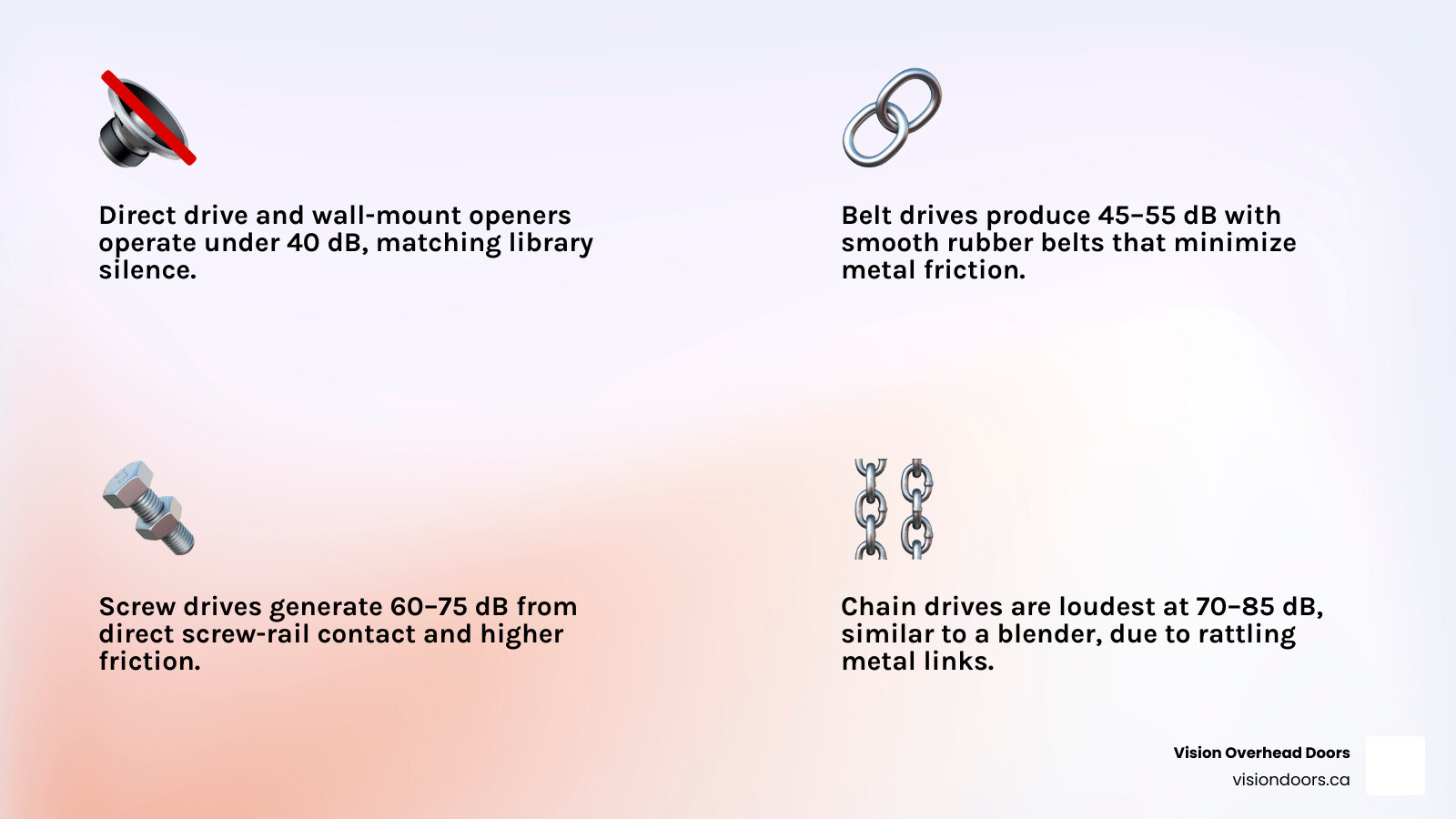
The quietest garage door opener type ranked from quietest to loudest is:
| Opener Type | Typical Noise Level | Best For |
|---|---|---|
| Direct Drive / Wall-Mount (Jackshaft) | Under 40 dB | Attached garages, rooms above garage |
| Belt Drive | 45–55 dB | Most residential homes, noise-sensitive spaces |
| Screw Drive | 60–75 dB | Detached garages, moderate noise tolerance |
| Chain Drive | 70–85 dB | Detached garages, budget-focused installs |
If your garage is attached to your home — especially if there’s a bedroom, nursery, or living space above or beside it — that difference between 40 dB and 85 dB is enormous. To put it in perspective, a quiet library sits around 40 dB, while 85 dB is closer to a running blender. That’s the gap between sleeping through your partner’s early morning departure and being jolted wide awake by what sounds like a mechanical jackhammer overhead.
Noise from a garage door opener isn’t just about the motor, either. Vibration travels through the rail, into the ceiling joists, and straight into your home’s structure. The type of drive mechanism you choose plays a huge role in how much of that vibration — and sound — actually makes it into your living space.
I’m Daryl Rands, owner of Vision Overhead Doors, and after 26 years installing and servicing garage door openers throughout the Okanagan Valley, I’ve seen how choosing the right quietest garage door opener type transforms the daily experience of homeowners, especially those with attached garages. In the sections below, we’ll break down exactly what separates a whisper-quiet opener from a racket-maker — and how to pick the right one for your home.
The Science Behind the Quietest Garage Door Opener Type
When we talk about the “quietest” opener, we aren’t just talking about the hum of the motor. True silence in a garage door system comes from managing three distinct factors: mechanical friction, structural vibration, and acoustic output.
In many homes across the Okanagan Valley—from the modern builds in Predator Ridge to the lakeside retreats in Sorrento—garages are built directly under master bedrooms or adjacent to nurseries. In these architectural layouts, the garage ceiling joists are often the same joists supporting your bedroom floor. When a standard opener operates, it creates a “drum effect,” where vibrations are amplified by the hollow spaces in your walls and floors.
Decibel (dB) ratings are our primary tool for measurement. A standard, older chain-drive unit often clocks in at 70 to 85 dB. For context, that is loud enough to cause hearing fatigue over long periods. Conversely, a premium quietest garage door opener type like a direct drive or wall-mount unit operates at under 40 dB—equivalent to the ambient noise in a quiet library or a soft whisper.
Achieving this level of silence requires acoustic dampening and high-quality Garage Door Openers. By choosing a system designed to minimize structural noise, you aren’t just buying a motor; you’re investing in the peace and comfort of your entire home.
Comparing Drive Mechanisms for Silent Operation
Choosing the right mechanism is the most important decision you’ll make for noise reduction. While the motor does some work, the “drive” is what moves the door, and it’s usually the primary source of clatter.
| Feature | Direct Drive / Wall-Mount | Belt Drive | Screw Drive | Chain Drive |
|---|---|---|---|---|
| Noise Level | Ultra-Quiet (<40 dB) | Very Quiet (45-55 dB) | Moderate (60-70 dB) | Loud (70-85 dB) |
| Vibration | Minimal | Low | Medium | High |
| Maintenance | Low | Low | Moderate | High |
| Durability | High | High | Medium | Very High |
Why Belt Drives are a Top Quietest Garage Door Opener Type
For the vast majority of residential homes in Salmon Arm or Vernon, the belt drive is the reigning champion of quiet. Instead of a noisy metal chain, these systems use a reinforced rubber belt—often strengthened with internal steel braids or polyurethane cords.
The magic of the belt drive lies in the elimination of metal-on-metal contact. As the motor turns, the rubber teeth of the belt engage with the drive sprocket silently. There is no “clinking” or “rattling” as the door moves along the rail. Furthermore, the flexible nature of the belt allows it to absorb minor shocks and vibrations that would otherwise be sent straight into your ceiling.
Installing the Quietest Garage Door Opener Type in Okanagan Homes
In our local climate, from the dry heat of Kelowna to the cooler winters in Silverstar, temperature sensitivity is a factor. While older rubber belts could sometimes become brittle, modern premium belts are designed to handle 100°F summers and freezing winters without losing their silent properties.
However, even the best belt drive will be noisy if the rail isn’t aligned perfectly. Professional Garage Door Opener Installation ensures that the rail is mounted to solid joists using vibration-isolation brackets. We often use rubber bushings between the opener’s chassis and the mounting straps to prevent any leftover motor hum from reaching the living spaces above.
Essential Features for Noise Reduction in 2026
As we move through 2026, technology has given us more tools than ever to silence the garage. If you are shopping for a new unit, look for these specific features:
- DC Motors vs. AC Motors: This is a game-changer. Older AC (Alternating Current) motors are essentially “on or off,” meaning they start with a loud jolt and stop with a bang. DC (Direct Current) motors allow for Soft Start/Stop technology. The motor gradually accelerates the door and gently slows it down before it touches the floor, eliminating that final “thud” that shakes the house.
- Vibration Isolation: Premium models now come with insulated motor housings and rubberized mounting points. This traps the sound inside the unit rather than letting it escape.
- Smart Wi-Fi Integration: In addition to sound, smart features allow you to monitor your door from an app. If you have a truly quiet opener, you might actually need the app to confirm the door closed because you won’t hear it from inside the house!
- Battery Backup: Many quiet DC models include a battery backup, ensuring that even during a power outage in places like Eagle Bay or Tappen, your door operates smoothly and silently.
How Door Maintenance and Components Impact Sound
You could install the most expensive, ultra-quiet direct drive opener on the market, but if your garage door itself is a rusted, rattling mess, you’ll still have a noise problem. The opener is only one half of the equation; the door is the other.
- Nylon Rollers: If you still have standard steel rollers, you are listening to metal grinding against metal every time the door moves. Upgrading to high-quality nylon rollers with ball bearings can reduce noise by up to 50%. Nylon glides through the tracks silently and absorbs vibration.
- Torsion Springs: A well-balanced door is a quiet door. If the springs are worn out, the opener has to strain, which increases motor noise and vibration.
- Lubrication Schedule: We recommend lubricating all moving parts—hinges, rollers, and springs—every six months. Use a silicone-based lubricant or lithium grease; avoid WD-40, as it is a degreaser and can actually make the noise worse over time.
- Hardware Tightening: Over time, the vibrations of the door can loosen the nuts and bolts on the tracks and hinges. A quick “tune-up” involving tightening this hardware can stop those annoying “chattering” sounds.
If your door is struggling or making strange noises despite your best efforts, it might be time for a professional Garage Door Opener Repair to ensure the system is properly aligned and balanced.
Frequently Asked Questions about Silent Openers
Which drive type is objectively the quietest?
The direct drive or wall-mount (jackshaft) opener is objectively the quietest. Because the motor is mounted on the wall beside the door rather than on the ceiling, it eliminates the long rail and the vibration transmission through the ceiling joists. Many of these units operate at under 40 dB, providing library-level silence.
Can I make my existing chain drive opener quieter?
Yes, though it will never be as quiet as a belt drive. You can install rubber vibration-isolation mounts between the opener and the ceiling, upgrade your door to nylon rollers, and ensure the entire system is meticulously lubricated with silicone spray. These steps can significantly dampen the “clatter” associated with chain drives.
When should I replace my opener for noise reduction?
If your opener is over 10 to 12 years old, it likely uses an older AC motor and a chain drive. If you’ve tried lubricating and tightening the hardware but still hear persistent grinding or loud humming, it’s time to upgrade. Modern DC motor units are not only quieter but safer and more energy-efficient.
Conclusion
At Vision Overhead Doors, we believe your home should be a sanctuary, not a construction zone every time someone comes home. From the quiet streets of Lake Country to the busy neighborhoods of Kelowna and Salmon Arm, we specialize in providing the quietest garage door opener type solutions tailored to your specific home layout.
Whether you need a premium wall-mount system to save ceiling space or a whisper-quiet belt drive for a bedroom-adjacent garage, our team brings local expertise and industry-leading products to every job. Don’t settle for a noisy morning wake-up call. Upgrade to a quiet system today and experience the difference that professional craftsmanship and custom architectural solutions can make for your home.