Why Your Garage Door Springs Deserve More Attention Than You’re Giving Them
Can you extend the life of your garage door springs? Yes — and doing so is simpler than most homeowners think. Here’s a quick summary of what works:
- Lubricate regularly – Apply a silicone-based lubricant or white lithium grease every 3–6 months
- Inspect twice a year – Look for rust, gaps between coils, or visible deformation
- Test door balance every 6 months – Disconnect the opener and lift the door halfway; it should stay in place
- Avoid unnecessary cycles – Every open-and-close counts against your spring’s rated lifespan
- Control moisture and temperature – Use weatherstripping and keep humidity low to slow corrosion
- Schedule annual professional inspections – A technician can catch wear before it becomes a failure
Standard garage door springs are rated for roughly 10,000 cycles — that’s one open and one close counted as a single cycle. For a typical household using the garage door four times a day, that works out to somewhere between 7 and 12 years of service life. With proper care, some springs push well beyond that. Without it, they can fail much sooner — and when a spring snaps, it doesn’t go quietly. It goes with a bang loud enough to sound like a gunshot, leaving you with a door that can weigh 150 to 400 pounds and won’t budge.
The good news is that most of what shortens a spring’s life is entirely preventable. Friction, corrosion, poor alignment, and overuse are the main culprits — and all of them respond to consistent, straightforward maintenance.
I’m Daryl Rands, owner of Vision Overhead Doors and a garage door professional with 26 years of experience serving the Okanagan Valley, and I’ve seen how a simple maintenance routine can answer the question of can you extend the life of your garage door springs with a confident yes — often doubling the useful life of a set of springs. In the sections below, I’ll walk you through exactly what to do, what to watch for, and when to call in a professional.

Understanding the Lifespan of Your Garage Door Springs
When we talk about how long a spring lasts, we aren’t just talking about years on a calendar. We are talking about “cycles.” Every time you press that button to leave for work and press it again when you return, you’ve used one cycle. Most residential springs are engineered for roughly 10,000 cycles.
While the average lifespan of a garage door spring is approximately 8.5 years, this number varies wildly based on how often the door moves. If you have a busy household in Kelowna or Vernon where the door opens ten times a day, those 10,000 cycles will disappear much faster than in a home where the door is only used twice.
There are two main types of springs: torsion springs (mounted on a bar above the door) and extension springs (mounted along the tracks). Torsion springs generally offer a smoother operation and a slightly longer lifespan—averaging 7 to 10 years—compared to the roughly 7-year average for extension springs. Regardless of the type, metal fatigue is the ultimate enemy. Over time, the constant stretching and twisting cause the steel to become brittle until it eventually snaps. Understanding this lifecycle is the first step in Garage Door Spring Repair.
Cycle Ratings and Real-World Durability
In April 2026, many homeowners are opting for “high-cycle” springs during their initial installation or replacement. While standard springs hit that 10,000-cycle mark, high-cycle alternatives are often rated for 25,000 to 50,000 cycles. These are essentially “heavy-duty” versions of the standard spring, designed with thicker wire to distribute stress more evenly.
If you plan on staying in your home for the long haul, investing in a higher cycle rating can mean the difference between replacing your springs every 7 years or every 20 years. However, even the best springs can’t overcome a lack of maintenance. Daily operation impact is cumulative; every jerky movement or “sticking” point in the track adds unnecessary stress to the metal coils.
Environmental Factors in the Okanagan
Living in the Okanagan Valley means our garage doors face unique challenges. From the dry heat of a Kelowna summer to the freezing temperatures in Silver Star or Revelstoke, the metal in your springs is constantly expanding and contracting. This thermal stress can make the steel more prone to cracking.
Humidity and moisture are also major factors. In damp environments or coastal-adjacent areas, rust can form between the coils. Rust creates friction, and friction creates heat and weakness. A rusted spring is a ticking time bomb. Keeping your garage well-insulated and ensuring proper weatherstripping can help mitigate these environmental stressors. For more localized advice, check out our Garage Spring Repair Guide Vernon BC.
Can You Extend the Life of Your Garage Door Springs?
The short answer is a resounding yes. You don’t have to just sit back and wait for the “big bang” of a snapping spring. By focusing on friction reduction and corrosion resistance, you can keep that steel supple and strong for years beyond its “rated” lifespan.
Proper alignment is also key. If your tracks are slightly off or your rollers are seized, the springs have to work twice as hard to pull the door up. It’s like trying to run a marathon while wearing lead boots. By ensuring the rest of the door system is healthy, you take the “heavy lifting” off the springs. This proactive approach is detailed further in The Essential Guide to Commercial Garage Door Spring Repair in Armstrong BC.
Using Lubrication: Can You Extend the Life of Your Garage Door Springs?
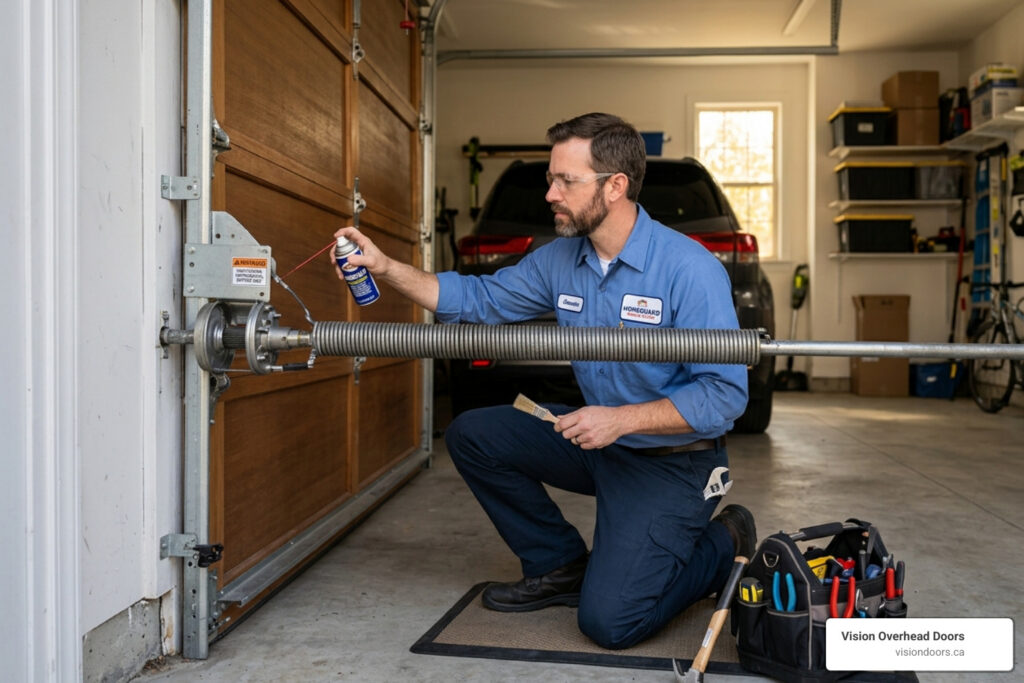
Lubrication is arguably the single most important maintenance task you can perform. When a spring operates, the coils rub against each other. Without lubrication, this creates friction that wears down the metal.
What to use: Always opt for a silicone-based lubricant or white lithium grease. These products stay on the metal and don’t attract as much dust and grime as oil-based products.
What to avoid: Never use WD-40 “Multi-Use Product” on your springs. It is a degreaser and a solvent, not a long-term lubricant. It will actually strip away any existing protection and leave the metal vulnerable to rust.
We recommend applying lubricant every 3 to 6 months. Simply spray the length of the spring and use a cloth to wipe away any excess. This keeps the operation quiet and the metal protected. For homeowners in Enderby, our Garage Door Spring Repair Enderby Guide offers specific tips for our local climate.
Signs It’s Too Late: Can You Extend the Life of Your Garage Door Springs?
Sometimes, despite your best efforts, the springs reach the end of their road. You need to know when to stop maintaining and start replacing. Look for these “red flags”:
- Visible Gaps: If you see a gap in the coils of a torsion spring, it has already snapped.
- Rust Pitting: Deep rust that has eaten into the metal surface means the structural integrity is compromised.
- Stretched Coils: If an extension spring looks “elongated” or doesn’t fully retract, it has lost its tension.
- Squeaking sounds: While some noise is normal, a persistent grinding or loud “popping” sound usually indicates internal fatigue.
If you notice these signs, don’t wait for a total failure. Catching it early prevents the “broken spring blues”—a situation we see often in our Kelowna Garage Door Repair Solutions.
Essential Maintenance Steps for Homeowners
Beyond lubrication, there are several “safe” DIY tasks that can significantly improve your door’s health. We’ve broken these down into a simple comparison:
| Task | DIY Friendly? | Frequency |
|---|---|---|
| Visual Inspection | Yes | Monthly |
| Lubrication | Yes | Every 3-6 Months |
| Balance Test | Yes | Every 6 Months |
| Tightening Hardware | Yes | Annually |
| Spring Adjustment | NO | Professional Only |
| Spring Replacement | NO | Professional Only |
One often overlooked safety feature for extension springs is the safety cable. These cables run through the center of the spring. If the spring snaps, the cable contains the flying metal, preventing it from smashing through a car window or causing serious injury. If your door doesn’t have these, they are a vital addition.
How to Test if Your Garage Door is Properly Balanced
A balanced door is a happy door. When a door is perfectly counterbalanced, the springs are doing exactly what they were designed to do—no more, no less. To test this:
- Close the door completely.
- Disconnect the automatic opener (usually by pulling the red emergency release cord).
- Lift the door manually to about the halfway point and let go.
The Result: If the door stays in place or moves only slightly, it is balanced. If it slams shut or “shoots” upward, the spring tension is wrong. An imbalanced door puts immense strain on the opener motor and the springs themselves. For those in Armstrong, you can find more on this in our Garage Door Spring Repair Guide Armstrong BC.
Cleaning and Protecting the Spring Assembly
Dust and debris are the silent killers of garage door components. Use a microfiber cloth to wipe down the springs and the tracks twice a year. This prevents abrasive particles from getting caught in the coils.
Additionally, check your weatherstripping. If the seals at the bottom or sides of your door are cracked, moisture from snow and rain can blow directly onto your springs. Keeping the garage dry is the best way to prevent rust. If you manage a warehouse or shop, Commercial Garage Door Spring Repair in Vernon BC covers these needs for larger industrial systems.
Safety and Professional Intervention
We cannot stress this enough: Garage door springs are dangerous. They store between 100 and 200 pounds of force—enough to cause severe injury or even death if they release unexpectedly. Professional technicians use specialized winding bars and safety gear to manage this tension.
While you can—and should—perform visual checks and lubrication, never attempt to loosen the bolts on a torsion spring’s center bracket or end cones. If you suspect a problem that requires more than a spray of lubricant, it’s time for Emergency Garage Door Spring Repair in Armstrong BC.
Why You Should Always Replace Springs in Pairs
If one spring breaks, the other is usually only a few weeks or months behind. Think about it: they were installed at the same time, they’ve performed the exact same number of cycles, and they’ve faced the same Okanagan weather.
Replacing them in pairs ensures that the stress distribution is even across the door. It also saves you money on a second service call in the near future. Keeping your system symmetrical is a hallmark of the Best Garage Door Spring Repair in Vernon BC.
The Risks of Ignoring Spring Wear
Ignoring a worn spring is a gamble where the stakes are high. When a spring fails, the door becomes “dead weight.” If your opener tries to lift a door with a broken spring, the motor can burn out in seconds. Even worse, if the spring snaps while the door is moving, the door could collapse, causing massive property damage or injuring anyone standing nearby.
Don’t ignore the warning signs. Regular maintenance is an investment in your safety and your wallet. For expert help, look to Armstrong BC’s Top Picks Expert Garage Door Spring Repair You Can Trust.
Frequently Asked Questions about Garage Door Springs
How often should I lubricate my springs?
We recommend lubricating your springs every 3 to 6 months. In the Okanagan, it’s a great idea to do this at the start of spring and again before the first frost in the fall. This helps the metal handle the transition between temperature extremes.
What is the best lubricant for garage door springs?
The gold standard is a high-quality silicone-based spray or a specialized garage door lubricant. These provide excellent dust resistance and stay viscous even in the cold winters of Salmon Arm or Lake Country. White lithium grease is also a solid choice for pivot points and hinges.
Is it safe to adjust my own torsion springs?
No. Adjusting torsion springs requires specialized winding bars and an understanding of the exact number of “turns” required for your door’s weight. One slip can result in broken bones or worse. Always leave tension adjustments to a trained professional.
Conclusion
At Vision Overhead Doors, we believe that a little bit of care goes a long way. By following these tips, you can confidently answer the question: can you extend the life of your garage door springs? Whether you are in Kelowna, Vernon, Salmon Arm, or anywhere in the Okanagan Valley, our team is here to provide the premium craftsmanship and custom architectural solutions your home deserves.
From same-day service for emergencies to expert advice on high-cycle upgrades, we ensure your garage door remains a safe and reliable part of your home. Don’t wait for the snap—take care of your springs today. For all your needs, trust the local experts at Garage Door Spring Repair.