Your Garage Door Spring Is Wearing Out — Here’s How to Know
How to tell if your garage door spring is wearing out is something every Okanagan Valley homeowner should know — because a failing spring rarely gives much warning before it becomes a full breakdown.
Here are the most common signs to watch for:
- Door feels unusually heavy when lifted manually
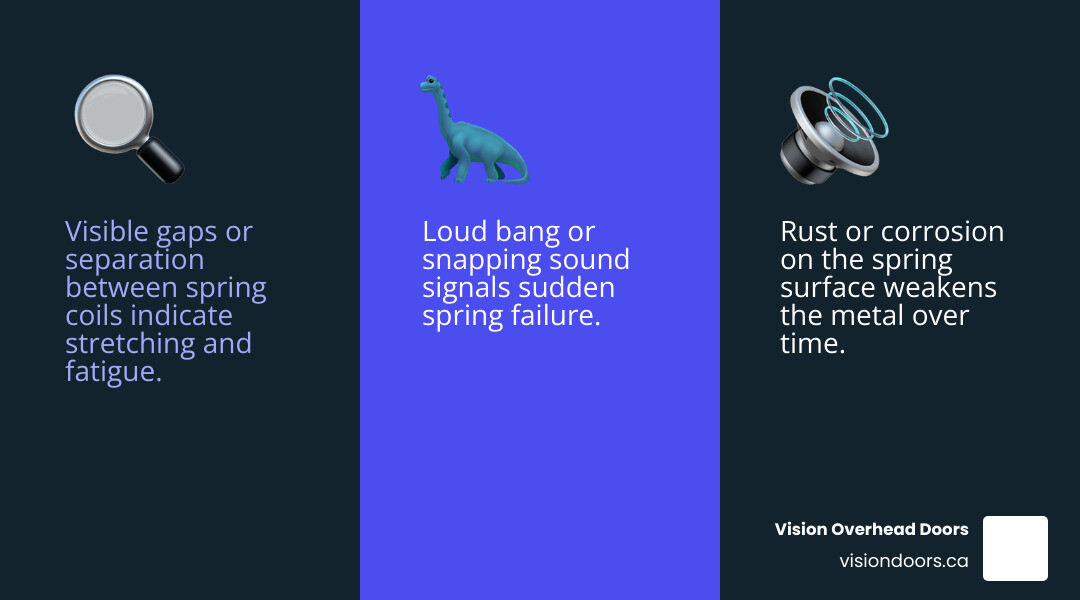
- Visible gaps or separation in the spring coils
- Rust or corrosion on the spring surface
- Jerky, uneven, or lopsided movement when the door opens or closes
- Door falls too fast or won’t stay open on its own
- Loud bang or snapping sound from the garage (often the moment a spring breaks)
- Garage door opener struggling or stopping mid-cycle
- Door stops after opening only a few inches
If you’re noticing any of the above, your springs deserve a closer look — and soon.
Your garage door is one of the hardest-working parts of your home. It opens and closes thousands of times over its life, and the springs are doing the heavy lifting every single time. Most garage doors weigh several hundred pounds, and without properly functioning springs to counterbalance that load, the door simply can’t operate safely. When those springs start to wear out, the whole system is at risk — not just the door, but your garage door opener, your cables, and anyone nearby when things go wrong.
The tricky part? Spring wear is often gradual. There’s rarely one dramatic moment (well, except for that loud bang — more on that later). Instead, the clues tend to build quietly over time: a door that feels a little heavier, a movement that’s slightly off, a noise you haven’t heard before. Knowing what to look for means you can catch the problem early — before it becomes an emergency.
I’m Daryl Rands, owner of Vision Overhead Doors and a garage door professional with 26 years of experience serving the Okanagan Valley — and knowing how to tell if your garage door spring is wearing out is one of the most valuable things I teach homeowners to spot early. Let’s walk through the signs together so you know exactly what to look for.
Torsion vs. Extension Springs: Knowing Your System
Before we dive into the warning signs, we need to identify which “muscles” your garage door is using. In the Okanagan, from Salmon Arm down to Kelowna, we typically see two main types of spring systems. Understanding which one you have changes how you inspect them and what a failure looks like.
| Feature | Torsion Springs | Extension Springs |
|---|---|---|
| Location | Mounted on a metal rod above the door opening. | Located on the sides, parallel to the horizontal tracks. |
| Action | They twist (torque) to lift the door. | They stretch and contract to lift the door. |
| Lifespan | Typically 10,000 to 20,000 cycles (8–12 years). | Typically 5,000 to 10,000 cycles (3–7 years). |
| Safety | Generally safer; if they break, they stay on the shaft. | Can be dangerous if they snap without safety cables. |
| Movement | Smoother, more controlled operation. | Can lead to more “jerky” movement as they age. |
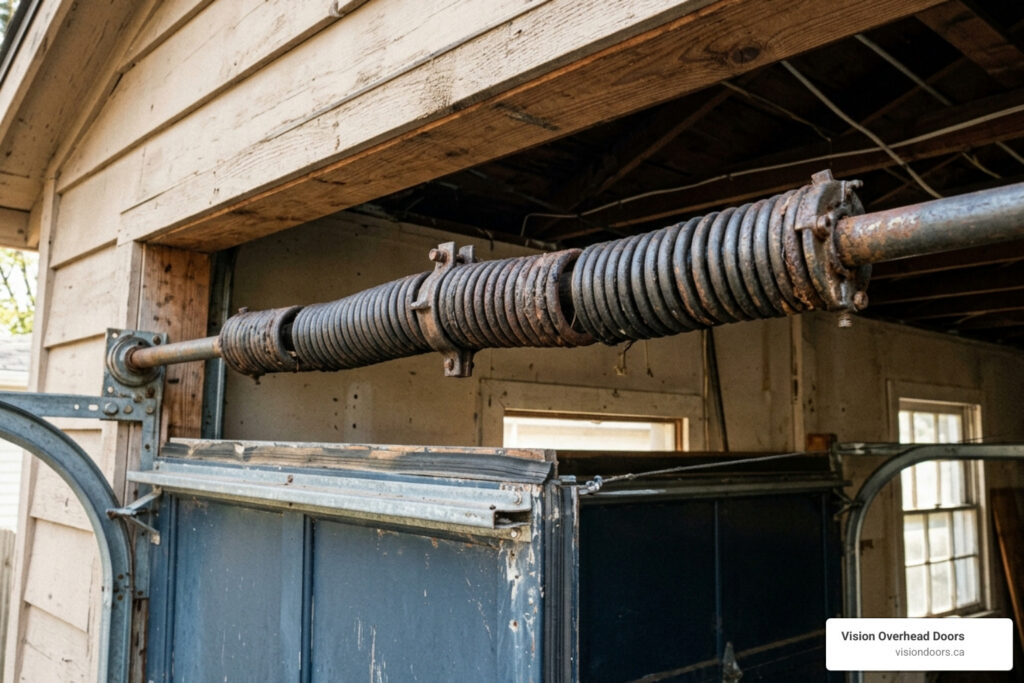
Torsion Springs are the modern standard for most residential homes in places like Vernon and Armstrong. Because they are mounted on a shaft, they distribute weight more evenly. When they break, you’ll see a very specific gap in the coils.
Extension Springs are more common on older doors or in tight spaces where there isn’t enough “headroom” above the door. These springs act like giant rubber bands. Because they stretch so much, they are prone to “fatigue” faster than torsion springs. If you suspect your springs are reaching the end of their rope, our team provides expert Garage Door Spring Repair to get your system back in balance.
How to Tell if Your Garage Door Spring is Wearing Out
Visual cues are often your first line of defense. We recommend that homeowners in the Shuswap and Okanagan regions perform a quick visual inspection at least once a month. It only takes a minute, but it can save you from being trapped in your garage on a Monday morning.
1. Visible Gaps and Separation
This is the “smoking gun” for torsion springs. When a torsion spring reaches its breaking point, it literally snaps in two. You will see a clear gap — usually about one to two inches wide — in the middle of the spring coil. If you see this, do not attempt to move the door; the spring is no longer providing any lift.
2. Rust Accumulation and Corrosion
Our Okanagan climate can be tough on metal. Between the humid winters in Salmon Arm and the temperature swings in Kelowna, moisture can settle on your springs. Rust creates friction between the coils and eats away at the steel, making it brittle. If your springs look “flaky” or orange, they are losing their structural integrity.
3. Elongated or “Stretched” Coils
Extension springs are particularly susceptible to this. If you notice that the spring looks “limp” or has sections where the coils don’t sit tightly together when the door is closed, it has lost its tension. An elongated spring can’t pull its weight, leading to many of the Five Signs You Need Garage Door Repair that we often see in the field.
4. Fraying Cables
While the cables aren’t the springs themselves, they work in tandem. When a spring is wearing out, the cables often become loose or start to fray because they are taking on uneven loads. If you see “fishing line” type threads sticking out of your steel cables, your springs are likely failing to support the door correctly.
Operational Red Flags and Audible Warnings
Sometimes the clues aren’t visible; they’re felt. Your garage door is a finely tuned machine, and when the counterbalance system is off, the whole performance suffers.
- Jerky or Stuttering Movement: If the door hitches or “jumps” while opening, one spring might be providing more lift than the other.
- The 6-Inch Stop: Does your door open about six inches and then stop? This is a safety feature of modern openers. The motor senses that the door is too heavy (because the spring isn’t helping) and shuts down to prevent the motor from burning out.
- A Crooked Door: If the door looks lopsided as it moves, or if one side seems higher than the other, you likely have an extension spring that has failed on one side.
If your door is acting up, you might be facing the Broken Spring Blues: Your Kelowna Garage Door Repair Solutions are just a phone call away to prevent further damage to your tracks and rollers.
Audible Clues: How to Tell if Your Garage Door Spring is Wearing Out by Sound
Your ears are just as important as your eyes when diagnosing garage door issues.
- The “Gunshot” Bang: If you are home and hear a sudden, massive CRACK coming from the garage, that’s almost certainly a spring snapping. It sounds like a firecracker or a gunshot because of the immense tension being released instantly.
- Squeaking and Grinding: While some noise is normal, a high-pitched squeal often means the metal is under extreme stress or the coils are rubbing together without proper lubrication.
- Popping Noises: This often happens when the coils of a rusted spring “bind” and then suddenly release as the door moves.
Physical Tests: How to Tell if Your Garage Door Spring is Wearing Out Safely
If you want to be proactive, you can perform a Balance Test. This is the gold standard for checking spring health.
- Close the garage door completely.
- Pull the red emergency release cord to disconnect the door from the opener.
- Lift the door manually halfway up.
- The Result: A well-balanced door with healthy springs should stay in place at the halfway point. If it crashes down or feels like “dead weight” that you can’t even lift, your springs are worn out.
For a deeper dive into these procedures, check out our Garage Spring Repair Guide Vernon BC for step-by-step local advice.
Why Professional Service is Non-Negotiable
We love a good DIY project as much as anyone, but garage door springs are the one area where we tell homeowners to put the tools down. Here’s why:
- Extreme Tension: A garage door spring stores enough energy to lift a 300-pound door. If that energy is released uncontrollably (like when a DIYer uses the wrong tool), it can cause catastrophic injury.
- Specialized Tools: Torsion springs require specific “winding bars.” Using a screwdriver or a pipe wrench is a recipe for disaster.
- The Snowball Effect: If you install the wrong size spring or wind it incorrectly, you’ll quickly destroy your garage door opener’s gear kit. What started as a spring swap becomes a full system replacement.
When the unexpected happens, we offer Emergency Garage Door Spring Repair in Armstrong BC and throughout the North Okanagan to ensure your home stays secure and your family stays safe.
Frequently Asked Questions
How long do garage door springs typically last?
On average, a standard garage door spring lasts between 7 and 12 years. However, we measure lifespan in “cycles” (one open and one close). Most springs are rated for 10,000 cycles. If you use your door four times a day, you’ll hit that limit in about 7 years. In the Okanagan, our extreme temperature fluctuations — from +35°C summers to -25°C winters — can cause the metal to contract and expand, which may lead to premature fractures.
Should I replace both springs if only one is broken?
Yes, absolutely. Think of it like replacing the tires on your car. If one spring has snapped, the other one has been through the exact same number of cycles and is likely days or weeks away from failing too. Replacing both at once ensures the door remains balanced and saves you a second service call fee later.
Can I still use my garage door if a spring is wearing out?
We strongly advise against it. Using an opener on a door with a failing spring puts immense strain on the motor. You risk burning out the circuit board or stripping the gears. Furthermore, if the second spring snaps while the door is moving, the door could crash down, damaging your car or causing injury.
Conclusion
Knowing how to tell if your garage door spring is wearing out is about more than just home maintenance — it’s about safety and peace of mind. Whether you’re in Enderby, Lake Country, or right here in Vernon, keeping an eye on those coils can prevent a major headache down the road.
At Vision Overhead Doors, we pride ourselves on our local expertise and same-day service across the Okanagan Valley. We live where you live, and we know exactly how our local climate affects your home’s hardware. If your door is sounding a little too loud or feeling a little too heavy, don’t wait for the “bang.”
Is your garage door acting up? Contact Vision Overhead Doors today for a professional inspection and expert spring replacement you can trust.