How Long Does a Garage Door Opener Last? Here’s Your Quick Answer
How long does a garage door opener last is one of the most common questions homeowners ask — and the short answer is: most openers last between 10 and 15 years under normal residential use. Here’s a quick breakdown by drive type:
| Drive Type | Typical Lifespan |
|---|---|
| Belt Drive | 15-20 years |
| Wall-Mount / Jackshaft | 15-20 years |
| Chain Drive | 10-15 years |
| Screw Drive | 10-15 years |
| Direct Drive | 15+ years |
That said, your actual lifespan depends heavily on how often you use your opener, how well it’s maintained, and the climate conditions in your area — all of which we’ll walk through in this guide.
Your garage door opener works quietly in the background every single day. Most people don’t give it a second thought — until the morning it doesn’t respond and you’re stuck in the driveway. Understanding what drives opener lifespan helps you get ahead of that moment before it happens.
Here in the Okanagan Valley, temperature swings, dry summers, and cold winters add extra stress to mechanical systems like garage door openers. That means the guidance you’ll find in this guide is especially relevant if you’re a local homeowner trying to get the most out of your system.
I’m Daryl Rands, owner of Vision Overhead Doors, and after 26 years in the garage door industry across the Okanagan Valley, I’ve seen how the question of how long does a garage door opener last plays out differently depending on the home, the hardware, and the habits of the owner. Whether your opener is approaching 10 years or already showing signs of wear, this guide will help you make a confident, informed decision.
Understanding How Long Does a Garage Door Opener Last
When we talk about the longevity of these machines, we aren’t just looking at the calendar. While the 10-to-15-year range is the industry standard for May 2026, the real measure of an opener’s life is its cycle rating.
A “cycle” is one full opening and closing of the door. Most residential openers are rated for anywhere from 10,000 to 25,000 cycles. If you use your door twice a day, you’re looking at about 730 cycles a year, which could theoretically keep your motor running for decades. However, many modern families in Kelowna or Salmon Arm use their garage as the primary entrance to the home. If you’re opening and closing that door 6 to 10 times a day for cars, kids’ bikes, and lawnmowers, you’re hitting those cycle limits much faster.
Choosing the right Garage Door Openers for your specific needs is the first step in ensuring you aren’t replacing the unit prematurely.
Average Lifespan of a Garage Door Opener by Drive Type
The mechanical “DNA” of your opener—the drive type—is one of the strongest predictors of how long it will last.
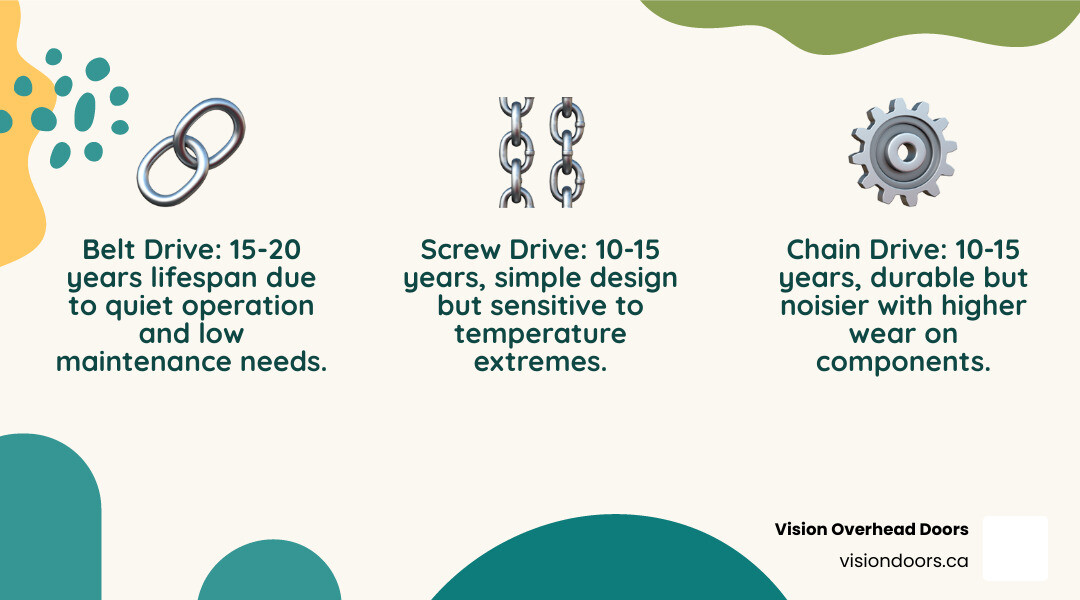
- Belt Drive: Often considered the gold standard, these use a rubber-like belt to move the trolley. Because there is less metal-on-metal friction, they experience less vibration and wear. They typically last 15-20 years.
- Chain Drive: The classic “workhorse.” These use a metal chain similar to a bicycle. While durable and great for heavy doors, the friction of the chain against the rail tends to wear parts down slightly faster, usually landing in the 10-15 year range.
- Screw Drive: These use a threaded steel rod to move the trolley. They have fewer moving parts than a chain drive, but they are sensitive to temperature changes. In the Okanagan, where winters get chilly, the lubricant on the screw can thicken, causing the motor to work harder. They generally last 10-12 years.
- Wall-Mount (Jackshaft) Systems: These are mounted on the wall beside the door rather than the ceiling. Because they drive the torsion bar directly and eliminate the rail and trolley system, they have fewer wear points and can easily last 15-20 years.
| Drive Type | Estimated Years | Maintenance Level | Noise Level |
|---|---|---|---|
| Belt Drive | 15 – 20 | Low | Very Quiet |
| Chain Drive | 10 – 15 | Moderate | Loud |
| Screw Drive | 10 – 12 | Moderate | Moderate |
| Wall-Mount | 15 – 20 | Low | Quiet |
Factors Influencing Garage Door Opener Longevity
The motor isn’t a lone ranger; it’s part of a complex system. If the rest of the system is failing, the motor will die young.
- Spring Balance: This is the most critical factor. Your garage door springs do 95% of the heavy lifting. If your springs are worn or “out of balance,” the door becomes incredibly heavy. Your opener, which is only meant to guide the door, suddenly has to pull hundreds of pounds. This burns out the logic board and gears quickly.
- Installation Quality: A motor that is slightly misaligned will vibrate excessively, leading to loose hardware and stripped gears. Professional Garage Door Opener Installation ensures the rail is perfectly level and the travel limits are set correctly.
- Environmental Conditions: High humidity or extreme cold can affect the electronics and lubricants. For those in Beachcomber Bay or Sunnybrae, moisture from the lake can occasionally lead to premature rusting of internal components if the garage isn’t well-ventilated.
- Motor Horsepower: If you have a heavy, insulated double-car door but installed a low-horsepower motor, you’re asking for trouble. Always match the motor’s power to the door’s weight to avoid getting screwed by the wrong garage door opener.
Warning Signs Your Opener is Reaching the End of Its Life
How do you know if your opener is just having a bad day or if it’s truly on its last legs? Listen and watch—your opener will usually tell you when it’s tired.
- Excessive Noise: If your once-quiet belt drive is now screeching, or your chain drive sounds like a box of rocks, the motor is struggling. This often indicates worn-out bearings or a failing motor winding.
- Slow Movement: Does it feel like you could walk to the mailbox and back before the door finishes opening? As motors age, they lose torque. If the door moves sluggishly despite the tracks being lubricated, the motor is likely failing.
- Intermittent Operation: If the door starts to open and then randomly reverses, or if the remote only works half the time, it could be a sign of a failing logic board or aging wiring.
- Vibration: A motor that shakes in its mounting brackets is a safety hazard and a sign that internal components are no longer balanced.
Safety is paramount, and many older units lack the magic of auto-reverse and photo-eye sensors that function correctly. If your safety features are failing, it’s time to stop repairing and start replacing.
When to Repair vs. Replace Your Aging System
We often suggest the “50% Rule”: if a repair costs more than half the price of a new unit, and the opener is over 10 years old, replacement is the smarter investment.
- The 15-Year Threshold: If your opener was installed before 2011, it’s likely missing modern security features. Older units used “dip switches” with static codes that were easy for tech-savvy thieves to hack. Modern units use rolling code technology, which changes the access code every single time you use the remote.
- Safety Compliance: Federal laws regarding safety sensors have evolved. If your unit is so old it doesn’t have photo-eye sensors, it is a significant liability.
- Frequent Breakdowns: If we’ve been out to your home in Vernon or Lake Country twice in the last year for Garage Door Opener Repair, the writing is on the wall. Constant small fixes add up to the cost of a brand-new, warrantied system very quickly.
Proactive Maintenance to Extend Your Opener’s Service Life
You wouldn’t drive your car for 10 years without an oil change, right? Your garage door opener needs the same love. A little bit of proactive care can easily add 5 years to the life of your motor.
We recommend a “Spring and Fall” checkup. In the spring, check for any damage caused by winter ice or salt. In the fall, prepare the system for the cold.
Essential Tips for Garage Door Opener Maintenance
- Visual and Audio Checks: Once a month, stand in the garage and watch the door move. Look for “jerky” movements and listen for new squeaks. Catching a problem early is the best way to ensure the best garage door opener repair in Vernon BC is just a minor tune-up rather than a full replacement.
- Lubrication: Use a garage-door-specific silicone spray or white lithium grease. Lubricate the hinges, rollers, and springs. If you have a chain or screw drive, lubricate the drive mechanism as well. Do not lubricate a belt drive; the belt needs friction to move the trolley.
- Hardware Tightening: The vibration of the door moving up and down can loosen the bolts on the tracks and the motor mounting. A quick turn with a wrench once a year keeps everything stable.
- Balance Testing: This is the most important DIY test. Pull the emergency release cord (usually red) while the door is closed. Lift the door halfway by hand. If it stays in place, it’s balanced. If it slams shut or shoots upward, your springs are the problem, and they are currently killing your opener motor.
- Sensor Cleaning: Dust and cobwebs can block the photo-eyes, causing the door to reverse unnecessarily. Wipe them with a soft cloth and ensure they are still aligned.
Don’t forget that winter can be particularly harsh on these systems. Make sure you’ve read up on the cold hard truth about choosing a winter-proof opener to ensure your setup is ready for an Okanagan December.
Modern Features Worth Upgrading For in 2026
If your opener is nearing that 15-year mark, you might be tempted to keep “limping it along.” However, the technology available in May 2026 offers benefits that go far beyond just opening a door.
- Wi-Fi Connectivity (MyQ Technology): Never wonder “Did I leave the garage door open?” again. You can check the status and close the door from your phone while you’re at work in Kelowna or on vacation.
- Battery Backup: Here in the Okanagan, summer storms or winter snow can knock out power. A battery backup ensures you aren’t trapped in (or out of) your garage. Most backups provide about 20 full cycles after the power goes out.
- LED Lighting: Modern openers often come with integrated LED systems that flood the entire garage with bright, energy-efficient light, eliminating the need for separate shop lights.
- Soft Start/Stop: Rather than “jerking” the door into motion, modern DC motors gradually accelerate and decelerate. This significantly reduces the stress on the door’s hardware and the opener’s gears.
- Ultra-Quiet Operation: If you have a bedroom above the garage, you need to stop the racket with the quietest garage door openers. Modern belt drives are so quiet you can barely hear them from the next room.
Frequently Asked Questions about Opener Durability
How long does a garage door opener last with heavy daily use?
In a “high-traffic” household—think a family with three cars and active kids—you might be hitting 10 cycles a day. That’s 3,650 cycles a year. In these cases, a standard “builder-grade” opener might only last 5 to 7 years. For these homes, we strongly recommend heavy-duty, professional-grade models (like the LiftMaster Elite series) which are designed to handle the increased workload without burning out.
Can a power surge shorten the life of my opener?
Absolutely. The “brain” of your opener is a logic board filled with sensitive electronics. A lightning strike or a power surge from the grid can fry this board instantly. While you can sometimes replace just the board, it’s often a sign to upgrade. We always recommend plugging your opener into a dedicated surge protector to prevent this.
Does a noisy opener always mean it needs replacement?
Not always! Sometimes a noisy opener is just a cry for help. It could be as simple as loose mounting hardware, dry rollers, or a chain that needs tensioning. However, if the noise is coming from inside the motor housing—like a grinding or loud humming—that usually points to a failing motor or stripped internal gears. If you’re unsure, it’s worth having a professional look before you commit to a replacement.
Conclusion
At the end of the day, how long does a garage door opener last depends on the balance between the quality of the unit and the care you give it. While 10 to 15 years is the average, we’ve seen well-maintained units in the Okanagan Valley last 20 years, and neglected ones fail in five.
At Vision Overhead Doors, we pride ourselves on being the local experts for the Okanagan Valley. From Sorrento to Kelowna and everywhere in between, we understand the specific challenges our climate poses to your home. We offer same-day service, local expertise, and industry-leading products to ensure your garage door system is safe, quiet, and reliable.
If your opener is making strange sounds, moving slowly, or is simply past its prime, don’t wait for it to fail at the worst possible moment. Whether you need a quick tune-up or a brand-new Garage Door Opener Installation, our team is ready to help.
Ready to upgrade your home’s security and convenience? Contact us today for a personal consultation and let’s make sure your garage door is ready for the years ahead.