
Can Your Current Motor Handle a Heavy Wooden Door Upgrade?
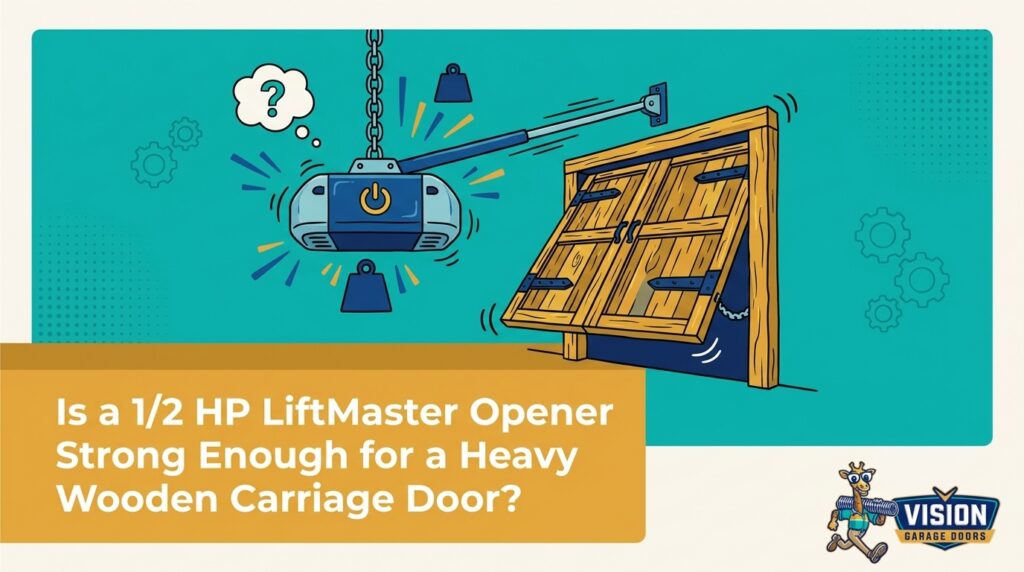
Are you wondering, “Is a 1/2 HP LiftMaster Opener Strong Enough for a Heavy Wooden Carriage Door?” before committing to a massive exterior upgrade? When upgrading your home’s exterior, the sheer mass of natural wood raises an immediate mechanical concern. You might be worried that installing a beautiful, heavy carriage door will immediately burn out your existing motor. The short answer is yes, a standard 1/2 HP motor is technically sufficient to operate a heavy wooden door, but only under highly specific, perfectly calibrated mechanical conditions.
Most homeowners assume that a heavier door automatically requires a heavier-duty motor. This leads to a common decision point: should you invest in a brand-new 3/4 HP or 1 HP motor, or keep your current 1/2 HP LiftMaster and focus on professional spring calibration? The reality is that your garage door opener is not a crane. It is not designed to hoist the dead weight of your garage door. Instead, the actual heavy lifting is handled by a completely different component of your garage door system.
Before you decide to rip out your current setup for an expensive horsepower upgrade, the real focus needs to be on your mechanical balance. Upgrading a motor without addressing the underlying mechanics is a recipe for long-term structural damage. Whether you currently need garage door opener repair for a struggling unit or you are planning a complete garage door installation, understanding the true relationship between motor horsepower and spring tension will save you time, frustration, and unnecessary mechanical failures.
The Physics of Garage Doors: Springs Do the Heavy Lifting
To understand why a 1/2 HP LiftMaster can move a massive wooden carriage door, you have to look at the physics of the entire system. A common misconception is that the motor hanging from your ceiling pulls the entire weight of the door up the tracks. If this were true, a 1/2 HP motor would strip its gears and burn out on the very first cycle.
In reality, the motor acts as a guide, not a crane. It simply initiates the movement, pushes or pulls the top panel, and controls the speed of the door’s travel. The actual lifting muscle comes from the heavy-duty metal coils mounted above the door opening.
How Torsion Springs Counterbalance Weight
Torsion springs are the true powerhouse of your garage door system. When your garage door is closed, these springs are wound tightly, storing an immense amount of rotational energy. As the door opens, the springs unwind. This unwinding motion turns a metal tube, which spins the cable drums, which in turn pull the lifting cables attached to the bottom corners of your door.
This stored energy neutralizes the downward pull of gravity. A perfectly balanced garage door, regardless of its total mass, should only require about 10 to 15 pounds of lifting force from the motor to open and close. A standard 1/2 HP motor has more than enough output to handle 10 to 15 pounds of force. The motor’s job is simply to overcome the initial inertia and guide the door smoothly along the track.
| System Component | Primary Function | Weight Handled |
|---|---|---|
| Torsion Springs | Counterbalance gravity and lift the door | 95% of total door weight |
| Lifting Cables | Transfer spring energy to the door panels | Full counterbalanced load |
| 1/2 HP Motor | Initiate movement and guide travel speed | 10 to 15 lbs of residual force |
| Track & Rollers | Keep the door aligned during travel | Friction and lateral shifting |

Understanding the True Weight of Wooden Carriage Doors
While the physics of counterbalancing apply to all garage doors, heavy wooden carriage doors introduce a unique set of challenges. Standard aluminum or steel garage doors are relatively lightweight. A standard double-car steel door often weighs under 150 pounds. Because they are light, there is a small margin of error allowed in the spring tension.
Solid wood carriage doors are a completely different class of hardware. Depending on the size and the specific materials used, these doors can easily weigh between 300 and 400 pounds. The sheer mass of natural wood leaves zero margin for error in the door’s mechanical balance.
Baseline Weight vs. Operating Weight
When evaluating whether your 1/2 HP LiftMaster can handle the upgrade, you must understand the difference between baseline weight and operating weight.
- Baseline Weight: This is the dead weight of the door panels sitting on the ground, disconnected from any springs or cables. For a carriage door, this is the full 300 to 400 pounds.
- Operating Weight: This is the effective weight the motor feels when the torsion springs are fully engaged and properly calibrated. If the springs are tensioned correctly, the operating weight drops to that manageable 10 to 15 pounds.
The type of wood also significantly impacts the baseline weight. A cedar carriage door will generally be lighter and put slightly less strain on the system than a door built from dense mahogany or oak. However, regardless of the wood species, a 300-plus pound door requires absolute precision in the spring setup. If the springs are even slightly under-tensioned, the operating weight spikes rapidly, forcing your 1/2 HP motor to lift 40, 50, or even 80 pounds of dead weight. This will destroy the motor’s internal gears in a matter of months.
How Moisture and Climate Affect Wooden Door Weight
One of the most critical factors homeowners overlook when installing wooden carriage doors is the environment. Unlike steel or aluminum, wood is a porous, organic material that naturally responds to humidity, precipitation, and temperature changes. This means the weight of your garage door is not static—it changes with the seasons.
During the wet British Columbia winters, the climate in the Enderby BC area creates a specific mechanical challenge. Prolonged exposure to high humidity, heavy rainfall, and melting snow causes porous wooden carriage doors to absorb moisture. Even if the exterior is well-sealed, wood naturally takes on water weight from the ambient humidity in the air.
The Hidden Strain of Seasonal Swelling
When wood panels absorb moisture, they physically swell and become heavier. This seasonal swelling is a hidden killer of garage door motors.
Consider the math: If a 400-pound wooden carriage door absorbs enough winter moisture to increase its total weight by just 5%, the door gains 20 pounds of dead weight. Your torsion springs were precisely calibrated to lift exactly 400 pounds. They cannot automatically adjust to lift 420 pounds.
Because the springs are no longer perfectly counterbalancing the door, that extra 20 pounds of water weight is transferred directly to the operating weight. Instead of pulling the standard 10 to 15 pounds, your 1/2 HP LiftMaster is suddenly forced to drag 30 to 35 pounds every time you press the button. This extra strain causes the motor to overheat, the gears to grind, and the internal components to wear out prematurely. This is why seasonal climate factors make precise mechanical balance so vital.
Why Spring Calibration Matters More Than Motor Horsepower
When a heavy wood door starts struggling to open, many homeowners assume their 1/2 HP motor is simply too weak. The immediate reaction is to rush out and buy a 3/4 HP or 1 HP unit. However, upgrading the motor without fixing the spring balance only masks the underlying mechanical problem.
At Vision Overhead Doors, we prioritize honest expertise and safe mechanics over pushing unnecessary upgrades. We want to save your existing motor by ensuring the foundational mechanics are sound. A 1/2 HP LiftMaster is an incredibly reliable piece of equipment, provided it isn’t being abused by an unbalanced door.
The Danger of Masking Imbalance with Horsepower
Installing a 1 HP motor to lift an unbalanced, heavy wood door is dangerous. A high-horsepower motor has immense pulling force. If the springs are weak or the door has gained seasonal moisture weight, a powerful motor will forcibly drag the heavy door up the tracks anyway.
This brute force causes severe structural issues. The excessive pulling can tear the top panel of your wooden carriage door right off its hinges. It can bend the steel tracks, snap the lifting cables, or rip the trolley mechanism from the ceiling. Proper calibration is the cost-effective, mechanically sound alternative to unnecessary motor upgrades.
Important Safety Warning: Adjusting torsion springs is extremely dangerous. These springs hold hundreds of pounds of lethal tension. This must never be attempted as a DIY project. If your heavy wood door is out of balance, you must hire a licensed professional for garage door spring repair and calibration.
Warning Signs Your Opener is Struggling Under the Weight
How do you know if your 1/2 HP LiftMaster is failing, or if your springs are simply unbalanced due to seasonal moisture? There are several diagnostic signs you can look and listen for before calling a professional.
Pay attention to how the system behaves during its daily cycles. If the operating weight has exceeded the motor’s safe capacity, the system will give you clear warning signs.
- Unusual grinding or straining noises: A healthy motor hums smoothly. If you hear loud grinding, whining, or a deep straining sound from the motor housing, the internal gears are fighting against too much dead weight.
- Slow or jerky movement: A balanced door travels up the tracks at a consistent speed. If the door hesitates, moves in jerky increments, or visibly slows down halfway up, the motor is struggling to overcome gravity.
- Bowing opener rails: Watch the metal rail that connects the motor to the wall above the door. If this rail bows or flexes upward significantly when the door starts to open, the motor is pulling far too hard against an unbalanced load.
The Manual Release Test:
The best way to check the balance of a heavy wooden carriage door is the manual release test. With the door fully closed, pull the red emergency release cord to disconnect the motor from the door. Carefully attempt to lift the door by hand. A perfectly balanced 400-pound door should lift easily with one hand and stay in place if you let go halfway up. If the door feels incredibly heavy, slams back to the floor, or requires immense physical effort to lift, your springs are out of balance.
Note: If your door passes the manual release test and feels perfectly balanced, but your opener is still excessively loud, the issue might be the drive type (chain vs. belt). In that case, upgrading to one of the quietest garage door openers could resolve the noise without needing to fix the springs.
Frequently Asked Questions About Garage Door Motors and Weight Limits
What horsepower garage door opener do I need for a wood door?
A 1/2 HP motor is sufficient if your torsion springs are perfectly balanced and calibrated to the door’s exact weight. While a 3/4 HP or 1 HP motor is often recommended for heavy doors because it offers greater longevity and less daily wear and tear, the higher horsepower is not strictly required for the actual lifting. The springs do the lifting; the motor simply guides the movement.
Can a 1/2 hp opener lift a heavy garage door?
Yes, a 1/2 HP opener can easily operate a heavy garage door because it only lifts the residual dead weight left over after the springs counterbalance the door. In a properly calibrated system, this residual weight is typically only 10 to 15 pounds. As long as the springs are doing their job, the total mass of the door does not overwhelm the motor.
Why does my heavy wood garage door struggle to open?
Your heavy wood garage door usually struggles to open due to stretched or failing torsion springs, or because the wood has absorbed seasonal moisture and increased in weight. When wood takes on water weight, the existing spring tension is no longer strong enough to counterbalance the door. This forces the motor to lift the difference, resulting in slow, struggling, or jerky movement.
How much weight can a 1/2 hp LiftMaster lift?
While the motor itself can pull a significant amount of dead weight in short bursts, it is designed to move a balanced load of up to 300 to 400 pounds with the help of properly tensioned springs. The motor is engineered to exert about 10 to 15 pounds of continuous force. If forced to lift more than that on a daily basis due to bad springs, its internal gears will wear out rapidly.
Is it safe to adjust garage door springs myself to help the motor?
No, it is never safe to adjust garage door springs yourself. Torsion springs hold immense, potentially lethal tension required to lift a 400-pound door. A sudden release of this stored energy can cause catastrophic injury or property damage. Adjusting, repairing, or replacing springs requires specialized winding bars, technical training, and a licensed professional.
Ensure Your Carriage Door Operates Safely and Smoothly
Ultimately, a 1/2 HP LiftMaster opener is strong enough to handle a heavy wooden carriage door, provided the mechanical foundation of the system is flawless. Your current motor is likely fine, but the mechanical balance must be perfect to prevent premature failure. Relying on the motor to do the heavy lifting is a fundamental misunderstanding of how the system works.
Remember that heavy natural wood is dynamic. Wet British Columbia winters will cause your door to absorb moisture, gain weight, and throw off the delicate balance of your torsion springs. Instead of rushing to buy a more powerful motor that might just tear your unbalanced door apart, focus on the mechanics. Schedule a professional balance check and spring calibration to ensure your beautiful carriage door operates safely, smoothly, and reliably for years to come.