Facing Extended Grid Failures: Why Your Garage Door Needs a Reliable Backup
Winter storms are already brewing, and if you live outside the main city grids, you know that means preparing for the inevitable loss of power. When evaluating battery backup openers: comparing standby times during rural BC power outages becomes an essential part of getting your home ready for the freezing weather. Here at Vision Overhead Doors, we’ve spent years helping our Enderby neighbors prepare for these exact scenarios. It is one thing to lose the lights for a few hours in the summer; it is an entirely different scenario when you are trapped inside (or locked out of) your garage during a freezing, extended winter storm. A proper garage door opener installation that includes a robust backup battery ensures you are never stranded, which is why relying on emergency garage door services in Enderby before a storm hits is the smartest move you can make to protect your home and family.
For most homeowners, the garage is the primary entrance to the house. When the grid fails, a standard electric opener becomes dead weight. While every opener has a manual release cord, manually lifting a heavy, insulated, double-wide garage door is physically demanding and sometimes impossible for elderly family members or anyone with physical limitations. In an emergency situation where you need to leave your property quickly, wrestling with a heavy door in the dark is a significant safety hazard.
Choosing the right battery backup system requires understanding realistic standby times, not just reading the ideal manufacturer claims printed on the side of the box. Many off-the-shelf units are designed for mild climates and brief grid interruptions. If you rely on a basic system during a multi-day blackout, you might find that the battery has drained completely just sitting idle in the cold, long before you actually push the button to open the door.
To truly prepare your home, you need to look beyond the marketing materials and understand how these systems actually perform when the temperature drops and the power stays off for days. By comparing the real-world capabilities of different backup batteries, you can make an informed decision that guarantees your garage door will open when you need it most.
Standard 24-Hour Claims vs. the Reality of Rural Winter Outages
When you walk down the aisle of a big-box hardware store, almost every standard integrated backup battery advertises an impressive 24 hours of standby time, or the ability to complete 20 to 40 full open-and-close cycles. On paper, this sounds like more than enough capacity to get you through a blackout. However, these metrics are tested under ideal, room-temperature conditions in a controlled laboratory. Those laboratory conditions rarely apply to a severe rural BC / Enderby area grid failure.
In a typical urban environment, a power outage might last a few hours. Utility crews are stationed nearby, and the grid is often restored before the food in your refrigerator even begins to spoil. In these scenarios, a standard 24-hour battery is perfectly adequate. But rural outages are a completely different story. Heavy snowfall, ice storms, and fallen trees on remote transmission lines can sever power for several days. In our years of servicing properties across the North Okanagan, our team typically sees standard batteries fall far short of that 24-hour mark during a deep freeze. If you are choosing a winter-proof opener, you must account for the reality that a standard battery will not survive a 72-hour blackout.
Understanding the critical difference between idle standby time and active cycles:
- Idle Standby Time: This is how long the battery can sit attached to the motor, doing absolutely nothing, before it loses its charge. The motor’s internal computer and safety sensors constantly draw a tiny trickle of power, which slowly drains the battery over time.
- Active Cycles: One complete cycle means opening the door fully and closing it fully. Lifting a heavy garage door requires a massive surge of power from the battery. Every time you cycle the door, you significantly reduce the remaining idle standby time.
If your power goes out on a Friday evening, and you don’t attempt to open the garage door until Sunday morning, a standard battery rated for 24 hours of idle time will likely be completely dead. You will push the button, hear a faint click, and the door will remain firmly shut. Planning for rural outages means assuming the power will be out longer than a day, and selecting a backup system built to outlast the wait.
How Freezing Okanagan Temperatures Degrade Battery Standby Times
The gap between manufacturer claims and real-world performance widens significantly when you introduce cold weather into the equation. To understand why your backup system might fail during an extended winter storm, it helps to understand the basic science of how sub-zero temperatures negatively impact 12V DC battery performance.
Cold weather slows down chemical reactions. Inside your standard 12V DC backup battery, chemical reactions generate the electrical current needed to power the opener motor. When freezing Okanagan Valley winter temperatures seep into an uninsulated or unheated garage, the ambient temperature drops dramatically. We get calls every winter from local homeowners who are completely locked out because the cold has zapped their battery’s power. As the battery gets colder, the internal chemical reactions become sluggish. The battery’s internal resistance increases, meaning it has to work much harder to push the same amount of electrical current out to the motor.
The double-whammy of cold weather mechanics:
- Reduced Battery Capacity: In an unheated garage during a freezing storm, a fully charged battery can lose a significant percentage of its operational capacity. A battery that holds 100% of its charge at 70°F might only hold 60% or less of its accessible charge when the temperature drops to 15°F.
- Increased Lifting Load: Cold weather doesn’t just affect the battery; it affects the garage door itself. Freezing temperatures cause the metal tracks to contract slightly. More importantly, the grease and lubrication inside the rollers, hinges, and springs thickens and stiffens. Because the door is physically harder to move, the motor requires more electrical amperage to lift it.
The result is a drastically reduced cycle count. You have a battery that is outputting less power, trying to lift a door that requires more power. Because of this, a battery rated for 20 cycles at room temperature may only reliably perform 5 to 10 cycles when temperatures drop below freezing. This temperature-induced degradation means homeowners must plan for reduced standby times during the exact moments they need the backup the most. Ignoring the climate factor when selecting a backup system is a recipe for being stranded.
Comparing Standby Limits: Standard Batteries vs. Heavy-Duty Systems
Now that we understand the challenges of extended outages and freezing temperatures, it is time to look at the solutions. Not all battery backups are created equal. When comparing systems, you generally have two categories to choose from: standard integrated batteries and heavy-duty, winter-rated systems. Making the right choice often comes down to matching the equipment to your specific geographical risks.
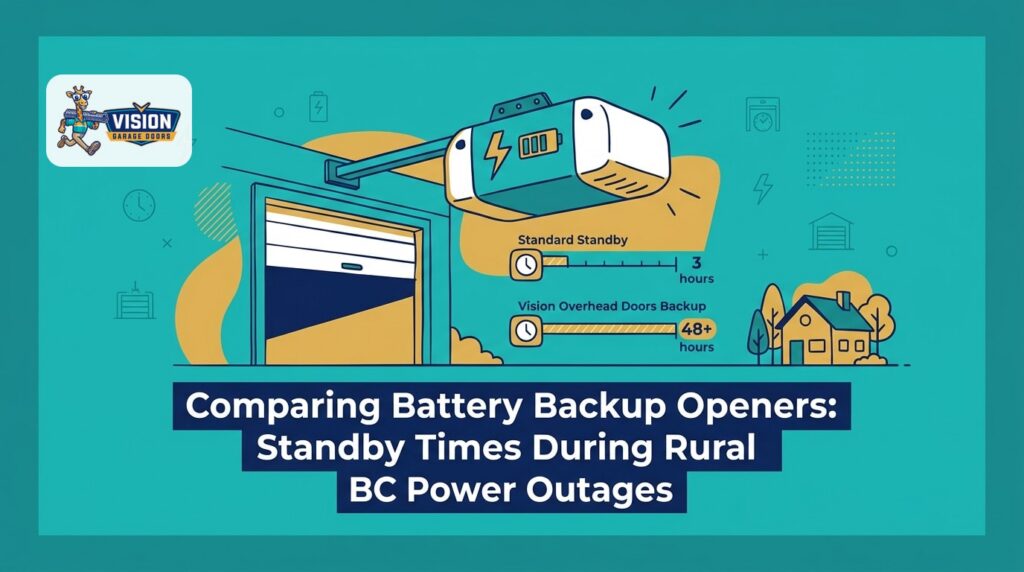
Because we see firsthand how harsh our local winters can be, we highly recommend heavy-duty, winter-rated systems for homes outside the main city grid. Standard integrated batteries are excellent for brief, urban outages, but they are highly susceptible to cold-weather drain and typically max out at 24 hours of idle standby. Heavy-duty winter-rated systems, on the other hand, are designed with better insulation and higher capacity cells. They are capable of retaining their charge much longer in freezing temperatures, making them far better suited for multi-day outages.
Standard Battery Profile
The standard battery is what you will find in most entry-level to mid-range openers. It is a sealed lead-acid battery, similar to a small motorcycle battery. While affordable and easily accessible, it has distinct limitations in harsh environments.
- Ideal for short disruptions: Sufficient for short grid blips lasting a few hours.
- Rapid capacity loss: Experiences severe voltage drop in sub-zero temperatures.
- Limited cycle count: Often drops to single-digit cycle capabilities in unheated winter garages.
Heavy-Duty Winter-Rated Profile
Heavy-duty systems are engineered for resilience. They often utilize advanced cell technology (such as specific cold-weather lithium-ion blends or high-density AGM cells) and feature internal housing designs that shield the battery from extreme temperature fluctuations.
- Extended multi-day standby: Designed to hold a charge for 48 to 72 hours or more, even while idle.
- Cold-resistant design: Maintains a higher voltage output when the temperature drops below freezing.
- Essential for rural properties: The most reliable choice for homes at the end of the utility line.
Many modern heavy-duty models also integrate seamlessly with smart garage door openers. These WiFi-enabled systems monitor the battery’s health and voltage levels constantly, sending real-time alerts directly to your smartphone if the battery is beginning to fail or lose its ability to hold a full charge.
| Feature | Standard Battery Backup | Heavy-Duty Winter-Rated Backup |
|---|---|---|
| Ideal Standby Time | Up to 24 hours | 48 to 72+ hours |
| Ideal Cycle Count | 20 to 40 cycles | 50+ cycles |
| Sub-Zero Performance | High capacity loss; sluggish operation | Maintains voltage; reliable lifting power |
| Cold Weather Cycles | 5 to 10 cycles | 20 to 30+ cycles |
| Best Use Case | Urban areas with fast grid repairs | Rural areas with multi-day storm outages |

Decoding the Beeps: Monitoring Your Battery Health Before a Storm
One of the most common sources of confusion for homeowners is the series of beeps coming from their garage door motor. Your opener uses audio cues to communicate the status of the battery. Understanding what these beeps mean is crucial for proactive maintenance, ensuring you aren’t caught off guard when the power drops.
The quick fix: If you hear a beeping garage door opener during a power outage, do not panic. A slow, steady beep (usually once every few seconds) simply indicates that the unit has successfully switched over and is currently running on battery power. This is normal operation. The unit is letting you know that it is drawing from the reserve.
However, if the unit beeps when the power is on and the grid is fully operational, it is issuing a warning. A fast beep, or a beep accompanied by a flashing red or orange LED light on the motor housing, means the battery is failing, disconnected, or no longer holding a full charge. This is the motor’s way of telling you that if the power were to go out right now, the battery would not be able to lift the door.
In our experience, proactive testing before the winter storm season is crucial. You do not want to discover a dead battery in the middle of a blizzard. Here is how you can test your system safely:
- Step 1: Close the garage door completely.
- Step 2: Unplug the main power cord of the garage door opener from the ceiling outlet.
- Step 3: Press the button on your wall console or remote. The door should open smoothly, though it may move slightly slower than normal.
- Step 4: Press the button again to close the door.
- Step 5: Plug the motor back into the ceiling outlet.
If the door fails to open, stutters, or stops halfway during this test, your battery is depleted and needs immediate replacement. Most backup batteries need replacing every 1 to 2 years, depending on climate exposure and usage. If you are unsure how to source or install the correct replacement cell, scheduling a garage opener repair with a professional technician ensures the new battery is properly seated, connected, and charging correctly.
Manual Override: What to Do When the Battery Eventually Dies
Even the best heavy-duty, winter-rated battery will eventually deplete if a grid failure lasts for a week. When you have exhausted your standby time and your cycles, the electric motor will no longer function. At this point, you must rely on the manual override system to get your vehicles out of the garage.
Every automated garage door is equipped with an emergency release mechanism. This is typically a red cord hanging from the trolley (the carriage that moves along the metal rail on your ceiling). Pulling this cord disconnects the door from the motorized track, allowing you to safely lift it by hand. However, doing this incorrectly can be dangerous.
A pattern we see often during extended outages is homeowners struggling to safely use the manual release. Follow these practical steps for handling a dead battery situation:
- Ensure the door is fully closed. Never pull the emergency release cord when the garage door is open or partially open. If a spring is broken or weakened, disconnecting the motor could cause the heavy door to crash down violently, leading to severe injury or property damage.
- Locate the red emergency release cord. It should be hanging down from the center rail, easily reachable. If it is tied up out of reach, untie it now before an emergency happens.
- Pull the cord down and back. Pull the red handle straight down, and then slightly back toward the motor unit. You will hear a loud click as the trolley disconnects from the carriage.
- Lift the door manually. Grab the door from the bottom handle (or the bottom edge if there is no handle). Lift straight up using your legs, not your back. A properly balanced door should feel relatively light, despite its size, because the tension springs are doing the heavy lifting. Push it all the way up until it rests securely in the horizontal tracks.
- Secure the door if necessary. If you need to leave the door open, ensure it is resting firmly in the fully open position so it does not slowly slide back down.
- Re-engage the trolley once power is restored. When the grid comes back online, you must reconnect the door. Pull the red cord straight down (without pulling back) to reset the mechanism. Then, simply press the button on your remote. The trolley will move along the rail until it automatically clicks back into the carriage, re-engaging the system.
Frequently Asked Questions About Garage Door Battery Backups
How long does a garage door battery backup last in the cold?
In freezing temperatures, a standard 24-hour battery may only last 12 to 18 hours on standby due to cold-weather drain. The chemical reactions inside the 12V DC battery slow down significantly when the temperature in an unheated garage drops below freezing. If you live in an area prone to multi-day outages, upgrading to a heavy-duty, winter-rated battery is highly recommended to extend that standby time to 48 hours or more.
How many cycles can a battery backup perform during a power outage?
Under ideal, room-temperature conditions, you can expect a standard backup battery to perform 20 to 40 complete open-and-close cycles. However, in sub-zero unheated garages, this capacity can drop drastically to just 5 to 10 reliable cycles. Cold weather not only weakens the battery but also stiffens the grease in the door’s tracks and springs, forcing the motor to draw more power for every single lift.
Do battery backup garage door openers beep when power is out?
Yes, a slow, intermittent beep (usually once every few seconds) indicates the unit has successfully switched over and is running on battery power. This is completely normal during an outage. However, a fast, rapid beep—especially when the main house power is on—often means the battery is critically low, failing to hold a charge, or completely disconnected and requires immediate replacement.
Can I add a battery backup to my existing garage door opener?
It depends entirely on the specific make and model of your current motor. Many modern openers are designed with ports that allow for add-on battery units to be mounted on top of or next to the main housing. Older models, however, generally do not have the internal circuitry required to support a backup system, meaning you would require a full replacement of the motor head to gain battery backup functionality.
How often should I replace the backup battery in my garage door opener?
For optimal performance, especially in regions with harsh winters, you should replace the battery every 1 to 2 years. Even if the battery has never been used during an outage, the constant trickle-charging process and exposure to extreme temperature fluctuations in an uninsulated garage will slowly degrade the internal cells over time, reducing its reliability.
Upgrade to a Reliable Battery Backup System for Your Rural Home
Don’t wait until you are stranded in the cold to find out your standard battery can’t handle a rural BC / Enderby area winter outage. When the grid goes down for days, you need the certainty that you can safely get your vehicles out of the garage without wrestling a heavy door in the freezing dark. Choosing a heavy-duty, winter-rated system provides the peace of mind that your family can safely access the garage, no matter what the weather brings.
As a local family business, our team understands the unique challenges of rural BC winters. We specialize in tailored solutions that withstand the toughest local conditions, ensuring your equipment performs when you need it most. Reach out today for trusted emergency garage door services in Enderby, and let us help you secure your home with a reliable, winter-proof opener before the next major storm hits.