Outgrowing Your Shed: The Clearance Challenge for Local Farmers
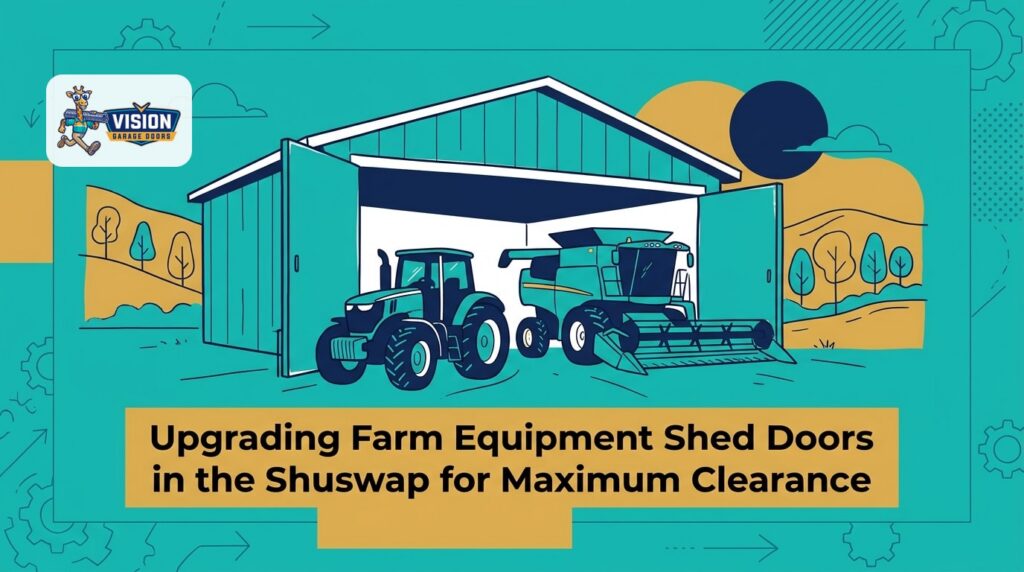
You just brought a massive new piece of machinery back to the property, only to realize the header on your older barn is completely in the way. Upgrading Farm Equipment Shed Doors in the Shuswap for Maximum Clearance is a frustrating reality many local agricultural operations face when their structures no longer match their evolving needs. That strange scraping noise from the exhaust stack or the sudden realization that the GPS dome won’t clear the opening means your equipment is effectively locked out of its own shelter.
When faced with an undersized opening, most property owners hit a difficult decision point: do you take on the massive, disruptive project of tearing down and rebuilding the barn structure, or do you look for smart retrofitting options? The short answer is that you rarely need to start from scratch. By choosing the right commercial overhead door configuration, you can salvage an existing building and drastically increase your vertical headroom. Professional commercial overhead door installation is the key to safely achieving that maximum vertical clearance without compromising the structural integrity of your shed. Whether you are trying to house modern high-clearance tractors and combines or store heavy implements, modifying the tracking system rather than the building itself is often the smartest path forward.
Why Today’s Agricultural Machinery Demands More Vertical Space
Farming technology has evolved rapidly over the last two decades, and the physical footprint of that technology has grown right alongside it. If your agricultural outbuildings were constructed twenty or thirty years ago, they were likely designed around the dimensions of older, lower-profile machinery. Standard barn openings were typically framed at 10 or 12 feet high, which was plenty of room for traditional equipment. Today, that simply isn’t enough.
Modern high-clearance tractors and combines frequently require 14 to 16 feet of vertical clearance just to pass safely through a threshold. This increase in height isn’t just about larger tires or higher ground clearance. It comes down to the advanced components mounted on top of the machinery. Taller operator cabs designed for better visibility, advanced GPS antennas and receiver domes, folding augers, and extended exhaust stacks all add significant height. Trying to squeeze these modern marvels through an outdated door opening is a recipe for disaster.
When you attempt to force large machinery into tight spaces, the risk of equipment damage skyrockets. Even a slight miscalculation on a slight incline leading into the shed can cause the top of a cab or an exhaust pipe to catch the door header. Because standard overhead doors curve immediately inward and hang down slightly even when fully open, they often steal another six to eight inches of usable space from the opening. To safely house today’s equipment, you need specialized door tracking systems designed to pull the door completely out of the way.
The Hidden Costs of Inadequate Clearance
Operating with doors that are just barely tall enough creates a ripple effect of hidden costs and daily frustrations on the farm. If you notice your operators slowing to a crawl every time they park a vehicle, you are losing valuable time.
- Scraped roofs and damaged exhaust systems: A single misjudgment can result in thousands of dollars in damage to sensitive rooftop electronics or structural cab components.
- Wasted time maneuvering equipment: When clearance is tight, operators must spend excessive time inching equipment into place, often requiring a spotter to avoid hitting the header.
- Inability to store attached implements: If the door is too low, you may be forced to detach implements outside in the elements rather than storing the entire rig together, adding unnecessary labor to your daily routine.
- Deflated tires just to fit: Some operators resort to lowering tire pressure to gain a few inches of clearance, which causes premature tire wear and wastes time re-inflating them before the next use.
Barn Rebuilds vs. High-Lift Retrofits: Making the Smart Structural Choice
When an agricultural building no longer fits the equipment it was meant to protect, the immediate assumption is often that the building needs to be replaced. A full barn rebuild is a massive undertaking. It involves pulling new municipal permits, hiring structural engineers, pouring new concrete footings, and dealing with extended downtime where your equipment is left exposed to the elements. For many working farms in the Shuswap agricultural region, shutting down a primary storage facility for weeks or months is simply not an option.
This is where the high-lift track retrofit changes the equation entirely. Instead of tearing down the walls to build a taller structure, a high-lift track system leverages the existing dead space inside the building’s ceiling. In a standard garage door setup, the track curves horizontally almost immediately above the door opening. If your barn has a 12-foot door but a 16-foot vaulted ceiling, those four feet of upper space are completely wasted.
A high-lift modification alters the track radius. Instead of turning inward right above the header, the tracks are engineered to route vertically straight up the interior wall, hugging the building’s framing until they get as close to the ceiling as possible before finally turning horizontally. This allows the door to open much higher, completely clearing the framed opening and utilizing the building’s maximum interior volume. By choosing this route, you preserve the historical and structural integrity of older agricultural buildings while bringing their functionality into the modern era.
| Factor | Full Barn Rebuild | High-Lift Track Retrofit |
|---|---|---|
| Project Timeline | Weeks to months of construction and downtime. | Typically completed in a few days. |
| Structural Impact | Requires complete demolition and new framing. | Preserves the existing building structure. |
| Permitting Requirements | Extensive municipal building permits and engineering required. | Usually requires no structural permits, only professional door installation. |
| Use of Interior Space | Builds a completely new, taller envelope. | Maximizes the use of existing dead ceiling space. |
| Weather Exposure | Equipment left outside during the long construction phase. | Minimal exposure; door is replaced quickly. |

Eliminating Overhead Clutter with Side-Mount Operators
Upgrading your tracks to a high-lift configuration solves the problem of the door hanging down into the opening, but it introduces a new mechanical challenge: how do you open a door that travels that high? Traditional trolley openers—the kind with a long center rail and a motor head hanging from the middle of the ceiling—are counterproductive in high-clearance sheds. That center rail consumes valuable ceiling space and acts as a physical obstacle for tall machinery passing underneath.
The solution is pairing your new high-lift tracks with a wall-mounted jackshaft opener. This mechanical synergy is what truly maximizes your vertical space. Instead of pulling the door from the center, a jackshaft opener mounts directly to the wall beside the door opening. It connects straight to the torsion bar, turning the bar to raise and lower the door. By removing the center rail and motor head entirely, the ceiling area remains completely unobstructed, allowing modern high-clearance tractors and combines to park safely without their exhaust stacks or GPS domes hitting a motor housing.
If you are looking at jackshaft openers for low-clearance garages or high-clearance barns alike, the principle remains the same: move the hardware off the ceiling and onto the wall. This setup not only frees up space but also reduces the amount of hanging hardware that can vibrate loose or gather dust and debris over time.
How Jackshaft Openers Work in Agricultural Sheds
Switching from a ceiling-mounted system to a wall-mounted system involves a few specific mechanical changes that greatly benefit agricultural environments.
- Direct torsion bar connection: The motor mounts to the wall and physically turns the torsion bar, which winds or unwinds the springs to move the door. This eliminates the need for a pull-chain or trolley belt.
- Removal of the center rail system: The entire middle of your barn ceiling is cleared of tracks, rails, and hanging brackets, providing a clean path for tall machinery.
- Enhanced security with automatic deadbolts: Many commercial jackshaft openers feature electronic deadbolts that automatically slide a heavy-duty pin into the door track when closed, preventing the door from being forced open from the outside.
- Reduced vibration and noise: Because they are mounted directly to the sturdy wall framing rather than suspended from the roof trusses, side-mount operators transfer much less vibration through the building structure.
Sealing Out BC Winters: Protecting Your Agricultural Investments
Gaining vertical clearance is only half the battle when upgrading your outbuildings; the other half is climate control. Many older barns in the Shuswap agricultural region still rely on traditional sliding barn doors. While sliding doors are simple, they fail miserably at providing adequate weather sealing. They inherently require gaps at the bottom and along the sides to slide back and forth on their tracks. When the harsh winter weather arrives, those gaps become a massive liability.
With summer temperatures soaring and heavy snow accumulation combined with freezing drafts in the winter, the Shuswap experiences significant temperature swings. Modern agricultural equipment is heavily reliant on sensitive electronic systems, touchscreens, and complex wiring harnesses. When heavy winter snow accumulation and sub-zero drafts blow through the gaps of a sliding door, that moisture settles on cold metal and electronics. This leads to condensation, accelerated rust, and premature failure of expensive computer components inside your tractors.
Properly fitted overhead doors with heavy-duty weatherstripping and insulated panels create a tight seal against the concrete floor and the door jambs. This prevents freezing drafts and moisture from penetrating the shed. Furthermore, a tightly sealed overhead door is your first line of defense against rodents. Mice and rats love to seek shelter in warm tractor cabs or chew on soy-based wiring insulation during the cold months. By keeping bugs and pests out of your outbuildings with a properly sealed commercial door, you protect your machinery from costly wildlife damage during the off-season.
Why Heavy-Duty Hardware and Professional Installation Matter
Converting a standard overhead door to a high-lift system is not a simple swap of a few metal rails. It is a complex engineering task that fundamentally alters the physics of the door. When a door travels vertically up a wall for an extended distance before turning horizontally, the weight distribution changes drastically. Standard residential or light-duty springs cannot handle this altered weight profile.
High-lift commercial doors require specialized, heavy-duty commercial springs to counterbalance the extreme kinetic energy of a massive, insulated agricultural door moving vertically. Furthermore, the tracks themselves must be custom-engineered to match the exact roof pitch and ceiling height of your specific barn. Using thin-gauge steel tracks on a heavy farm door will lead to track bending, buckling, or a catastrophic door failure.
This is where Vision Overhead Doors’ specific expertise in engineering custom commercial and agricultural overhead door conversions designed for rural BC conditions becomes critical. We cannot stress this enough: you must never attempt DIY track or spring modifications on a high-lift system. The torsion springs are wound under immense tension, and a sudden release of that kinetic energy can cause severe injury or property damage. Upgrading agricultural doors requires licensed professionals who can accurately calculate the spring wire gauge, track radius, and drum size needed to keep the system balanced and safe, especially as you rush through your harvest season preparation.
The Dangers of DIY High-Lift Conversions
Attempting to modify door tracks or springs without professional training is one of the most dangerous things a property owner can do. The risks are severe and immediate.
- Extreme kinetic energy in commercial torsion springs: Commercial springs hold enough stored energy to lift hundreds of pounds of dead weight. If a winding bar slips or a set screw fails during a DIY adjustment, the spring can snap with explosive force.
- Risk of track failure under heavy door loads: High-lift doors place different stress points on the track brackets. Improperly secured or under-gauged tracks can buckle, causing the entire door to crash to the floor.
- Importance of precise balancing for motor longevity: If the custom springs are not perfectly calibrated to the high-lift drums, the door will be unbalanced. This forces the jackshaft opener to strain against dead weight, leading to stripped gears and burned-out motors in a matter of months.
Frequently Asked Questions About Farm Shed Clearances
How do high lift garage door tracks work?
High-lift tracks work by extending the vertical path of the door before it curves horizontally into the ceiling space. Instead of the track turning right above the door opening, it travels straight up the interior wall to utilize the dead space near the roofline. This keeps the door completely out of the opening, maximizing vertical clearance for tall vehicles.
Can you convert standard barn doors to high lift overhead doors?
Yes, standard barn doors can usually be converted to high-lift overhead doors as long as the building has adequate interior ceiling height above the door header. A professional will need to assess the framing to ensure it can support the torsion spring assembly and the wall-mounted tracks. This conversion is a highly effective way to modernize an older structure.
Why use a jackshaft opener for a high lift door?
A jackshaft opener is ideal for high-lift doors because it mounts on the wall beside the door rather than hanging from the center of the ceiling. By turning the torsion bar directly, it eliminates the need for a center rail and trolley system. This leaves the ceiling space completely open, which is essential when storing tall agricultural equipment.
How much clearance is needed for a high lift garage door?
The amount of clearance needed depends on how high you want the door to lift, but generally, you need at least 15 to 24 inches of space above the door header just to accommodate the spring assembly and drums. For a true high-lift system that travels several feet up the wall, you need a ceiling height that is significantly taller than your framed door opening.
Are high-lift track retrofits suitable for all pole barns in the Shuswap?
Most traditional pole barns in the region are excellent candidates for high-lift retrofits because they typically feature vaulted or high-pitched roofs with plenty of unused upper space. However, the existing header and wall framing must be structurally sound enough to anchor the heavy-duty commercial tracks and spring pads. A local door professional can quickly evaluate your specific barn to confirm compatibility.
Secure Your Farm Equipment with a Custom Clearance Solution
You don’t have to tear down your trusted outbuildings just because your machinery has gotten taller. Upgrading your tracks and openers is a highly effective way to reclaim the space you already have. By utilizing the dead space in your ceiling with a high-lift track and a wall-mounted jackshaft opener, you can safely house the largest equipment on your farm without the massive expense of a structural rebuild.
As you finalize your harvest season preparation, now is the time to ensure your sheds are ready to protect your investments from the incoming winter weather. Don’t leave your expensive new tractor sitting out in the elements because the barn door is six inches too low. Consult with a local commercial door expert to evaluate your shed’s high-lift potential, and get your equipment safely locked away behind a tightly sealed, custom-engineered overhead door.