
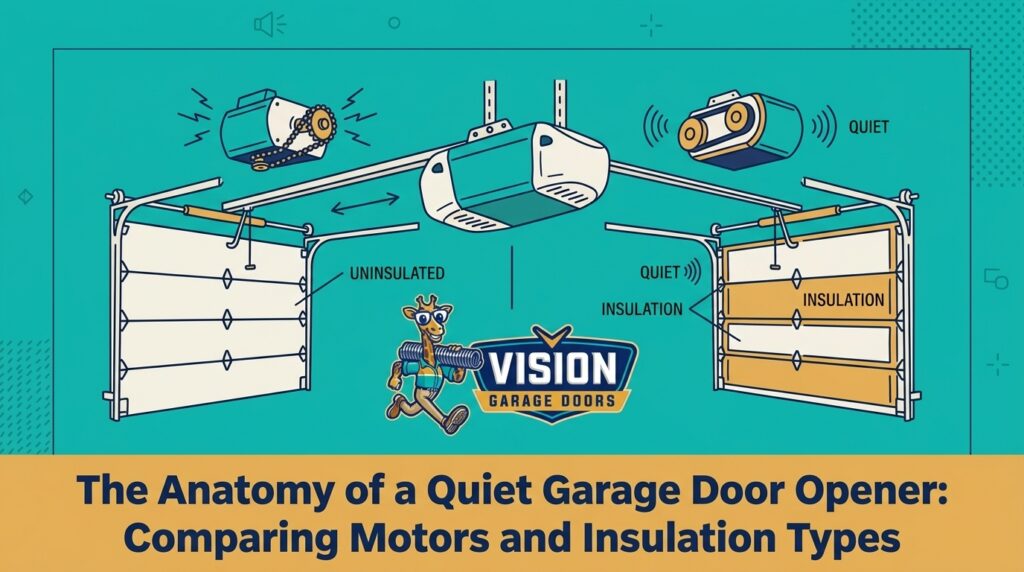
The Myth of the Silent Motor: Why a Quiet Garage Door Opener Isn’t Enough
Upgrading an aging, noisy system seems straightforward, but when looking at options comparisons for homeowners, our team at Vision Overhead Doors finds that a silent motor alone rarely solves the whole problem. We often hear from property owners who assume that swapping a rattling chain drive for a modern, high-tech motor will instantly transform their garage into a whisper-quiet space. The reality is much more complex. A garage door operates as a massive, interconnected acoustic and structural system. If you attach a premium, ultra-quiet motor to a thin, uninsulated steel door, you have essentially attached a high-end engine to a hollow tin can. The motor itself might be silent, but the structural vibration it causes will still echo through the entire house.
To truly eliminate the grinding, popping, and echoing that plague older systems, you have to look beyond the ceiling-mounted box. If your current setup is struggling, professional garage door opener repair can address mechanical failures, but achieving lasting silence requires balancing motor mechanics with the correct structural rigidity and insulation type. This is especially critical when dealing with harsh British Columbia winters, where extreme temperature drops expose every flaw in a door’s construction. A poorly specified door acts as a giant speaker diaphragm, amplifying every minor vibration from the tracks and rollers into a disruptive roar.
The true anatomy of a quiet system includes:
- A low-vibration drive mechanism: Moving away from metal-on-metal contact.
- Structural dampening: Using dense insulation to stop the door panels from flexing and vibrating.
- Precision hardware: Nylon rollers and calibrated torsion springs that absorb shock rather than transmitting it.
How Temperature Drops Amplify Garage Door Noise
Understanding why a garage door gets louder in December requires looking at the physics of cold weather on metal components. During freezing Enderby, BC winters, our technicians regularly see metal parts undergo significant thermal contraction. Steel tracks, hinges, and springs physically shrink and stiffen as the temperature drops. This contraction pulls components tighter together, eliminating the tiny tolerances that usually allow for smooth movement. The result is a dramatic increase in mechanical friction. What was a smooth glide in July becomes a harsh, grinding scrape in January.
If you are considering a full garage door installation, factoring in this thermal reality is crucial. Cold weather does not just affect the tracks; it affects the door panels themselves. Standard, uninsulated single-layer steel doors offer zero acoustic resistance. When the stiff, cold metal rollers grind against the contracted steel tracks, that vibration transfers directly into the hollow door panels. Because there is no internal dampening material to absorb the kinetic energy, the entire door vibrates like a tuning fork.
Common cold-weather acoustic symptoms include:
- Sharp popping sounds: Often caused by cold, stiff steel panels flexing as they transition around the curved portion of the overhead track.
- Deep grinding noises: The result of contracted metal rollers scraping against tightly contracted metal tracks.
- Echoing booms: Caused by the sudden release of tension in cold torsion springs echoing off uninsulated steel panels.
Solving this winter racket requires a two-pronged approach: you must address the drive mechanism generating the initial force, and you must address the door’s construction to absorb the resulting vibrations before they can amplify.
Comparing Opener Drive Types: Belt, Chain, and Jackshaft
The mechanism that pulls your door open plays a foundational role in the overall noise level of your garage. Traditional systems relied on heavy steel chains, which are durable but inherently noisy due to constant metal-on-metal contact. Modern engineering has introduced alternatives that drastically reduce this mechanical chatter. When evaluating the drive types for our clients, we always consider how the motor’s weight and torque interact with heavy, insulated doors that carry high R-value ratings, as a heavier door requires a smoother power delivery to avoid structural strain.
Belt Drive Systems
Belt drive openers are the standard upgrade we recommend for homeowners prioritizing quiet operation. Instead of a steel chain, these systems utilize a steel-reinforced rubber or fiberglass belt. This completely eliminates the metal-on-metal clanking as the drive moves along the rail. Furthermore, premium belt drives are almost exclusively paired with DC (Direct Current) motors rather than older AC (Alternating Current) motors. DC motors are inherently quieter and offer a critical feature known as soft-start and soft-stop. Instead of jerking the door upward at full speed, a DC motor gradually ramps up its power, and gently slows down before the door hits the floor. This eliminates the violent structural shock that often rattles the entire garage structure. If your garage is located directly beneath a bedroom or adjacent to a living room, a belt drive is an excellent baseline choice.
Jackshaft (Direct Drive) Openers
For the ultimate in acoustic control, jackshaft openers offer a completely different architectural approach. Also known as wall-mounted openers, these units eliminate the overhead rail and trolley system entirely. Instead of pulling the door from the center, a jackshaft motor mounts on the wall directly beside the door and turns the torsion bar itself. By removing the ceiling-mounted rail, you remove the primary pathway that vibrations use to travel into the floorboards of the room above. These are often considered the quietest garage door openers available on the market. They free up overhead ceiling space and deliver incredibly smooth, vibration-free lifting power, making them a favorite among our installers for high-end setups and heavy, heavily insulated doors.
Polystyrene vs. Polyurethane: The Hidden Key to Acoustic Dampening
In our experience, even with a whisper-quiet jackshaft opener and a soft-start DC motor, a hollow steel door will still rattle in its tracks. This is where insulation becomes an acoustic necessity rather than just a thermal upgrade. The materials used to insulate a garage door fall into two primary categories: polystyrene and polyurethane. While both improve thermal resistance and carry standardized R-value ratings, they perform entirely different structural functions.
Polystyrene, commonly known as EPS, consists of solid foam panels that are cut to size and dropped into the hollow cavities of the garage door sections. Often, a backing layer of vinyl or thin steel is placed over them. While polystyrene provides basic thermal resistance and stops the door from being completely hollow, it does not bond to the steel. Because the foam sits loosely inside the panel, the metal skin of the door can still flex, vibrate, and rattle when the opener engages.
Polyurethane, on the other hand, is a liquid-injected foam. During the manufacturing process, this liquid is pumped into the door panels where it rapidly expands, filling every microscopic crevice before curing into a dense, solid core. Crucially, the polyurethane chemically bonds to both the front and back steel skins of the door. This creates a solid, composite sandwich panel. The structural bonding completely prevents the steel from flexing. When a vibration travels from the track into a polyurethane door, the dense foam core instantly absorbs and dampens the kinetic energy, stopping the noise dead.
| Feature | Polystyrene (Drop-in Panels) | Polyurethane (Liquid-Injected) |
|---|---|---|
| Construction Method | Pre-cut solid foam blocks inserted into door cavities. | Liquid foam injected that expands and bonds to the steel. |
| Structural Rigidity | Low to Moderate. Metal skins can still flex and dent easily. | Very High. Creates a solid composite panel that resists impacts. |
| Acoustic Dampening | Noticeable improvement over hollow doors, but some rattling remains. | Exceptional. Absorbs vibration and deadens sound almost entirely. |
| R-Value Ratings | Generally lower (R-6 to R-9 typically). | Significantly higher (R-12 to R-20+ typically). |
| Best Application | Detached garages, budget-conscious thermal upgrades. | Attached garages, heated workshops, living spaces above the garage. |
Choosing the Right Setup for Your Garage Usage
Selecting the right combination of motor and insulation requires looking objectively at how you actually use your garage. Over-specifying can lead to unnecessary expenses, while under-specifying leaves you dealing with cold drafts and disruptive noise. Enderby’s cold climate makes choosing the correct insulation crucial not just for heat retention in workshops, but for maintaining structural integrity during extreme temperature drops. When reviewing R-value ratings, remember that the structural rigidity of the door is just as important as the thermal metric.
Scenario 1: The Detached Storage Garage
If your garage sits completely separate from your home and is used primarily for parking vehicles or storing lawn equipment, acoustic perfection is rarely necessary. In this scenario, basic polystyrene insulation paired with a standard chain drive or entry-level belt drive is often sufficient. The polystyrene provides enough thermal resistance to keep the edge off the freezing cold, while keeping the overall weight and cost of the door manageable.
Scenario 2: The Attached Garage (Bedrooms Above or Adjacent)
When the garage shares walls or a ceiling with your living space, noise transmission becomes the primary concern. A hollow or polystyrene door will transmit the rumble of the opener directly into the house framing. Here, we strongly recommend a polyurethane-injected door. The dense composite core will absorb the track vibrations, while a premium belt drive motor with soft-start technology ensures the lifting process doesn’t jolt the ceiling joists.
Scenario 3: The Heated Workshop or Home Gym
If you actively heat the garage during the winter to use it as a workshop, gym, or extended living space, you need maximum thermal efficiency and structural stability. Polyurethane insulation is mandatory in this setup to achieve the high R-value ratings necessary to trap heat efficiently. Because these heavy, heavily insulated doors require robust lifting power, pairing them with a wall-mounted jackshaft opener provides the smoothest, quietest, and most reliable operation, completely freeing up your ceiling space for lighting or overhead storage.

Why Professional Calibration Outperforms DIY Installation
Even if you purchase the highest-rated polyurethane door and the most advanced wall-mounted DC motor on the market, the system will still grind and rattle if it is not installed with absolute precision. The acoustic benefits of premium components are entirely dependent on professional calibration. A garage door is a heavy, moving wall. If the vertical tracks are misaligned by even a quarter of an inch, the nylon rollers will bind against the steel, creating friction that the quietest motor in the world cannot mask.
Proper garage door repair and installation require balancing the torsion springs to exact specifications. The springs, not the motor, do the actual heavy lifting. If the springs are under-tensioned, the motor strains, groans, and wears out prematurely. If they are over-tensioned, the door will slam upward, causing structural shock. Professional technicians ensure the door is perfectly neutrally buoyant, allowing the DC motor to glide the door open with minimal effort.
Furthermore, our local Okanagan expertise plays a vital role in preparing a system for British Columbia winters. At Vision Overhead Doors, we know exactly which low-temperature lithium-based lubricants to apply to the hinges, bearings, and torsion springs. Standard DIY sprays often freeze or turn to sludge when the temperature drops, causing the hinges to lock up and pop loudly as the door bends. Upgrading to sealed nylon rollers with precision ball bearings—and ensuring the track spacing is calibrated to accommodate thermal contraction—ensures the system runs silently and withstands local climate extremes year after year.
Frequently Asked Questions About Garage Door Noise and Insulation
Does an insulated garage door make it quieter?
Yes, significantly so, especially if you choose polyurethane-injected doors. The dense foam core absorbs mechanical vibrations from the tracks and rollers, preventing the steel panels from rattling and echoing. While hollow doors amplify sound like a drum, heavily insulated doors dampen kinetic energy, making the entire opening and closing cycle much quieter.
What is the best garage door opener for cold weather?
Belt drive or jackshaft openers equipped with DC motors are the superior choices for freezing climates. DC motors offer smooth, soft-start operation that prevents violent jerking on cold, contracted metal parts. Additionally, the rubber or fiberglass belts used in these systems do not suffer from the same stiffening and metal-on-metal grinding that plagues traditional steel chain drives in the winter.
What is the difference between polyurethane and polystyrene garage doors?
The primary difference lies in how the insulation interacts with the door’s structure. Polystyrene uses solid foam panels inserted loosely into the door cavities, offering basic thermal resistance but limited acoustic dampening. Polyurethane is injected as a liquid that expands and chemically bonds to the steel skins, creating a denser, highly rigid composite door that blocks both heat loss and vibration.
Why is my garage door so loud in the winter?
Cold temperatures cause all the metal components in your garage door system to contract and stiffen. As steel tracks, hinges, and springs shrink slightly in the cold, the mechanical friction between moving parts increases dramatically. This lack of tolerance causes rollers to grind and hinges to pop, turning minor operating noises into loud, disruptive rattling.
Can I upgrade my current opener without replacing the door?
Yes, upgrading to a quiet belt-drive or jackshaft motor will eliminate the noise generated by the opener itself. However, if your existing door lacks structural rigidity or uses uninsulated single-layer steel, the vibrations from the tracks and rollers will still cause the door to rattle. True silence requires addressing both the drive mechanism and the door’s structural dampening.
Make the Right Choice for a Quieter Home
Achieving a truly quiet garage requires looking past the marketing claims of silent motors and understanding how the entire system functions together. True noise reduction demands matching a smooth-operating drive mechanism with the structural rigidity of dense insulation. By comparing R-value ratings, understanding the distinct advantages of polyurethane over polystyrene, and evaluating your specific garage usage, finding the perfect setup becomes a straightforward, objective process. You don’t have to guess which components will survive the winter cold. Consulting with local experts like our team at Vision Overhead Doors to evaluate your current tracks, springs, and usage needs ensures you invest in a balanced system that provides lasting thermal comfort, structural reliability, and peace and quiet for years to come.