
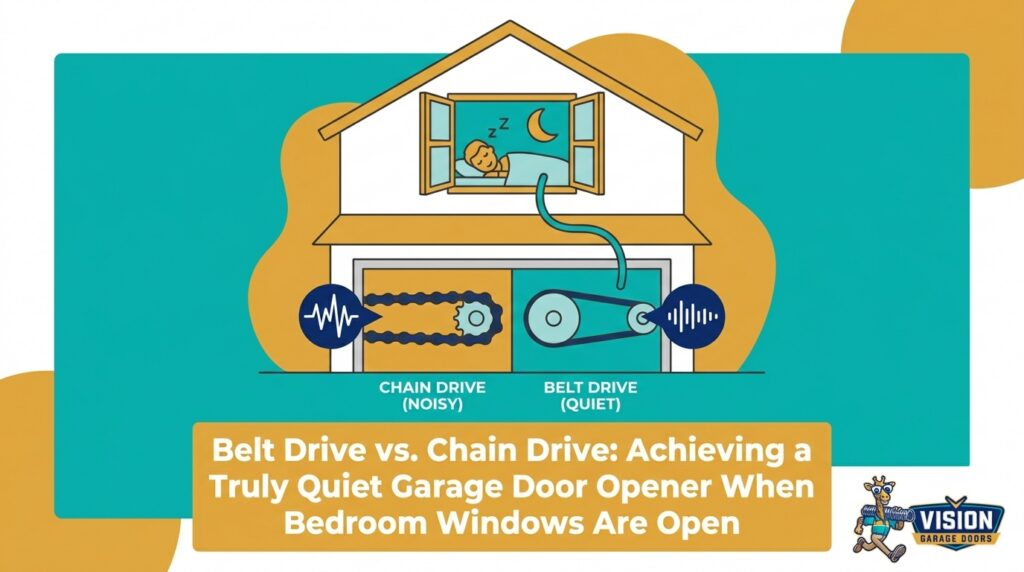
The 5 AM Wake-Up Call: Why Open-Window Season Exposes Noisy Garage Doors
Before the intense summer heat sets in and you rely on evening cross-breezes, understanding the difference between a Belt Drive vs. Chain Drive: Achieving a Truly Quiet Garage Door When Bedroom Windows Are Open becomes a top priority for your entire household. During the warm summer months with open windows, the thick, sound-dampening barrier of double-pane glass is removed. Suddenly, every exterior mechanical noise enters your home with startling clarity.
If someone in your family leaves for an early shift, the jarring, metallic rattle of an older garage door opener can easily wake up the entire house—and even the neighbors. Natural cooling is essential for comfort, but it should not come at the cost of your sleep. You are left facing a distinct decision point: do you continue to tolerate the rattling, attempt to patch the problem with minor fixes, or upgrade to a modern, acoustically optimized system? Navigating your options for professional garage door services is the first step toward reclaiming your quiet mornings.
This guide breaks down the mechanical realities of different drive types. We will explore exactly why traditional systems echo through your framing and how modern technology has evolved to provide maximum acoustic comfort for your home.
Understanding Structural Acoustics: Why Your Chain Drive Echoes
To fix a noise problem, you first have to understand how sound travels through a residential structure. Traditional chain drive openers rely on a heavy steel chain moving along a metal rail, pulled by a steel sprocket. This inherently creates metal-on-metal friction. While this design is incredibly strong and reliable, it is also fundamentally loud.
In quiet Enderby BC residential areas, night-time ambient noise drops significantly. Without the hum of daytime traffic or neighborhood activity to mask the sound, sudden mechanical noises become deeply disruptive. The sound you hear inside your bedroom is actually a combination of two different acoustic pathways.
The Anatomy of Garage Door Noise
Garage door noise does not just float through the air; it physically travels through the bones of your house. Here is how the disruption breaks down:
- Airborne Noise: This is the sound wave traveling directly from the motor and track, through the air, and into your bedroom. When windows are open for natural cooling, airborne noise has a direct, unobstructed path to your ears.
- Structural Vibration: This is often the more disruptive element. As the heavy chain clanks along the rail, it generates intense kinetic vibration. This vibration transfers from the opener’s steel mounting brackets directly into your garage ceiling joists.
- Acoustic Amplification: Once that vibration hits the wooden framing of your home, the drywall acts like the cone of a giant speaker, amplifying the low-frequency rumble into the rooms directly above or adjacent to the garage.
Because the ambient background noise is so low during the early morning hours, this combination of airborne screeching and structural rumbling feels much louder than it would at noon.
Can Maintenance Quiet a Loud Chain Drive?
Most homeowners don’t realize that a noisy system does not always require an immediate replacement. Sometimes, the issue stems from years of neglected upkeep. A heavy steel chain requires consistent lubrication to glide smoothly. When that lubrication dries up, metal wear accelerates, and friction noise skyrockets.
The Problem: Your opener screeches, grinds, and pops when engaging, sending sharp noises through the house during warm summer months with open windows.
The Cause: Dried-out grease, loose chain tension, and worn-out rollers create excessive resistance. The motor has to work harder, and the metal components scrape against one another.
The Solution: Professional lubrication, tension adjustment, and a thorough hardware inspection can significantly reduce the high-pitched squealing.
However, there are strict limits to what maintenance can achieve. While a tune-up can eliminate the screeching of dry metal, it cannot eliminate the fundamental clanking of a steel chain engaging a metal sprocket. If your opener still rumbles heavily after a professional garage door opener repair, the system is likely operating exactly as designed—it is simply an older, louder technology. When the core mechanics are too worn or the inherent design is just too disruptive for your living situation, it is time to look at modern alternatives.
The Belt Drive Advantage: Eliminating Metal-on-Metal Clanking
If you want to completely eliminate the harsh metallic rattle of a traditional opener, the belt drive is the definitive solution. Instead of a heavy steel chain, these systems utilize a thick, flexible belt to move the trolley along the rail. This fundamentally changes the acoustic profile of the machine.
Modern belts are typically constructed from polyurethane, fiberglass, or steel-reinforced rubber. The steel reinforcement provides the heavy-lifting tensile strength needed to move large doors, while the rubber or polyurethane casing acts as a built-in shock absorber. Rather than transferring kinetic energy into the mounting hardware, the rubber absorbs the vibration. This makes belt drives the preferred choice for homes in quiet Enderby BC residential areas where peace and quiet are highly valued.
Key Noise Sources: Belt vs. Chain Drives
- Vibration Transfer: Chain drives produce high vibration that transfers into home framing. Belt drives absorb this vibration internally, preventing the low-frequency rumble from reaching your living spaces.
- Track Friction: Chain drives feature grinding metal-on-metal contact. Belt drives offer a smooth, rubber-on-metal glide that is virtually silent.
- Start/Stop Jerking: Older chain systems often yank the door upward abruptly, causing the hinges and panels to pop. Modern belt systems are engineered for seamless, fluid motion.
By eliminating the metal-to-metal contact points, a belt drive drastically cuts down on both airborne noise and structural vibration. If you are researching the quietest garage door openers on the market, you will find that almost all of them rely on belt-driven technology.

Beyond the Drive: How DC Motors Reduce Vibration
While the drive mechanism (the belt or the chain) gets most of the attention in acoustic comparisons, the actual motor power plant is equally important. Competitors often miss this critical detail when discussing noise reduction. The type of electrical current your motor uses dictates how smoothly the door operates.
Older garage door openers typically use Alternating Current (AC) motors. AC motors are binary—they operate at full power the millisecond they turn on, and they stop abruptly the moment they turn off. This sudden burst of power yanks the door upward, causing the entire track system to shudder and the door panels to bang together. During warm summer months with open windows, that sudden slam is exactly what wakes you up.
Direct Current (DC) motors operate entirely differently. DC technology allows for variable speed control, enabling a feature known as “soft start and stop.” When a DC motor activates, it starts slowly, gradually ramping up to full speed. As the door approaches the fully open or fully closed position, the motor gently decelerates, setting the door down softly without a jarring thud. When you combine the vibration-absorbing qualities of a rubber belt with the smooth, controlled power of a DC motor, you achieve the ultimate acoustic solution for sensitive sleeping areas.
Matching Opener Technology to Your Home’s Architectural Layout
Choosing the right garage door opener is not just about picking the most expensive unit off the shelf; it is about matching the technology to the specific footprint of your property. The way sound travels through your home depends heavily on your architectural layout.
If you have a detached garage sitting fifty feet away from the house, a rugged, traditional chain drive might be perfectly fine. The distance naturally dissipates the noise before it reaches your bedroom. However, if you have a primary bedroom located directly above the garage, or a nursery sharing a common wall with the garage, structural acoustics become your biggest enemy. Sound travels easily through standard floor joists and minimal insulation.
This is where local expertise matters. Vision Overhead Doors evaluates the specific architectural layout of the home to recommend the right drive technology, protecting the homeowner’s peace and quiet. By assessing where the bedrooms are located relative to the garage mounting points, we can determine whether a standard upgrade is sufficient, or if specialized vibration-isolation mounts are required for homes in Enderby BC residential areas.
Side-by-Side Comparison: Belt Drive vs. Chain Drive
To help you make an informed decision before the heat of the warm summer months with open windows arrives, here is a clear breakdown of how the two drive types compare across the most important operational metrics.
| Feature | Chain Drive | Belt Drive |
|---|---|---|
| Acoustic Performance | Loud. High airborne noise and heavy structural vibration. | Extremely quiet. Minimal vibration and virtually silent gliding. |
| Durability | Exceptional. Highly resistant to temperature fluctuations and heavy lifting. | Excellent. Steel-reinforced rubber lasts for years without stretching. |
| Maintenance Needs | High. Requires regular lubrication to prevent friction and rust. | Low. Rubber belts do not require grease or traditional lubrication. |
| Best Application | Detached garages or homes where noise is not a concern. | Attached garages, especially with bedrooms above or adjacent. |
When you are planning a new garage door installation, factoring in the long-term acoustic value of a belt drive is a smart investment. The slight increase in upfront cost pays dividends in daily comfort and uninterrupted sleep.
Protecting Your Peace and Quiet: Making the Final Decision
Upgrading to a modern belt drive paired with a DC motor is the definitive solution to early morning noise disruptions. You shouldn’t have to choose between keeping your house cool and getting a full night’s rest. The right technology restores your ability to sleep peacefully, even when the neighborhood is quiet and your windows are wide open.
Every home in Enderby BC residential areas has a unique layout, and finding the perfect balance of lifting power and acoustic control requires a professional eye. Getting an expert assessment of your current system will give you a clear understanding of your upgrade options, ensuring you make a choice that protects your home’s peace and quiet for years to come.
Frequently Asked Questions
Is a belt drive garage door opener really quieter?
Yes, a belt drive is significantly quieter than traditional models. By replacing the metal chain with a steel-reinforced rubber or polyurethane belt, the system eliminates the metal-on-metal friction that causes loud grinding and clanking during operation.
How much quieter is a belt drive than a chain drive?
A belt drive can reduce operational noise by a substantial margin, often turning a loud, house-shaking rumble into a soft, ambient hum. While exact decibel drops vary by model, homeowners typically notice that the structural vibration—the noise that shakes the floorboards—is almost entirely eliminated.
Which garage door opener is best for a bedroom above the garage?
A belt drive opener paired with a DC motor is the absolute best choice for a bedroom located directly above a garage. The rubber belt absorbs track vibration, and the DC motor provides a soft start and stop, preventing the door from jerking and sending shockwaves through the ceiling joists.
Why is my chain drive garage door so loud?
Your chain drive is loud because it relies on heavy metal links being pulled across a metal sprocket and steel rail. If it has suddenly become louder than usual, it likely lacks proper lubrication, causing increased friction, metal wear, and excessive vibration.
Can I convert my existing chain drive to a belt drive?
In most cases, you cannot simply swap a belt onto a chain drive motor because the sprockets and internal gearing are designed specifically for chain links. Upgrading to a belt system requires installing a completely new powerhead and rail assembly designed for that specific drive type.
Does a quiet garage door opener require special maintenance?
Belt drive openers actually require less routine maintenance than chain drives because the rubber belt does not need to be greased or lubricated. However, you still need to routinely lubricate the door’s hinges, rollers, and springs to ensure the entire system remains quiet and balanced.