The Frustration of Late Afternoon Garage Door Reversals
When the intense seasonal heat arrives, diagnosing garage door sensor failures caused by peak Okanagan summer sun becomes a sudden necessity for many local homeowners. At Vision Overhead Doors, we receive a surge of frantic calls right when the days grow longer and the temperatures rise. You return home from work, press the button, and your perfectly functional garage door travels downward for a few inches before immediately reversing back upward, often accompanied by the flashing lights of the opener motor. This specific seasonal urgency catches many homeowners off guard during the peak Okanagan summer afternoons, leading them to believe their equipment has completely broken down.
Before you assume your safety sensors are permanently damaged and require a full garage door repair, it is highly beneficial to rule out environmental interference. What our team typically sees is a “phantom obstruction.” The garage door opener system genuinely believes something is blocking the path of the door, but the physical path is completely clear. The culprit is not a bicycle, a pet, or a mechanical failure—it is the intense glare of the afternoon sun.
Understanding the difference between a broken sensor and a blinded sensor is a crucial decision point for any homeowner. As specialized local garage door technicians, the Vision Overhead Doors team can accurately diagnose whether you need replacement parts or if you simply need targeted sun shielding techniques. By addressing this phantom obstruction proactively, you can restore the security of your home without unnecessary expenses.
The Mechanics of Infrared Safety Sensors and Solar Interference
To understand why your garage door behaves erratically in the afternoon, you have to look at the technology inside the safety sensors. Modern garage door openers rely on photo-eye safety sensors positioned near the floor on either side of the door track. These sensors operate by transmitting an invisible artificial infrared light beam from one side of the opening to the other. As long as this beam remains unbroken, the opener motor knows it is safe to close the heavy door.
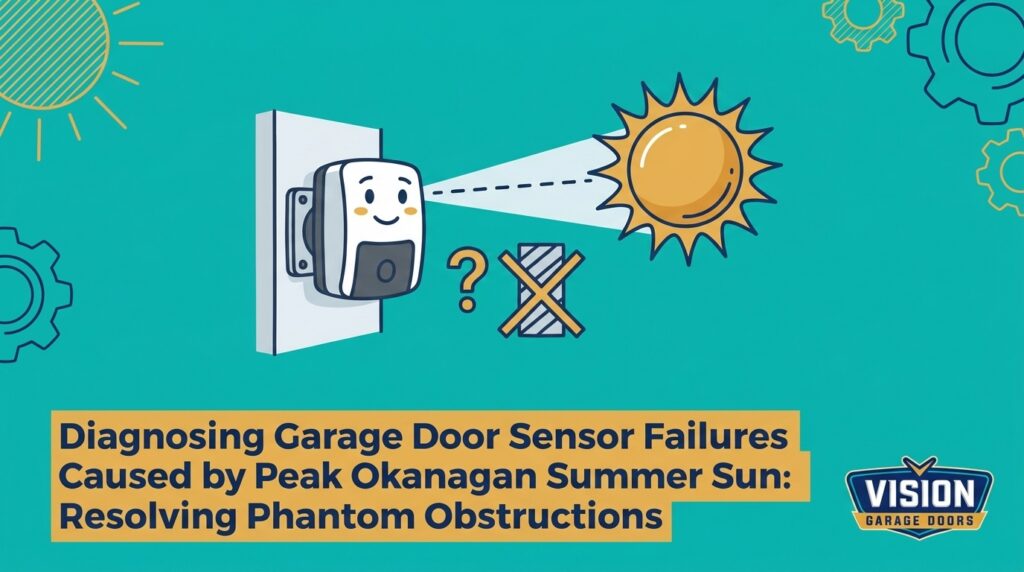
The problem arises because the artificial infrared beam is not the only source of infrared light in your environment. Direct sunlight contains massive amounts of natural infrared radiation. When the sun hangs low in the sky, its intense rays can shine directly into the lens of the receiving sensor. This receiving sensor is typically the one featuring a green LED indicator light. When it takes a direct hit from the sun, the sheer volume of natural infrared radiation completely overpowers the small, artificial infrared beam sent by the opposite sensor.
This overpowering effect creates a “blinding” scenario. The receiving sensor becomes overwhelmed by the sunlight and can no longer detect the artificial beam. Because the system is designed to fail safely, the garage door opener interprets this blinding exactly as it would a physical object breaking the beam. It immediately triggers an automatic safety reversal to prevent potential injury or property damage, resulting in phantom sensor obstructions that frustrate homeowners.
| Light Source | Infrared Intensity | Impact on Garage Door Sensors |
|---|---|---|
| Sending Sensor (Artificial) | Low, highly focused | Provides the baseline safety beam required for operation. |
| Direct Sunlight (Natural) | Extremely high, broad spectrum | Overpowers the receiver, causing phantom sensor obstructions. |
| Reflected Sunlight | Moderate, scattered | Can occasionally cause flickering or intermittent reversing. |

Why West and South-Facing Garages in the Valley Are Highly Vulnerable
The geography and climate of the region play a massive role in how frequently these sensor failures occur. In our years of servicing routes from Enderby to Kelowna, we’ve noticed that the regional topography of the valley creates specific challenges for properties facing west and south. Because the region experiences over 2,000 hours of bright sunshine annually, the natural infrared interference is maximized, particularly during the hottest months of the year.
Homeowners in communities like Kelowna and Vernon are uniquely vulnerable to this phenomenon. The valley’s geography creates prolonged, low-angle afternoon glare as the sun begins its descent over the western hills. This angle perfectly aligns with the low mounting position of garage door safety sensors (usually about six inches off the ground). The most intense blinding occurs precisely between 3:00 PM and 7:00 PM during July and August—exactly when most people are returning from work and trying to secure their homes.
Furthermore, the ambient environmental heat compounds the stress on your garage door system. While the light causes the immediate phantom obstruction, the sustained high temperatures can also affect the internal electronics of the motor head overhead. Understanding how summer heat affects your garage door opener is essential, as the combination of thermal expansion in the mechanical parts and infrared blinding in the safety sensors can make a garage door nearly inoperable during the late afternoon.
Identifying Sun-Related Sensor Interference vs. Mechanical Failure
Before you spend money on replacement parts, you need to confirm that the sun is actually the root cause of your reversing door. Diagnosing the problem accurately requires a few simple, hands-on tests that any homeowner can safely perform. By ruling out mechanical failures, you can confirm whether you are dealing with phantom sensor obstructions or a genuinely faulty component.
- Conduct time-of-day testing: Pay close attention to when the failures happen. If the garage door closes perfectly in the early morning or late at night, but consistently reverses between 3 PM and 7 PM, the sun is almost certainly the culprit. Mechanical failures do not operate on a predictable daily schedule.
- Perform a visual inspection of the sensor LEDs: Look closely at the small indicator lights on both sensors. The sending sensor (usually amber or yellow) should remain solid. The receiving sensor (usually green) will likely flicker, dim, or go out completely when the sun is hitting its lens directly.
- Check for dirty or dusty lenses: Dust and grime on the sensor lens act like tiny prisms, amplifying the glare of the sun. A slightly dirty lens will fail much faster in direct light than a perfectly clean one. Wipe both lenses gently with a soft, dry microfiber cloth.
- Test the wall button override: Most systems allow you to force the door closed by pressing and continuously holding the interior wall button until the door hits the floor. If this works, it confirms the opener motor is fine and the issue lies strictly with the safety sensor circuit.
The Shadow Diagnostic Technique
The most definitive way to diagnose solar interference is the shadow test. We often walk our Enderby customers through this simple technique over the phone because it provides immediate confirmation of the problem.
- Clear the path: Ensure there are absolutely no physical objects, tools, or debris anywhere near the garage door tracks.
- Cast a shadow: Stand safely inside the garage and position your body, a piece of cardboard, or your hand to cast a dark shadow directly over the receiving sensor (the one with the green light).
- Test the door: While keeping the sensor shaded, have another person press the remote or wall button.
- Observe the result: If the door closes normally and smoothly while the sensor is shaded, you have confirmed a phantom obstruction. The sensor is fully functional but was simply blinded by the glare.
Effective Sun Shielding and Realignment Techniques
Once you have diagnosed the problem, the next step is implementing a solution. You do not necessarily need to buy new sensors to resolve phantom obstructions; you simply need to manage the light hitting the existing ones. There are several ways to approach this, ranging from temporary fixes to long-term professional adjustments.
Many homeowners attempt temporary DIY fixes, such as taping empty cardboard toilet paper rolls over the sensors to create a tunnel for the beam. While this technically blocks the sun, these materials degrade rapidly. Cardboard absorbs moisture from summer humidity, warps in the heat, and easily blows away in the wind. These temporary hacks rarely last more than a few weeks.
For a permanent solution, creating or installing professional, weather-resistant sun shields is highly recommended. At Vision Overhead Doors, we frequently install UV-resistant PVC piping or small aluminum shielding brackets to provide a durable barrier against the peak Okanagan summer afternoons. These robust materials withstand the intense valley heat without warping. Applying our deep local expertise, we utilize proven, hands-on shielding techniques developed specifically to withstand intense local valley weather, ensuring the sensors remain protected year after year.
Swapping Sending and Receiving Sensors
If shielding the sensor is not aesthetically pleasing or practical for your specific garage layout, our technicians highly recommend the “sensor swap” method as an effective alternative.
- The logic behind the swap: The sending sensor (amber light) only transmits light; it does not receive it. Therefore, it is completely immune to sunlight blinding. The receiving sensor (green light) is the vulnerable component.
- The physical switch: Our technicians will physically unbolt the sensors and swap their positions from the left side of the garage to the right side (and vice versa). This places the vulnerable receiving sensor on the side of the garage that naturally stays in the shade of the wall during the afternoon.
- Realignment requirements: After swapping the positions, we carefully realign the sensors. The invisible beam must hit the exact center of the receiving lens, which is confirmed when the green LED light remains solid and stops flickering.
These professional shielding and swapping techniques preserve the lifespan of your existing equipment, saving you money while maintaining the strict safety standards required for heavy overhead doors.
When to Escalate to Professional Opener Diagnostics
While shielding techniques are highly effective for solar interference, there is a threshold where environmental troubleshooting ends and professional repair begins. If you have thoroughly cleaned the lenses, implemented the shadow test, and the door still refuses to close, the problem likely runs deeper than the Okanagan summer sun.
You should look for signs of actual mechanical or electrical failure. Inspect the thin wires running from the sensors up to the motor head. If you see frayed wiring, exposed copper, or signs of water damage from previous seasons, the sensors may be short-circuiting. Additionally, if the LED light on the receiving sensor is completely dead—even when perfectly shaded and aligned—the internal components of the photo-eye have likely failed and will require professional replacement.
It is also important to consider the toll that continuous reversing takes on your system. Every time the door starts to close and abruptly jerks back upward, it places immense strain on the opener motor, the internal gears, and the drive belt or chain. Over time, this repetitive stress can cause premature motor failure. If your door has been suffering from phantom obstructions for weeks, seeking professional garage door opener repair is a wise choice. As your local experts, we accurately diagnose the root cause of the failure, ensuring the motor has not sustained damage, rather than immediately pushing for unnecessary parts replacement.
Frequently Asked Questions About Sun Interference and Garage Doors
Can sunlight affect garage door sensors?
Yes, direct sunlight can absolutely affect your garage door sensors. Direct sunlight contains high levels of natural infrared light that can overpower the receiving sensor. This tricks the system into thinking a physical object is blocking the safety beam, causing the door to reverse automatically.
How do you block the sun from a garage door sensor?
You can block the sun by having a professional install a UV-resistant shield, such as a piece of PVC pipe or an aluminum bracket, directly over the receiving sensor. Alternatively, a technician can swap the positions of the sending and receiving sensors so the receiving unit sits safely in the natural shade of the garage wall.
Why does my garage door only close at night?
If your door works perfectly at night but reverses during the day, it is almost certainly due to solar glare blinding the receiving photo-eye during peak daylight hours. Once the sun sets, the natural infrared interference disappears, allowing the artificial safety beam to reconnect and function normally.
How do I know if my garage door sensor is bad or just blinded?
You can find out by casting a shadow over the receiving sensor with your body or a piece of cardboard. If the door closes normally while shaded, the sensor is perfectly functional but was blinded by the sun. If it still refuses to close while shaded, the sensor or its wiring may be faulty.
Does the color of the sensor light matter?
Yes, the color of the sensor indicator light helps you identify the components. Generally, the sending sensor has an amber or red light, which is unaffected by the sun. The receiving sensor typically has a green light, and this is the unit that is susceptible to blinding and phantom sensor obstructions.
Restore Your Garage Door’s Reliability Before the Heat Peaks
As the days get hotter, dealing with a garage door that refuses to close is the last thing you want to handle after a long day. Remember that “broken” sensors in the summer are often just victims of intense afternoon glare. By understanding how the sun interacts with your safety equipment in Kelowna, Vernon, and Enderby, you can take proactive steps to eliminate phantom obstructions.
At Vision Overhead Doors, we encourage you to seek professional realignment or sturdy shielding techniques before the peak summer heat causes daily frustrations and leaves your home unsecured. A clear, reassuring diagnosis from our expert technicians can often save you the cost of unnecessary replacement parts. If you need assistance confirming the health of your safety sensors or require adjustments, explore our comprehensive garage door services to keep your system running smoothly all season long.