Why Bent or Damaged Garage Door Tracks Are a Bigger Problem Than They Look
Understanding how bent or damaged tracks affect your garage door starts with one simple fact: the tracks are the entire foundation of how your door moves. When they are bent, misaligned, or pulling away from the wall, everything suffers — from the rollers and cables to the opener motor and the door panels themselves.
Here is a quick summary of the most important effects:
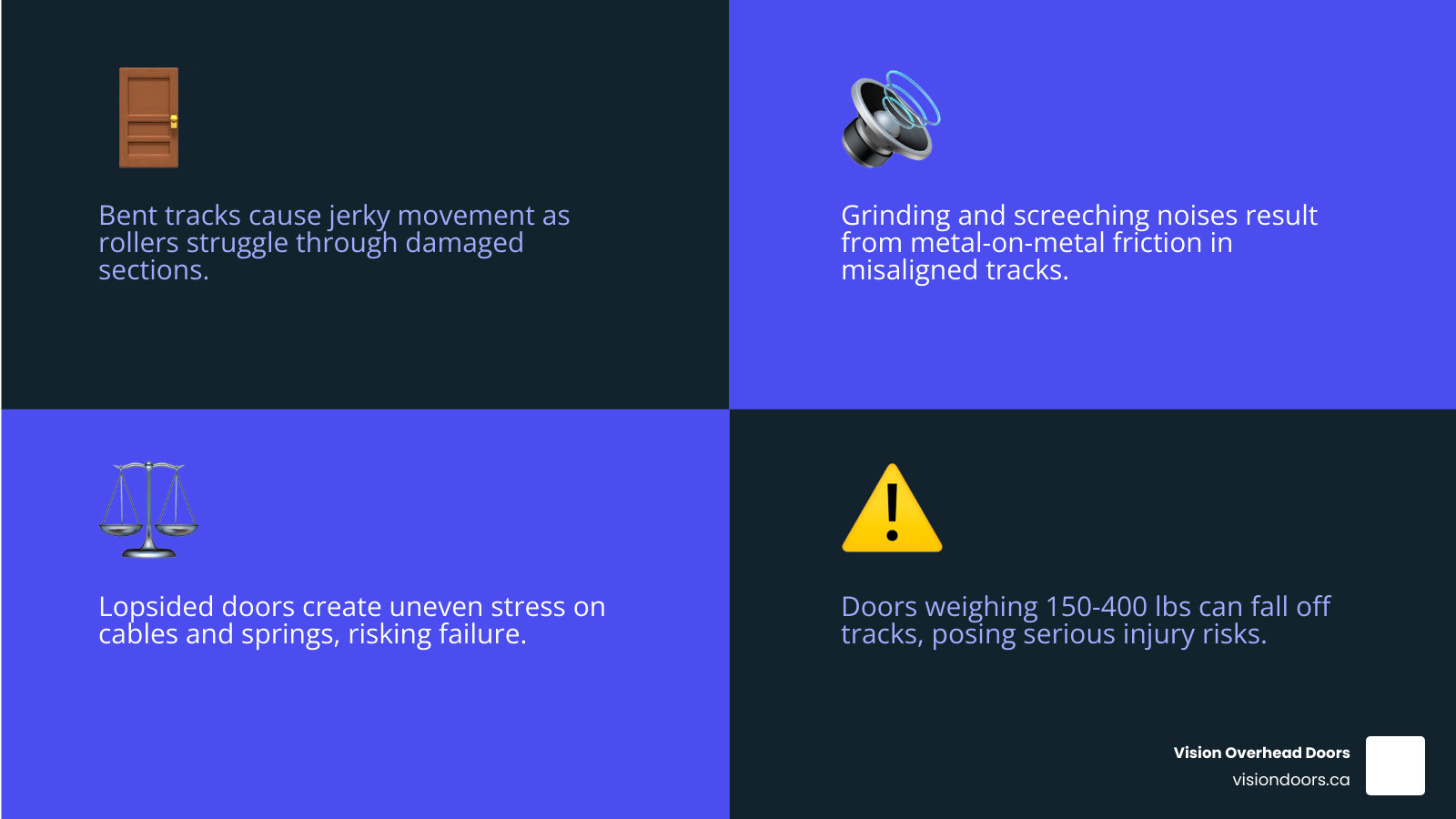
- Jerky or shaky movement — the door catches or stutters as rollers struggle through the damaged section
- Loud grinding, screeching, or banging noises — metal-on-metal friction from misaligned rollers
- Lopsided door — one side hangs lower, putting uneven stress on cables and springs
- Door gets stuck open or closed — a bent track can stop the door mid-travel, creating a security or safety risk
- Opener motor strain — the motor works harder to push through resistance, shortening its lifespan
- Risk of the door falling off the track entirely — a serious hazard given that residential garage doors weigh between 150 and 400 pounds
Even a small bend in a track that gets ignored tends to grow into a much larger and more expensive problem over time.
Garage doors are heavy, the components work under significant tension, and a track problem rarely stays isolated to just the track. That is why it pays to understand what is happening before it gets worse.
I’m Daryl Rands, owner of Vision Overhead Doors and a garage door professional with 26 years of experience serving the Okanagan Valley — and in that time, I have seen how bent or damaged tracks affect your garage door in ways that catch homeowners completely off guard. In the sections below, I will walk you through everything you need to know, from the early warning signs to when it is time to call for help.
What Causes Garage Door Tracks to Bend or Fail?
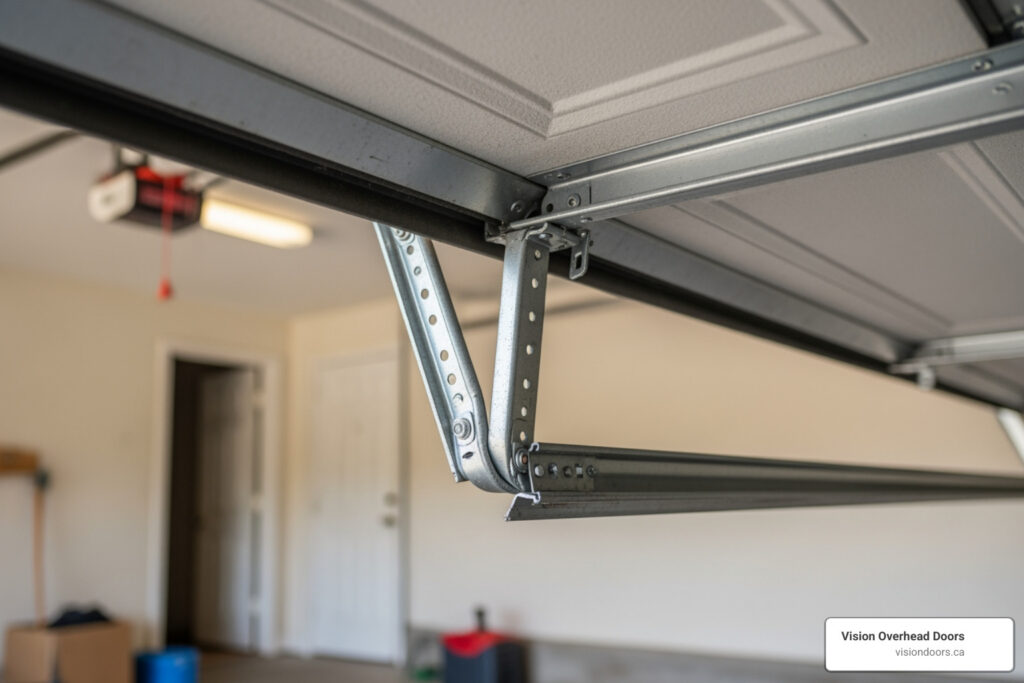
Garage door tracks are designed to guide the rollers smoothly from the vertical track beside the door to the curved and horizontal track overhead. They are durable, but they are not indestructible.
The most common causes of bent or damaged tracks include:
- Accidental impact from a vehicle
- Bumping the track with a lawnmower, bike, bin, or snow tool
- Items stored too close to the track getting wedged into the roller path
- Daily wear and vibration over years of use
- Rust and corrosion weakening the metal
- Poor lubrication that increases friction
- Loose mounting brackets or lag bolts
- Poor original installation or improper alignment
- Thin or lower-quality steel that warps more easily
- Seasonal movement in the garage structure
- Foundation settling or shifting
- Broken springs or snapped cables causing the door to hang unevenly
- Worn rollers that drag and put side pressure on the track
- Debris buildup in the track
In real life, track damage often starts with something boring and preventable. A homeowner backs out before the door is fully open. A broom falls against the rail. A garbage bin clips the vertical track. Not exactly dramatic movie scenes, but enough to create a dent that throws off the whole system.
The most common causes homeowners overlook
The hidden causes are usually the ones that keep getting missed until the problem becomes obvious.
One big one is an unbalanced door. If the spring system is no longer supporting the weight properly, one side of the door can carry more load than the other. That extra pressure can slowly bend a track or pull it out of alignment.
Another common issue is opener strain. The opener is supposed to guide the door, not force a heavy or binding door through resistance. When the opener keeps dragging a door through a damaged section, it can worsen the bend and loosen the hardware over time.
Vibration is another sneaky culprit. Normal use, seasonal expansion and contraction, and repeated movement can gradually loosen brackets. Once the track is no longer perfectly parallel and firmly mounted, rollers begin rubbing where they should be rolling.
Clutter also causes more trouble than most homeowners expect. The space beside a garage door track is narrow. A rake, shovel, shelf item, or kids’ gear leaning too close can interfere with the track path and knock things out of line.
Why related parts can make track damage worse
A bent track is sometimes the main problem, but other times it is the symptom.
If a spring breaks, the door can suddenly become crooked or heavy on one side. If a cable snaps or loses tension, one side may drop lower than the other. That uneven pull can twist the rollers and force them hard against the track, bending it further.
Worn rollers make this worse by no longer tracking cleanly. Instead of gliding, they wobble and scrape. That creates friction, noise, and side loading on the rail.
This is why we never look at tracks in isolation. A visibly bent rail may actually point to a deeper issue with springs, cables, rollers, or door balance.
How Bent or Damaged Tracks Affect Your Garage Door Right Away
If you want the short version of how bent or damaged tracks affect your garage door, it is this: the door stops moving the way it was designed to move.
A healthy garage door should open and close smoothly, stay level, and make a consistent sound. A damaged track changes all of that almost immediately.
Common immediate effects include:
- Jerky or hesitant movement
- Slow travel
- Shaking or vibration
- The door sticking at one point
- The door looking crooked or uneven
- One side moving ahead of the other
- Failure to close fully against the floor
- Failure to open all the way
- The opener working harder than usual
If the door gets stuck open, that is a security issue. If it gets stuck closed, your vehicle may be trapped inside. Either way, it is more than an inconvenience.
Damaged tracks can also increase friction enough that the opener uses more energy and experiences more wear. You may not notice that on a utility bill right away, but your opener definitely notices.
Visible signs that the track is bent, misaligned, or pulling away
Many track problems can be spotted before the door fails completely.
Look for:
- A visible dent, crease, or flat spot in the metal
- Twisting or waviness in the rail
- Cracks in the track or mounting area
- Gaps between the rollers and the track
- A track pulling away from the wall
- Loose bolts or brackets
- Rust spots or corrosion
- Uneven contact between the bottom of the door and the floor
- One side of the door sitting higher than the other
A healthy track should be straight, secure, and properly aligned so the rollers stay in consistent contact through the full travel of the door.
Noises and performance changes you should never ignore
Garage doors are not silent, but they should not sound angry.
Warning sounds include:
- Grinding
- Screeching
- Popping
- Rattling
- Banging
- Repeated opener humming without smooth movement
These sounds usually mean metal is rubbing where it should not, hardware is loose, or the door is binding in the track. If manual operation also feels unusually heavy or resistant, stop using the door until it is inspected.
What happens when the door keeps running on a damaged track
Continued use is where a small track issue turns into a larger system failure.
As the rollers force through the damaged section, they wear faster and may crack or flatten. Door sections can flex under uneven load. Brackets can loosen further. The opener motor and drive components can overheat or wear out early because they are constantly fighting resistance.
In the worst case, the rollers can climb out of the track or the door can jam hard enough to stop mid-cycle. That is how many off-track failures begin.
The Bigger Risks: Long-Term Damage and Safety Hazards
Track damage is not just about noise or inconvenience. It is a safety issue.
Residential garage doors commonly weigh around 150 to 400 pounds, and some larger systems can place enormous load on the track assembly. When that load is no longer properly guided, the results can be serious.
Long-term risks include:
- Door sections bending or cracking
- Rollers breaking
- Cables fraying
- Springs taking uneven stress
- Opener wear or failure
- Damage to vehicles or stored belongings
- Damage to the garage framing or mounting points
- Sudden door drop or off-track collapse
A damaged track can also leave you without reliable access in an emergency. If the garage is attached to the house, a door stuck open may affect security. A door stuck shut may block your vehicle when you need to leave quickly.
How a bent track damages rollers, springs, cables, and the opener
Here is where the chain reaction shows up most clearly.
| Issue level | What happens |
|---|---|
| Minor misalignment | Rollers rub, door gets noisy, opener works harder, hardware loosens faster |
| Moderate track damage | Door travels unevenly, rollers wear out, cables and brackets take uneven load, panels flex |
| Severe track damage | Door may jam, go off track, damage the opener, strain springs and cables, or become unsafe to operate |
When a track is bent, rollers no longer carry the load evenly. That added friction can chew through roller surfaces and bearings. Cables may start pulling at uneven angles. Springs may compensate for a door that no longer moves freely, which adds stress to already high-tension components. The opener can also suffer gear wear or motor overload.
Even photo-eye safety sensors can become part of the problem if the door closes crookedly or reverses unexpectedly due to binding.
Why an off-track or unstable door is a serious home safety issue
This is the part where we drop the polite homeowner tone for a moment: a garage door that is off track or close to coming off track is dangerous.
Heavy doors can shift suddenly. Fingers can get caught. Pets and children may be nearby without realizing the risk. Cars, tools, and stored items can all be damaged if the door drops or twists.
Research on off-track garage doors regularly points out that some systems can involve extremely heavy loads, and that loss of support can cause severe injury or worse. That is why we recommend treating visible track failure as urgent, not optional.
If your door is unstable, do not keep testing it “just one more time.” That usually ends badly and expensively.
If you need urgent help, see our emergency garage door services.
What to do immediately if your garage door is bent or off track
If you discover a bent track or an off-track door, take these steps right away:
- Stop operating the door immediately
- Do not hit the wall button again to “see if it clears”
- Unplug the opener if it is safe to do so
- Keep children, pets, and vehicles away from the area
- Do not stand under the open door
- Do not try to force the door closed
- Do not try to lift a heavy or crooked door by yourself
- Check from a safe distance for obvious obstructions
- Call for professional repair, especially if the door is visibly uneven, jammed, or off track
Can Bent Garage Door Tracks Be Repaired?
Sometimes yes, sometimes no.
A slightly bent track may be repairable if the metal is not cracked, the damage is localized, and the alignment can be restored safely. But severe bends, twisted rails, cracked metal, or tracks that have pulled away from the wall often need replacement.
The right answer depends on:
- How severe the bend is
- Whether the track is cracked or twisted
- Whether the rollers stayed in place
- Whether brackets or fasteners are damaged
- Whether springs, cables, or panels were also affected
- Whether the track can be returned to correct alignment
When a minor adjustment may be possible and when it is not
Some limited homeowner tasks may be reasonable if the door is otherwise operating safely and there is no sign of major structural damage.
Examples of minor issues include:
- Removing debris from the track path
- Cleaning out dirt buildup
- Tightening an obviously loose exterior bracket bolt
- Applying the correct lubricant to moving hardware where appropriate
Safe limits matter here. Slight cosmetic irregularities are very different from a twisted track, a roller gap, or a crooked door.
If there is a visible dent in the rail, the door is binding, or the track is no longer parallel, this has moved beyond a casual DIY fix. Also, tracks themselves are generally not the part you want to soak with lubricant; the goal is proper cleaning and lubrication of moving components as recommended, not creating a greasy dirt trap.
When homeowners should skip DIY and call a professional
Call a professional right away if:
- The door is off track
- One side is lower than the other
- A spring or cable looks damaged
- The track is cracked, twisted, or pulling away
- The opener is straining or stalling
- The door keeps jamming
- You hear loud popping, grinding, or banging
- The door feels very heavy in manual mode
- You are unsure what caused the issue
Garage doors may look simple, but they combine heavy weight with high-tension parts. That is not a great recipe for trial-and-error repairs.
If you need help, our garage door repair team can inspect the full system and restore safe operation.
How technicians restore safe track alignment
Professional track repair is about more than making the rail look straight again.
A proper service visit may include:
- Inspecting tracks, brackets, rollers, cables, and springs
- Measuring alignment and spacing
- Tightening or replacing mounting hardware
- Straightening minor damage where appropriate
- Replacing severely damaged track sections
- Resetting rollers into the track if safe to do so
- Checking door balance
- Testing opener performance
- Completing a final safety inspection
The goal is to restore smooth travel, level movement, and safe load distribution across the entire system.
How to Prevent Future Track Damage
The best track repair is the one you never need.
Good prevention is mostly about catching little issues before they become bent metal and emergency calls.
Key prevention steps include:
- Keep the track area clear of storage items
- Wait until the door is fully open before driving in or out
- Inspect tracks for dents, rust, or loose hardware every few months
- Clean out dirt, leaves, and debris
- Watch for changes in door balance or sound
- Schedule annual service
- Address small issues early instead of letting them “develop character”
Smart maintenance habits that help tracks last longer
Tracks can often last 15 to 20 years when properly maintained and when the rest of the system stays in alignment.
Helpful habits include:
- Visual inspection every 3 to 4 months
- Checking for rust, loose brackets, or gaps at the rollers
- Keeping tracks clean and free of obstructions
- Making sure tracks remain parallel and firmly mounted
- Booking a yearly tune-up for balance, roller, and hardware checks
If you are already noticing warning signs, our article on five signs you need garage door repair is a useful next read.
Local conditions in the Okanagan that can affect garage door tracks
In the Okanagan Valley, local conditions matter.
Dust and debris can build up faster in and around garages, especially in dry months. Moisture and winter freeze-thaw cycles can encourage rust or expose weakened mounting points. Summer heat can contribute to expansion, vibration, and hardware loosening over time.
That does not mean your tracks are doomed. It just means regular inspection is especially important in communities across Vernon, Armstrong, Salmon Arm, Lake Country, Kelowna, and surrounding areas.
Nearby service resources for homeowners
If you are dealing with a bent track, off-track door, or alignment issue, we offer local support throughout the region. You can also learn more here:
Frequently Asked Questions About How Bent or Damaged Tracks Affect Your Garage Door
Can a garage door still open if one track is bent?
Yes, sometimes it can partially open or close, but that does not mean it is safe. Uneven travel puts extra strain on rollers, cables, and the opener. A door that still moves on a bent track can suddenly jam or come off track.
Is it safe to force a garage door closed if the track is damaged?
No. Forcing the door can bend panels, damage rollers, worsen cable stress, and increase the chance of a sudden drop. If the track is damaged, stop using the door and have it inspected.
How long do replacement tracks usually last?
Replacement tracks often last 15 to 20 years with proper maintenance, clean operating conditions, secure mounting, and correct alignment. Their lifespan also depends on how well the rollers, springs, and balance of the door are maintained.
Conclusion
Bent or damaged tracks affect much more than the metal rail itself. They change how the entire door moves, increase wear on major components, create safety risks, and can quickly turn a minor issue into a major repair.
For homeowners across the Okanagan Valley, the safest approach is simple: if your door is shaking, grinding, crooked, or visibly off track, stop using it and get it checked promptly.
At Vision Overhead Doors, we provide same-day service, local expertise, and straightforward help when garage door track problems appear. If your door is not moving the way it should, book a professional inspection through our garage door repair service.