
Why Choosing the Right Commercial Overhead Door for Your Business Matters More Than You Think
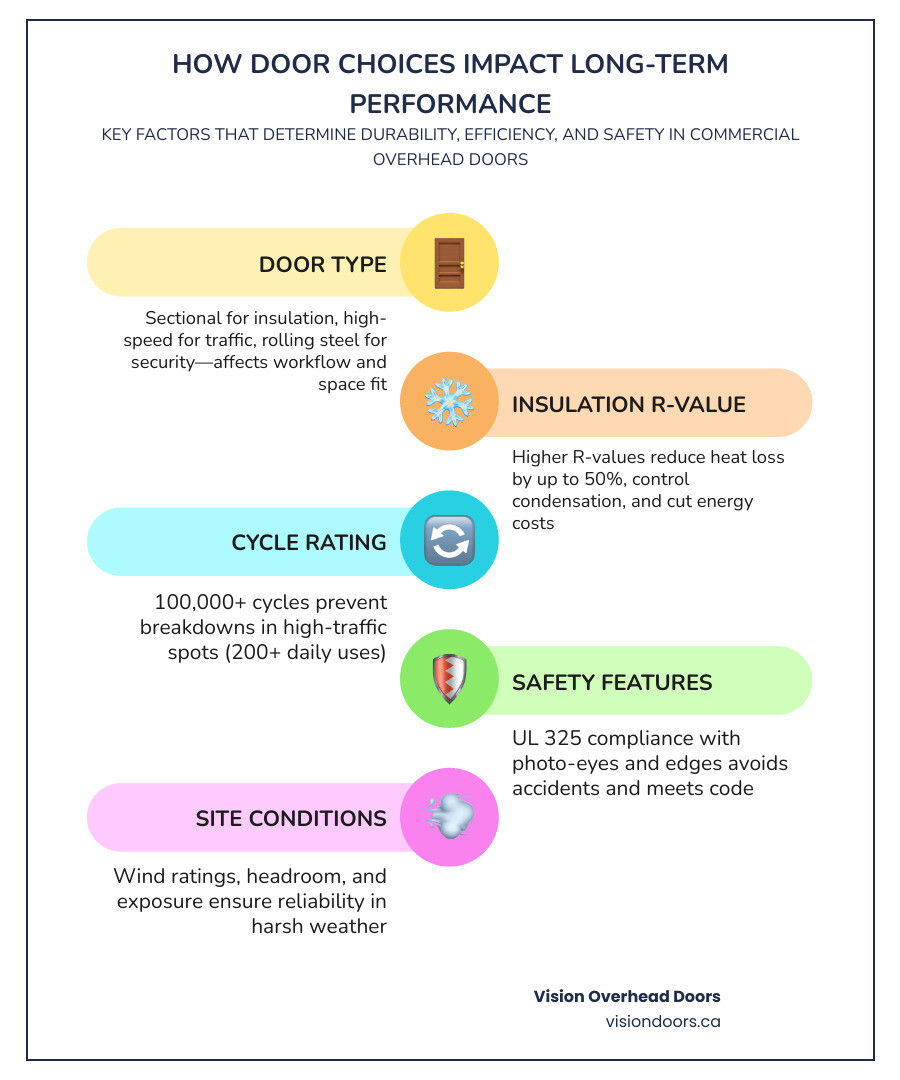
Choosing the right commercial overhead door for your business comes down to five key factors:
- Door type — sectional, rolling steel, high-speed, full-view, or fire-rated based on your operation
- Insulation (R-value) — critical for climate-controlled or temperature-sensitive spaces
- Cycle rating — commercial doors should handle at least 100,000 cycles for high-traffic use
- Safety compliance — UL 325 operators, photo-eye sensors, and NFPA 80 fire standards
- Site conditions — headroom, wind exposure, opening size, and daily traffic patterns
Every commercial facility in the Okanagan Valley has its own rhythm. A busy distribution warehouse cycling its doors 200 times a day has completely different needs than a boutique auto dealership focused on curb appeal and natural light. Yet every year, thousands of business owners treat their overhead door as an afterthought — something to figure out at the tail end of a build or renovation. According to industry estimates, over 600,000 new businesses open every year, and the commercial door decision is one of the most commonly overlooked choices during facility planning.
That oversight can be expensive. The wrong door slows workflow, drives up energy costs, creates safety risks, and wears out faster than it should. Commercial overhead doors are built to a fundamentally different standard than residential ones — they’re larger, thicker, more insulation-heavy, and engineered to handle the demands of daily business operations. Getting this decision right the first time means fewer repairs, lower energy bills, better security, and a door that keeps pace with your operation for years.
This guide walks you through everything you need to know — from assessing your facility’s needs to understanding materials, safety standards, and long-term costs — so you can make a confident, informed decision.
I’m Daryl Rands, owner of Vision Overhead Doors and a garage door professional with 26 years of hands-on experience in the Okanagan Valley, and choosing the right commercial overhead door for your business is one of the most common challenges I help clients navigate. I’ll share what I’ve learned from real-world installations across the region so you can avoid the pitfalls and find a door that genuinely works for your business.
Choosing the Right Commercial Overhead Door for Your Business Starts with Your Facility
Before we talk models, materials, or features, we need to talk about your building. The best commercial door on paper can still be the wrong choice if it does not fit your workflow, opening size, clearance, or environment.
Start with these questions:
- How many times will the door open and close each day?
- Will forklifts, cube vans, or larger trucks use the opening?
- Is the space heated, cooled, refrigerated, or dusty?
- Does the opening face customers?
- Is your business likely to grow, add shifts, or increase traffic?
A warehouse in Kelowna or Vernon may prioritize insulation, cycle life, and damage resistance. An auto shop in Armstrong may care more about visibility and a clean customer-facing look. An agricultural building near Salmon Arm or Enderby may need weather resistance, wider openings, and corrosion-conscious materials.
How to assess usage before choosing the right commercial overhead door for your business
Usage is one of the biggest decision drivers. In commercial doors, one cycle means one full open and close. That sounds simple, but businesses often underestimate how fast those cycles add up.
A door used 27 times per day reaches about 100,000 cycles in roughly 10 years. That is why commercial systems are built for far more use than residential doors. If your facility has peak shipping hours, multiple shifts, or repeated service-bay traffic, you may need high-cycle springs and heavier-duty hardware from day one.
When we assess usage, we look at:
- Daily cycle count
- Peak-hour traffic
- Number of employees using the opening
- Vehicle and equipment type
- Whether manual or motorized operation makes sense
For low-frequency storage spaces, a simpler setup may be fine. For loading docks, service bays, or production environments, motorized operation is usually the practical choice. Nobody wants staff wrestling a heavy door 40 times a day before lunch.
Space, layout, and site conditions that shape your options
Your building geometry matters more than many owners expect. Sectional doors travel on tracks and need overhead space. Rolling steel doors coil into a barrel above the opening and are often a good fit where ceiling space is limited.
Important site factors include:
- Opening width and height
- Headroom above the opening
- Side room for tracks or guides
- Backroom depth
- Roof slope or vertical-lift needs
- Wind exposure
- Moisture and corrosion risk
- Need to control air movement between spaces
In climate-controlled facilities, air transfer matters. Research tied to EPA guidance notes maintaining a garage-to-interior pressure differential of at least 45 Pa with doors closed can help reduce unwanted air movement. In plain English: better seals and proper installation help keep outside air where it belongs.

Matching security, visibility, and curb appeal to business goals
A commercial overhead door is not just a moving wall. It can also affect theft deterrence, employee comfort, customer impression, and brand image.
Think about the balance you need:
- Solid steel doors for security and privacy
- Glazed or full-view doors for natural light and visibility
- Security grilles where you want after-hours protection with sightlines
- Smart access control for staff-only entry points
Full-view doors can make retail, restaurant, and automotive spaces feel brighter and more open. On the flip side, a distribution or manufacturing facility may value privacy and impact resistance more than daylight. There is no universal best door – only the best fit for how your business actually works.
Commercial Door Types Explained by Performance and Best Use
There are several main commercial overhead door categories, and each shines in a different setting.
| Door type | Best for | Main strengths | Main trade-offs |
|---|---|---|---|
| Sectional | Warehouses, service bays, general commercial use | Versatile, good insulation options, durable | Needs ceiling track space |
| Rolling steel | Tight headroom, secure openings, loading docks | Compact coil, strong security, rugged | Typically less insulation potential than sectional |
| High-speed | Manufacturing, food, logistics, high-traffic openings | Fast cycle times, less air exchange, productivity | More specialized setup |
| Full-view | Auto shops, retail, showrooms, restaurants | Natural light, modern look, visibility | Less privacy, may not suit high-security needs |
Other important specialty types include fire-rated doors, security grilles, vinyl doors, and cold storage doors.
Sectional vs rolling steel: which design fits your building better?
Sectional doors are made of horizontal panels that ride up overhead tracks. They are a strong all-around choice for warehouses, fleet buildings, and service facilities because they can offer better insulation packages and flexible track layouts.
Rolling steel doors use interlocking slats that coil above the opening. They are often ideal when headroom is tight or when you need a compact, durable security solution.
In general:
- Choose sectional when you want versatility, stronger insulation options, and enough interior track space.
- Choose rolling steel when space is tight above the opening or when you want a compact, heavy-duty design.
For many loading docks and industrial buildings in the Okanagan, either can work well – but the building layout usually breaks the tie.
Choosing the right commercial overhead door for your business in high-traffic operations
If your operation has constant movement, speed matters. High-speed doors are designed to open and close quickly, reducing wait time, energy loss, and internal air exchange. Research suggests pairing high-speed doors with smart access systems can cut energy losses by 25% to 40% in the right environment.
These doors are especially useful in:
- Manufacturing facilities
- Distribution centres
- Food processing areas
- Cold storage transitions
- Emergency service buildings
Many high-speed models also have breakaway or impactable designs that help reduce downtime after accidental bumps. That matters when forklifts are involved, because forklifts and door openings have a long and complicated relationship.
Where full-view, insulated, and specialty doors make the most sense
Some businesses need more than a basic steel door.
- Auto shops and dealerships often benefit from full-view aluminum doors for visibility, natural light, and a polished appearance.
- Retail and restaurants may use full-view systems to create openness and improve curb appeal.
- Warehouses and temperature-sensitive spaces often need insulated sectional steel doors.
- Agriculture and equipment storage may need weather-resistant insulated steel with corrosion-conscious finishes.
- Freezer rooms and cold storage benefit from insulated specialty doors designed to limit air exchange.
- Security grilles work well for storefront protection where visibility still matters.
- Fire-rated doors are required in certain openings to slow the spread of fire and smoke.
If you want to explore options, our Commercial Overhead Doors page is a good place to start.
Materials, Insulation, and Durability: What Really Matters
Door type is only part of the decision. Material, insulation, finish quality, and hardware all affect performance over time.
Steel, aluminum, glass, and other material options
Steel is still the workhorse for many commercial applications. It is durable, secure, and available in insulated sandwich-panel designs. Aluminum is lighter and naturally more corrosion-resistant, making it popular for full-view doors and some moisture-prone environments.
Here is a simple breakdown:
- Steel
- Pros: strong, secure, dent-resistant, good insulation options
- Cons: can corrode if finish is damaged and maintenance is ignored
- Aluminum
- Pros: lightweight, rust-resistant, modern appearance
- Cons: dents more easily than steel
- Glass with aluminum framing
- Pros: visibility, daylighting, customer-friendly appearance
- Cons: less privacy, may not suit rough industrial use
- Fiberglass
- Pros: can offer a distinctive look and resist some corrosion issues
- Cons: needs maintenance to handle UV and weather over time
- Stainless steel
- Pros: excellent corrosion resistance for harsh or washdown settings
- Cons: typically chosen for specialized environments rather than general use
Weather seals also deserve more love than they get. Bottom seals, perimeter seals, and thermal breaks all help reduce drafts, moisture intrusion, and energy waste.
How insulation and R-value affect energy efficiency and comfort
R-value measures resistance to heat flow. The higher the R-value, the better the door resists heat transfer. If your building is heated, cooled, refrigerated, or simply trying not to feel like a giant oven in July, insulation matters.
Insulation helps with:
- Lower heat loss in winter
- Better cooling retention in summer
- Reduced HVAC strain
- Improved comfort near workstations
- Less condensation risk in some applications
- Better separation between interior zones
Insulated commercial doors can significantly reduce energy waste, and some research points to energy bill reductions of up to 30% in the right conditions. Just remember: high R-value alone is not enough. You also need quality perimeter seals, proper installation, and a door that closes consistently.
Polyurethane-insulated sandwich panels generally deliver stronger thermal performance than basic non-insulated designs. For conditioned spaces in the Okanagan, that can make a meaningful difference.
Wind load ratings, impact resistance, and long-term durability
Wind load and structural durability are not glamorous topics, but they are very important. Commercial doors may need to meet wind resistance requirements based on code, opening size, and building exposure.
Research referencing ANSI/DASMA testing and ASCE 7 wind design standards shows why this matters: the door must resist pressure loads without failing, deforming excessively, or compromising safety.
When durability is a priority, look at:
- Wind load rating
- Steel gauge and panel strength
- Track and hinge quality
- Spring design
- Corrosion-resistant finishes
- Impact resistance for forklifts and equipment traffic
Heavy-gauge steel, better hardware, and proper spring sizing usually pay off in reliability. In exposed areas around Lake Country, Kelowna, Vernon, and surrounding communities, weather and seasonal shifts are part of the design conversation, not an afterthought.
Safety Standards, Fire Requirements, and Professional Installation
A commercial door should not only work well – it should work safely and comply with applicable standards.
Safety features every automated commercial door should include
UL 325 is the key safety standard for automatic door operators. In practice, that means automated commercial doors should include proper entrapment protection.
Common safety features include:
- Photo-eye sensors
- Inherent reversal systems
- Reversing edges or safety edges
- Light curtains in higher-risk or busier openings
- Emergency manual release
Research also notes that manual release mechanisms have been required on commercial operators since 1993. If a power outage happens, staff still need a safe way to operate the door.
Sensor alignment and operator setup are not minor details. A misaligned safety device can cause nuisance shutdowns at best and create risk at worst.
Fire-rated door requirements for commercial facilities
Some commercial openings must be protected by fire-rated assemblies. These doors are designed to help contain fire and smoke long enough to support compartmentalization and safe evacuation.
Common fire ratings range from 20 to 180 minutes depending on the opening and code requirement. Fire doors should have:
- A visible permanent fire label
- A listed assembly
- Proper closing and release function
- Required inspections and testing
NFPA 80 governs installation, inspection, testing, and maintenance of fire doors. In Canada, annual fire door drop testing is an important part of compliance for many facilities. If your building requires a fire-rated door, this is not a place for guesswork.
Why professional installation is critical to choosing the right commercial overhead door for your business
Even the best door can underperform if installed poorly. Professional installation helps ensure:
- Correct spring sizing
- Proper track alignment
- Safe operator setup
- Sensor placement and testing
- Wind-load compliance
- Fire-door setup where required
- Better long-term reliability
- Protection of manufacturer warranty terms
This is why we always recommend working with experienced installers for Commercial Overhead Door Installation. Proper clearances, balance, and safety setup make a huge difference in day-to-day performance.
Maintenance, Cycle Ratings, Automation, and True Long-Term Value
The real value of a commercial door shows up over time – in uptime, repair frequency, energy performance, and how rarely your staff has to say, “The bay door is stuck again.”
How to choose the right cycle rating for your door
Cycle rating is one of the most overlooked specs. Many commercial applications should be looking at 100,000-cycle hardware, especially for frequent use. Research commonly contrasts commercial expectations with residential ones: about 100,000 cycles versus roughly 10,000 for residential systems.
A simple way to think about it:
- 25,000 cycles: lower-use openings
- 50,000 cycles: moderate commercial traffic
- 100,000+ cycles: high-use operations, multiple shifts, busy docks
If your business has seasonal spikes, plan for peak traffic, not average traffic. A door that is barely adequate in March may be completely overwhelmed in harvest season or holiday shipping season.
Recommended commercial door maintenance schedule
Preventive maintenance is cheaper in stress than emergency downtime. High-traffic doors should usually be professionally serviced quarterly. Lower-traffic doors should still have at least an annual inspection.
A good maintenance plan includes:
- Lubrication of moving parts
- Cable and spring inspection
- Roller and hinge wear checks
- Balance testing
- Track inspection
- Operator review
- Safety sensor testing
- Weather seal inspection
If you need help keeping doors reliable, we provide Commercial Overhead Door Repair and ongoing service throughout the Okanagan Valley.
Smart features that improve efficiency, safety, and control
Automation has come a long way from a basic wall button.
Useful smart and automated features include:
- Keypads
- Card or fob access
- Timers and scheduled closing
- Motion sensors
- Remote controls
- Touchless activation
- Monitoring alerts
- Integration with access systems
For the right operation, smart access can improve control and reduce wasted energy by limiting how long doors stay open. That matters in warehouses, food distribution, and conditioned spaces where every extra minute open means more air exchange.
Frequently Asked Questions About Choosing the Right Commercial Overhead Door for Your Business
Which commercial overhead door is best for warehouses, auto shops, manufacturing, and retail?
It depends on the workflow.
- Warehouses: insulated sectional steel or rolling steel, depending on layout and security needs
- Auto shops: full-view aluminum or insulated sectional doors, depending on appearance and visibility goals
- Manufacturing: high-speed doors for frequent traffic and environmental control
- Retail: full-view doors or security grilles where visibility and customer experience matter
Industry fit matters because commercial doors differ in speed, strength, insulation, and visibility. The wrong match can slow operations and raise maintenance demands.
How often should a commercial overhead door be serviced?
As a rule of thumb:
- High-traffic doors: quarterly
- Lower-traffic doors: annually
Doors with high daily cycles, forklifts, or harsh environments may need closer attention. Planned maintenance is the best way to catch wear before it becomes downtime.
For local tips, you can also read our Commercial Overhead Door Tips Vernon BC.
Can an older building be upgraded with a new commercial overhead door?
Yes, in many cases. Older facilities can often be retrofitted with:
- New insulated doors
- Upgraded operators
- Modern safety devices
- High-cycle spring systems
- Better seals and weather protection
The key is reviewing structural clearances, opening condition, operator compatibility, and current code requirements. Older buildings often benefit the most from modern door improvements because the original system may be under-insulated, under-protected, or simply worn out.
Conclusion
The right commercial overhead door supports workflow, protects your building, improves safety, and helps control energy loss. The wrong one does the opposite – usually at the worst possible time.
If you are still weighing options, we can help you sort through door types, cycle requirements, insulation levels, safety features, and installation details based on your actual building and usage. At Vision Overhead Doors, we provide local expertise, same-day service, and professional support across the Okanagan Valley.
To learn more about available solutions, visit our Commercial Overhead Doors page.