Can You Use a Residential Garage Door for a Business?
Can you use a residential garage door for a business — and do it legally and safely? Here’s the short answer:
It depends on how you’re using it.
- Low-traffic home-based businesses (like a home studio or bicycle workshop) may be fine with a residential door — provided you meet local zoning rules, HOA requirements, and insurance obligations.
- High-traffic or commercial operations (frequent deliveries, large vehicles, daily cycles exceeding typical residential use) will quickly overwhelm a residential door, leading to premature failure, voided warranties, and potential code violations.
- The key factors are daily cycle count, vehicle size, load weight, and whether your municipality classifies the space as commercial.
Think of it this way: a standard residential garage door is typically rated for 10,000 to 50,000 open/close cycles over its lifetime. A busy commercial operation can burn through that in just a few years — or less. Commercial doors, by contrast, are built to handle 100,000 to 500,000+ cycles, heavier structural loads, and stricter safety standards like UL 325 compliance.
That gap matters more than most people realize — and getting it wrong can cost you in repairs, insurance gaps, and legal headaches.
I’m Daryl Rands, owner of Vision Overhead Doors and a garage door professional with 26 years of experience serving the Okanagan Valley — including many homeowners and business owners who’ve asked exactly whether you can use a residential garage door for a business before making a costly mistake. In the sections ahead, I’ll walk you through everything you need to assess your situation clearly and make the right call.
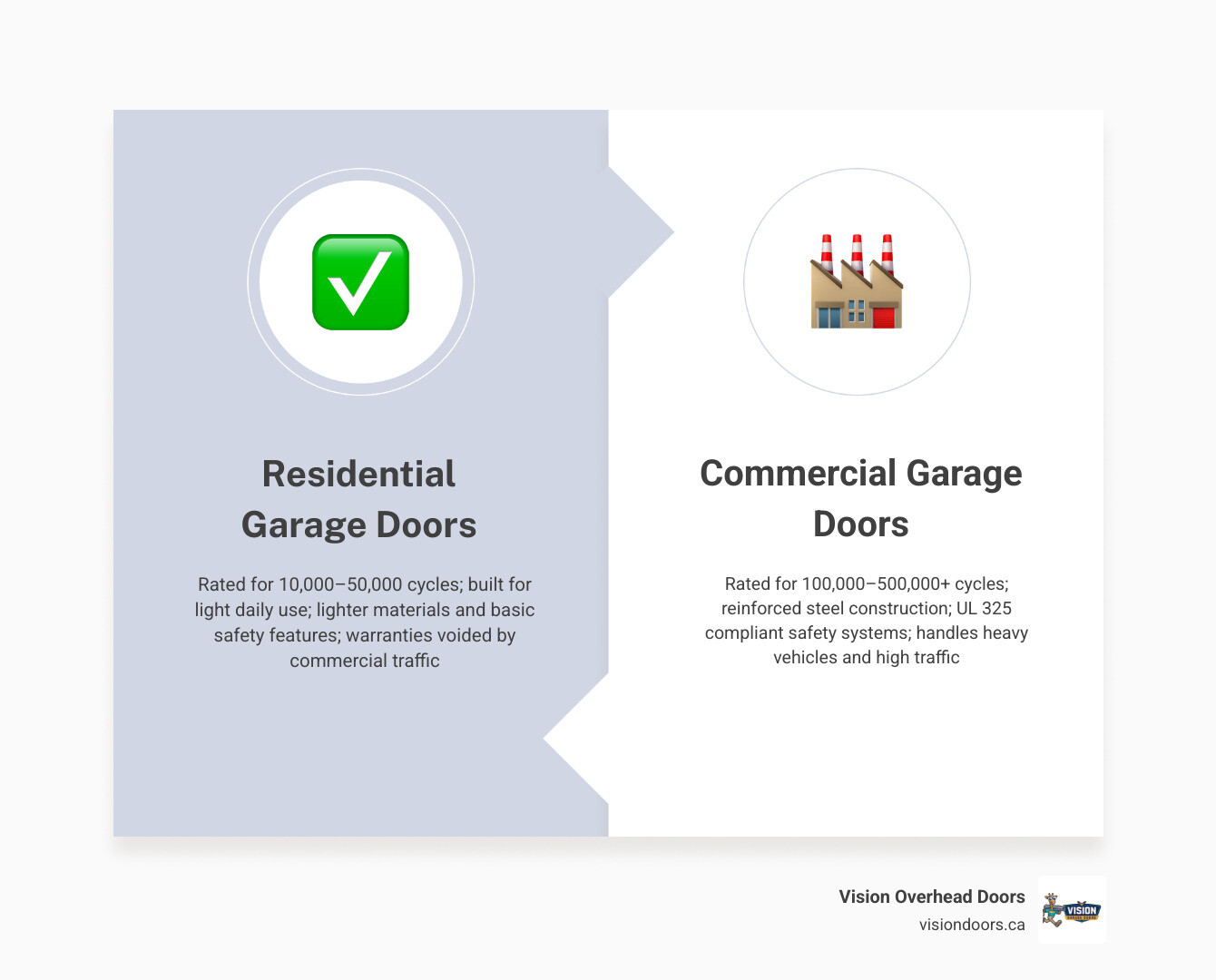
To help you visualize where your door selection fits into your business operations, we have broken down the primary physical and operational differences between residential and commercial systems:
| Feature Specification | Residential Garage Doors | Commercial Garage Doors |
|---|---|---|
| Typical Width Range | 8 to 16 feet | 12 to 32+ feet |
| Typical Height Range | 7 to 10 feet | 12 to 24+ feet |
| Weight Comparison | Standard (Light to Medium) | 3 to 5 times heavier than residential |
| Steel Gauge (Thickness) | 24 to 28-gauge (Thinner) | 16 to 24-gauge (Industrial strength) |
| Cycle Life Rating | 10,000 to 50,000 cycles | 100,000 to 500,000+ cycles |
| Motor / Opener Voltage | Standard 115V | High-voltage (220V/460V, three-phase) |
| Safety Standard Compliance | Basic residential sensors | UL 325 (Dual entrapment protection) |
| Primary Design Focus | Curb appeal, aesthetics, quietness | Durability, security, maximum uptime |
If you are currently evaluating your property in the Okanagan, transitioning from a home storage space to a commercial workspace requires careful planning. For a deeper dive into making this exact transition safely, read our guide on From Garages to Warehouses: Commercial Residential Overhead Door Installation in Vernon.
Understanding the Structural and Operational Differences
When you look at a residential garage door and a commercial overhead door side-by-side, they might look somewhat similar at a glance. However, under the hood, they are entirely different animals.
Commercial doors are engineered to be the workhorses of industrial facilities, warehouses, and shipping docks. They are constructed using heavy-duty, industrial steel or thick aluminum panels designed to withstand brute force and harsh weather conditions. The steel used in commercial doors is significantly thicker (often 16 to 22-gauge) compared to the thinner 24 to 28-gauge steel commonly found in residential panels.
This difference in material thickness directly impacts the door weight. A commercial door can weigh up to five times more than a standard residential door. Because of this massive weight, commercial systems require heavy-duty tracks, reinforced rollers, and industrial-grade torsion springs to lift them safely. Trying to support these industrial-weight loads on residential tracks is a recipe for structural failure.
Why Residential Doors Struggle with Commercial Traffic
If your business relies on vehicles entering and exiting throughout the day, a residential door will quickly show its limitations.
First, consider vehicle clearance. Standard residential doors are typically 7 to 8 feet high—perfect for an SUV or a sedan, but completely inadequate for delivery box trucks, transport vans, or forklifts. Commercial operations require taller, wider openings to ensure large vehicles can clear the opening without striking the header or the tracks.
Second, think about daily cycles. A standard residential garage door is opened and closed about 1,500 times a year (roughly 3 to 4 times a day). A commercial loading dock door, however, can easily open and close 50 times or more per day. If you put a residential door in that high-traffic environment, you will hit its lifetime cycle limit of 10,000 cycles in less than a year.
This rapid wear leads to premature failure of the springs, cables, and operator. Even worse, using a residential door in any commercial or high-use business setting will immediately void the manufacturer’s warranty. When the springs snap under the stress of commercial traffic, you will be on the hook for the full cost of repairs.
Legal and Zoning Requirements for Home-Based Businesses
Operating a business from your home changes how your property is viewed by local authorities. You cannot simply open a commercial shop in a residential neighborhood without ensuring you are legally compliant.
To keep your business running smoothly and legally in the Okanagan Valley, follow these essential compliance steps:
- Verify Local Zoning Bylaws: Check with your municipality (such as the City of Kelowna, City of Vernon, or District of Lake Country) to ensure home-based businesses are permitted in your specific zone.
- Apply for a Business Licence: Obtain a valid home occupation business licence from your local city hall.
- Review HOA and Strata Guidelines: If you live in an area governed by a homeowner’s association or strata council, review their bylaws regarding commercial activity, signages, and exterior modifications.
- Acquire Necessary Building Permits: If you plan to modify your garage door opening or upgrade the electrical system, apply for the required municipal building permits.
- Update Your Insurance Policies: Notify your insurance provider about your business operations to secure proper business liability coverage.
Failing to plan for these steps can result in heavy fines, forced closures, or denied insurance claims. To understand why having a clear plan for your facility’s entry points is so critical, check out our insights on Why Your Vernon Business Needs a Reliable Overhead Door Repair Strategy.
Local Building Codes and HOA Regulations
Local building codes and municipal bylaws are incredibly strict when it comes to the safety of commercial spaces. Even if your business is home-based, if you are inviting clients, employees, or delivery drivers into your garage workspace, that space may need to comply with commercial building codes.
For example, commercial spaces often require specific fire-rated separations between the garage and the main living areas. While rolling steel commercial doors can be rated for up to 4 hours of fire resistance, standard residential sectional doors are not typically fire-rated.
Furthermore, if your home is part of a Homeowners Association (HOA) or a strata development in areas like Predator Ridge or Adventure Bay, you must adhere to strict guidelines regarding exterior aesthetics. HOAs exist to maintain consistent curb appeal across the neighborhood. Installing a rugged, industrial-looking rolling steel door or adding prominent commercial signage to your garage door will likely violate HOA rules, leading to fines and legal demands to restore the original residential look.
Insurance and Liability Considerations
One of the biggest mistakes home-based business owners make is assuming their standard homeowners insurance policy covers their business activities.
It does not.
If a delivery driver is injured by a malfunctioning residential garage door while delivering inventory to your home-based business, your standard homeowners policy will likely deny the claim. Why? Because the accident occurred during a commercial activity.
To protect yourself, your property, and your clients, you must obtain a business insurance rider or a dedicated commercial general liability policy. Insurance adjusters will look closely at the equipment involved in any claim. If they discover you were using a residential-grade garage door for heavy commercial operations, they may argue that the door was subjected to negligent, off-label use, potentially leaving you personally liable for thousands of dollars in property damage or medical bills.
Comparing Performance: Residential vs. Commercial Overhead Doors
When selecting an overhead door for your business, performance metrics like cycle life, speed, and safety must guide your decision. In Kelowna, Vernon, and Armstrong, local businesses rely on these systems to secure their inventory, control indoor temperatures, and keep daily workflows moving.
For a comprehensive look at how commercial operators keep businesses running smoothly, read The Business Owner’s Guide to Commercial Garage Door Opener Installation in Kelowna.
Cycle Ratings and Durability Standards
When we talk about the lifespan of a garage door, we measure it in “cycles.” One cycle represents the door opening and closing once.
Residential garage doors are built with light-duty torsion springs designed to last between 10,000 and 50,000 cycles. For a typical family, a 10,000-cycle spring will last about 7 to 10 years. However, if your business operates high-volume shipping and receiving, those springs will wear out incredibly fast.
Commercial doors must comply with ANSI/DASMA 109 cycle testing standards, which require a minimum durability rating of 100,000 cycles, with heavy-duty rolling steel options easily exceeding 500,000+ cycles. These systems utilize massive, high-tensile steel springs designed to handle continuous daily stress. If your business relies on constant access, you need springs built for the job. If you are experiencing issues with your current setup in the North Okanagan, explore our specialized services for Commercial Garage Door Spring Repair in Vernon BC.
Safety Features and UL 325 Compliance
Safety is paramount in any business setting. Under federal and provincial regulations, all commercial door operators must comply with UL 325 safety standards.
UL 325 mandates that automatic commercial doors must feature dual entrapment protection systems. This includes:
- An inherent reversing mechanism (the motor reverses if it detects an obstruction).
- Secondary sensors, such as photoelectric eyes or pneumatic safety edges that stop the door instantly upon contact.
Residential openers have basic safety eyes, but they are not built to withstand the rugged environment of a commercial warehouse or auto shop where dust, moisture, and heavy machinery are present. If a worker or customer is injured by a door that does not meet these commercial safety standards, the legal and financial consequences can be devastating.
To ensure your business opener is safe and compliant, refer to Don’t Let a Broken Door Stop Business: Commercial Garage Door Opener Repair in Kelowna BC.
Insulation, Energy Efficiency, and Security
If your business involves storing temperature-sensitive inventory (like wine, food, or electronics) or if you heat your workshop during cold Okanagan winters, energy efficiency is a major priority.
- Insulation: High-quality sectional commercial doors utilize advanced polyurethane insulation injected between the steel skins, achieving impressive thermal performance (up to R-18). Rolling steel doors, because of their coiling design, usually max out around R-10.
- Weather Seals: Commercial-grade heavy-duty perimeter weather seals keep drafts, moisture, and pests out of your workspace, protecting your valuable business assets.
- Security: Residential doors are relatively easy to bypass using basic tools. Commercial doors provide superior protection against brute force entry. For retail environments or high-security storage, adding heavy-duty locking mechanisms or rolling security grilles ensures your business is protected after hours.
When Can You Use a Residential Garage Door for a Business?
Now that we have compared the two options, let’s look at the practical side. Is there ever a scenario where using a residential garage door for a business is acceptable? Yes, absolutely—but only under specific, low-demand conditions.
If you are looking to install a new system in Vernon or the surrounding areas, we can help you choose the ideal opener for your setup. Read more about your options in Beyond Residential: Commercial Garage Door Opener Installation Solutions in Vernon.
Acceptable Low-Traffic Business Scenarios
If you operate a quiet, low-traffic business out of your residential property, a high-quality residential garage door is often the best choice. Excellent examples include:
- A professional home studio (for photography, graphic design, or painting).
- A low-volume bicycle workshop or artisan craft space.
- A home office where clients occasionally visit but do not bring heavy vehicles.
In these scenarios, the door is only opening a few times a day. A residential door is perfect here because it preserves the residential aesthetics of your home, operates quietly (especially if you choose a belt-drive opener with nylon rollers), and provides excellent insulation to keep your workspace comfortable.
When to Upgrade to a Commercial-Grade System
If your business operations expand beyond occasional personal use, you must upgrade to a commercial-grade system. You need to make the switch if your business involves:
- Heavy Machinery: If you are moving forklifts, pallet jacks, or tractors in and out of the space.
- High Traffic: If the door opens and closes more than 10 to 15 times per day.
- Large Vehicles: If delivery trucks, cube vans, or commercial transport vehicles need to enter the building.
- Stricter Codes: If local municipal codes require fire-rated assemblies or specific wind-load ratings for your commercial property.
In these cases, installing a commercial sectional steel or rolling steel door is the only way to ensure safety, legal compliance, and operational efficiency. If you are ready to make the upgrade in Kelowna, check out our Commercial Overhead Door Installation Kelowna Guide for expert advice.
Frequently Asked Questions
Can you use a residential garage door for a business if it is home-based?
Yes, you can use a residential garage door for a home-based business, provided the daily traffic is light and you do not require large commercial vehicles to enter the garage. You must also ensure that your home occupation complies with local municipal zoning laws and any HOA guidelines regarding exterior aesthetics.
What happens to my warranty if I use a residential door for commercial purposes?
If you install a residential garage door in a commercial facility or use it for high-volume commercial operations, the manufacturer will immediately void the warranty. Residential warranties are strictly written for single-family residential use. If a spring or panel fails under commercial stress, you will have to pay for the repairs out of pocket.
Can you use a residential garage door for a business with high daily traffic?
No, it is highly discouraged. A residential door is not built to handle the physical weight or the continuous open/close cycles of a busy business. Attempting to use a residential door for high-traffic operations will lead to premature wear, frequent breakdowns, safety risks, and potential code violations. You should always invest in a commercial-grade upgrade for high-cycle environments.
Conclusion
So, can you use a residential garage door for a business? If your business is a quiet, low-traffic home occupation, a residential door is a fantastic, aesthetic, and energy-efficient choice. But if your business involves heavy vehicles, frequent daily cycles, or strict building code compliance, a commercial-grade system is a legal and operational necessity.
At Vision Overhead Doors, we have spent over two decades helping homeowners and business owners across the Okanagan Valley make the right choice for their properties. Whether you are in Salmon Arm, Enderby, Armstrong, Vernon, Lake Country, or Kelowna, we provide expert, same-day service, competitive pricing, and industry-leading products.
Don’t guess when it comes to the safety and legality of your business. Explore Commercial Overhead Doors and contact us today for a professional consultation to find the perfect door system for your unique needs!