Why Your Garage Door Decision Deserves More Thought Than Most Homeowners Give It
Knowing how to choose the right garage door for your home is more important than it might seem at first glance. Your garage door covers up to 30–40% of your home’s front-facing exterior — making it one of the single biggest visual elements on your property. Get it right, and it elevates your entire home. Get it wrong, and it’s hard to ignore every time you pull into the driveway.
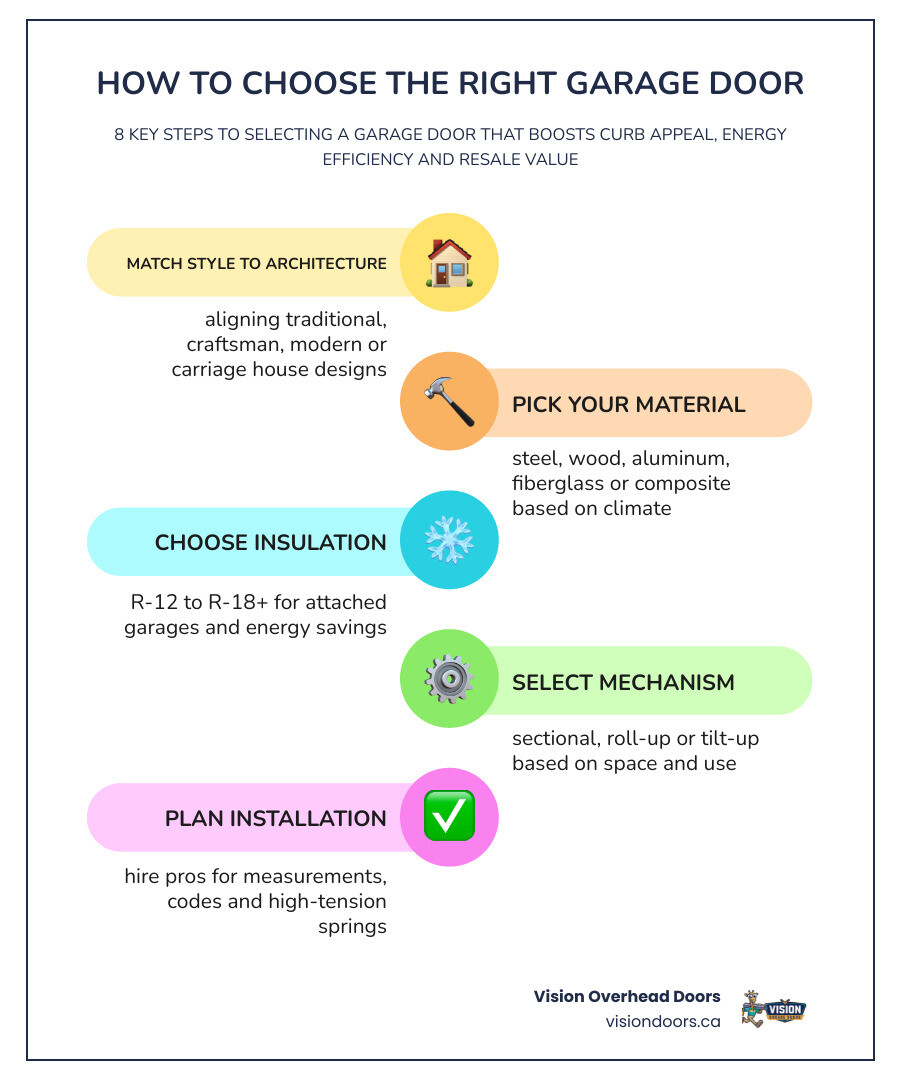
Here is a quick overview of the key steps to choosing the right garage door:
- Match the style to your home’s architecture — traditional, craftsman, modern, farmhouse, or carriage house
- Choose your material — steel, wood, aluminum, fiberglass, or composite, based on your climate and maintenance preferences
- Select the right insulation level — look for R-12 to R-18+ for attached garages; higher R-values mean better energy efficiency
- Pick the right opening mechanism — sectional doors are the most common and practical choice for most homes
- Measure your opening accurately — width, height, headroom, side room, and backroom all matter
- Factor in security and smart features — rolling code technology, auto-reverse sensors, and smart openers add safety and convenience
- Understand local building codes — wind-load requirements and fire-rating rules may affect your options
- Plan for professional installation — high-tension springs make this a high-risk DIY project
The stakes are real. Garage door replacement consistently ranks among the top home improvement projects for return on investment, with some reports showing returns of over 100% at resale. And with the average homeowner opening and closing their garage door around 1,500 times a year, the right choice pays off in comfort, energy savings, and curb appeal for decades.
I’m Daryl Rands, owner of Vision Garage Doors and a Red Seal Carpenter with 26 years of experience helping Okanagan Valley homeowners figure out how to choose the right garage door for your home — from matching styles to navigating local building codes. In this guide, I’ll walk you through every decision point so you can feel confident before you buy.
Matching Aesthetics: How to Choose the Right Garage Door for Your Home

A garage door shouldn’t just plug a hole in your wall; it should complement the architectural language of your entire home. Think of it as a design feature that ties together your siding, entry doors, trim, and roofline. When these elements work in harmony, they create a powerful visual impact that dramatically boosts curb appeal.
Architectural Harmony: How to Choose the Right Garage Door for Your Home
The secret to visual harmony is selecting a door style that echoes the lines and details of your home’s existing architecture. A mismatch can look like wearing running shoes with a tuxedo. Let’s break down the most popular home styles in British Columbia and the garage doors that suit them best:
- Traditional Homes (Colonial, Cape Cod, Ranch): These classic designs are best served by traditional raised-panel or flush-panel steel doors. Symmetrical panels add clean, structured lines that blend seamlessly with classic siding and brickwork.
- Craftsman Bungalows: Known for their hand-crafted details, tapered columns, and exposed rafters, Craftsman homes look beautiful with carriage-house doors or doors featuring clean vertical lines, rectangular window inserts, and elegant, simple hardware.
- Modern & Contemporary Architecture: If your home features flat roofs, large windows, and minimalist design, a full-view aluminum and glass door is an exceptional match. Alternatively, clean flush panels with asymmetrical, long-panel windows can emphasize modern horizontal lines.
- Farmhouse & Rustic Properties: Modern farmhouse designs are incredibly popular throughout the Okanagan. They are perfectly complemented by carriage-house doors featuring prominent “X” or “V” bracing, rustic hardware, and barn-door paneling.
Investing in a door that matches your architecture does more than please your eye—it protects your home’s equity. In fact, real estate data shows that up to 80% of buyers consider the garage a major decision influencer when buying a home, and 70% of realtors agree that an updated garage door helps sell a home faster. To understand the long-term value of this upgrade, read our detailed guide on Why a New Garage Door is Your Best Bet for Resale Value.
Customization: Windows, Colors, and Decorative Hardware
Once you have identified the base style, the magic lies in the details. Customization allows you to fine-tune your door so it looks uniquely yours.
- Window Inserts & Glass Options: Windows do double duty. They break up the solid mass of a large door and flood your dark garage interior with natural light. You can choose from clear glass, frosted glass (for privacy), tinted glass, or even insulated glass panels. For security, placing windows in the top panel only is a smart way to let light in while keeping your belongings out of sight.
- Strategic Color Selection: Should your garage door match your front door? Not necessarily, but they should belong to the same color family. If your garage faces south and receives intense Okanagan sun, choosing light, neutral, or earthy tones will help prevent heat absorption and UV fading. Many premium manufacturers offer custom color matching to ensure your door aligns perfectly with your home’s trim.
- Decorative Hardware: Magnetic or bolt-on handles, hinges, and clavos can instantly transform a simple panel door into an authentic-looking carriage-house classic.
Every design decision you make—from window counts to material finishes—plays a role in the final aesthetic and performance of your door. To learn more about how design choices interact, explore our analysis on The Price of Style: How Materials and Customization Impact Costs.
Selecting the Best Garage Door Materials for Durability and Maintenance
The material you choose determines how your door stands up to the elements, how much effort you will spend maintaining it, and how long it will last. In British Columbia, where climates can range from damp coastal winters to hot, dry Okanagan summers, choosing the right material is critical.
Material Performance: How to Choose the Right Garage Door for Your Home
Let’s look at the strengths and considerations of the most common garage door materials:
- Steel: The most popular choice for a reason. Steel doors are incredibly strong, highly durable, and require minimal upkeep. For a long-lasting, dent-resistant door, look for heavy-duty 24-gauge steel rather than thinner, economy-grade 25-gauge options. Steel doors are multi-layered, allowing for excellent insulation, and they can be painted or finished with faux-wood coatings that mimic the real thing.
- Natural Wood: Nothing matches the rich warmth and high-end beauty of real cedar, redwood, or fir. However, natural wood requires a serious commitment. The freeze-thaw cycles and intense UV rays in BC mean you must sand, seal, or paint a real wood door every 2 to 3 years to prevent warping, cracking, and rot.
- Aluminum and Glass: Highly resistant to rust and corrosion, aluminum is lightweight and perfect for full-view glass doors. They are ideal for modern designs, though they offer less natural insulation unless paired with insulated glass and thermally broken frames.
- Fiberglass and Wood Composites: These materials offer the stunning texture of real wood grain without the heavy maintenance. Composite overlays are typically built over a durable steel and polyurethane core, giving you the best of both worlds: high-performance insulation and a rustic, rot-proof exterior.
To dive deeper into the pros and cons of each option, check out our resource on The Tough Truth About the Best Garage Door Materials.
Material Comparison
| Material | Durability | Maintenance Level | Insulation Potential | Best Suited For |
|---|---|---|---|---|
| Steel | High | Low (Occasional wash) | Excellent (Triple-layer) | All climates; busy families wanting durability |
| Natural Wood | Moderate | High (Refinish every 2–3 years) | Moderate | Custom traditional or rustic luxury homes |
| Aluminum | High | Low | Low to Moderate | Modern, contemporary designs; coastal areas |
| Composite | High | Low to Moderate | Excellent | Homeowners wanting a wood look with zero rot risk |
Understanding Insulation, R-Value, and Climate Control
If your garage is attached to your home, shares a wall with a living space, or has a bedroom above it, insulation is not an optional luxury—it is a necessity. An uninsulated garage door acts as a giant radiator, letting winter cold and summer heat seep directly into your home.
Deciphering R-Value and Insulation Types
When shopping for an insulated door, you will constantly see references to R-value. Simply put, R-value measures a material’s thermal resistance—its ability to stop heat from moving through it. The higher the R-value, the better the door is at keeping your garage comfortable.
There are two primary types of insulation used in garage doors:
- Polystyrene: This is rigid foam paneling inserted into the door sections. It provides moderate insulation (typically R-9) and is a budget-friendly option.
- Polyurethane: This is a liquid foam injected directly into the door’s steel cavity. As it expands, it bonds tightly to the steel skins, filling every crevice. Polyurethane delivers nearly double the insulating power of polystyrene in the same thickness (often reaching R-12 to R-18+). It also acts as a structural glue, making the door incredibly rigid, dent-resistant, and noticeably quieter.
To understand how these ratings apply to our regional climate, explore our guide on All About R-Value in Garage Doors for Vancouver Homes.
Why You Might Want to Pay More for an Insulated Door
While an insulated door requires a slightly higher upfront investment, it pays dividends in several practical ways:
- Energy Savings: An insulated garage door can reduce heat loss through your garage by up to 70%. This helps stabilize temperatures in adjacent living spaces, saving homeowners up to 20% on annual heating and cooling costs.
- A Quieter Home: Polyurethane dampens street noise and eliminates the loud, hollow rattling sound of cheap, uninsulated doors when they open and close.
- Structural Integrity: Triple-layer doors (steel + insulation + steel) are solid-core doors. They resist dents from stray basketballs and hold up far better against heavy winds.
To see if this upgrade makes sense for your property, read Why You Might Want to Pay More for an Insulated Door. Furthermore, if you are planning a broader home upgrade, you can learn how to offset your costs by reading our guide on How to Get Paid for Your Reno with BC Energy Rebates.
Technical Specifications: Opening Mechanisms, Measurements, and Security
Beyond colors and materials, a garage door is a heavy piece of machinery. To ensure it operates safely and fits your space perfectly, you must understand the mechanical and structural details.
Opening Mechanisms and Spring Systems
How your door opens dictates how much space you have inside and outside your garage.
- Sectional Doors: The standard for modern homes. These doors consist of horizontal panels connected by hinges. As the door opens, rollers travel along tracks, and the door nests flat against the ceiling. They provide excellent sealing and are highly space-efficient.
- Roll-Up Doors: Common in commercial settings but used in some residential spaces with limited headroom. The door rolls around a drum located above the opening.
- Tilt-Up / Canopy Doors: Older single-panel doors that pivot outwards and up. These are rarely installed today as they require significant clearance in the driveway and seal poorly compared to sectional doors.
Behind every door is a spring system that does the heavy lifting. This is the “muscle” of your door, and it comes in two types:
- Torsion Springs: Mounted on a metal rod directly above the door opening. They twist and unwind to lift the door smoothly, distributing weight evenly. Torsion springs are safer, last longer (usually rated for 10,000 to 20,000 cycles), and are highly recommended.
- Extension Springs: Mounted along the sides of the horizontal tracks. They stretch and contract to lift the door. Because they operate under intense tension and can fly off if they break, they require safety cables to contain them.
To learn more about how these essential mechanical parts keep your door moving, read Torsion vs Extension: A Guide to Your Garage Door’s Muscle.
Measuring and Local Building Codes
Before ordering a door, you must take precise measurements of your garage opening. Do not simply measure your old door; measure the physical opening itself:
- Rough Opening (Width & Height): Measure the inside width and height of the door frame.
- Side Room: The distance from the edge of the opening to the side wall (needed for track mounting; usually 3 to 4 inches minimum).
- Headroom: The space from the top of the opening to the ceiling (needed for the springs and curved tracks; typically 10 to 12 inches is required for standard installation).
- Backroom: The distance from the opening to the back wall of the garage (must be equal to the door height plus at least 18 inches).
Additionally, building codes in British Columbia regulate structural safety. If your garage is attached to your home, you must comply with strict fire-separation rules. This includes ensuring that any shared walls or access doors meet fire-resistance ratings. To make sure your project is fully compliant, check out The Homeowner’s Guide to Fire Rated Garage Door Requirements in BC.
Security and Smart Features
As the largest entry point to your home, your garage door must be secure. Modern doors and openers offer advanced safety and security features to protect your family and belongings:
- Rolling Code Technology: Older openers used fixed codes that thieves could easily intercept with code-grabbers. Modern openers change the access code every single time you press the button, rendering code-grabbing impossible.
- Auto-Reverse Sensors: Standard on all modern systems, these photo-eye sensors project an invisible beam across the bottom of the door. If a child, pet, or object breaks the beam while the door is closing, the door instantly stops and reverses.
- Smart Openers: Today’s smart openers connect to your home’s Wi-Fi, allowing you to monitor and control your door from anywhere via an app. You can receive real-time alerts if the door is left open, set auto-close timers, and grant temporary access to delivery drivers or guests.
- Battery Backup: In the event of a power outage during a winter storm, a built-in battery backup ensures your automatic opener still works, keeping you from getting locked out in the cold.
Frequently Asked Questions About Garage Door Selection
What is the best low-maintenance garage door material?
If your priority is low maintenance, steel and wood composite are your best options. High-quality steel doors with a baked-on, factory-applied paint finish require nothing more than an annual wash with mild soap and water. Wood composites offer the rich, textured look of natural wood but are built over a steel frame, meaning they will not rot, warp, or require periodic sanding and restaining.
Do I need an insulated garage door if my garage is detached?
While insulation is most critical for attached garages, it is still highly beneficial for detached garages. If you use your detached garage as a workshop, home gym, or storage space for temperature-sensitive items (like paints, tools, or vehicles), an insulated door helps regulate the temperature. Furthermore, the added structural rigidity of a triple-layer insulated door makes it much more durable and resistant to wind damage and break-ins.
Can I install a new garage door myself?
We strongly advise against DIY garage door installation. A garage door is the largest, heaviest moving object in your home, weighing anywhere from 100 to over 300 pounds. The torsion springs that balance this weight hold immense, potentially lethal tension. One slip of a winding bar can cause severe injury or property damage. Professional installers have the specialized tools, training, and experience to install the door safely, level it perfectly, and calibrate the opener so your door operates reliably for decades.
Conclusion
Choosing a new garage door is an investment that shapes your home’s curb appeal, energy efficiency, and security for years to come. By taking the time to match your home’s unique architecture, select the right durable materials, and understand essential technical details like R-values and spring systems, you can make a choice you will be happy with every time you pull into your driveway.
At Vision Doors & Windows, we are proud to serve homeowners across the Okanagan Valley—including Kelowna, Lake Country, Vernon, Salmon Arm, and surrounding communities. We combine premium, custom products with the local expertise and high-quality craftsmanship of Red Seal certified installers.
If you are ready to find the perfect door for your home, we are here to help. To ensure you partner with a team you can trust, read our guide on Don’t Get Stuck: How to Choose the Right Garage Door Service for You. If you are evaluating your options, bring along our checklist of 10 Smart Questions to Ask a Garage Door Company.
Ready to get started? Explore our premium custom garage doors or contact us today to schedule your personalized consultation.