Your Garage Door Is Telling You Something — Are You Listening?
When should you replace your garage door? Here’s the short answer:
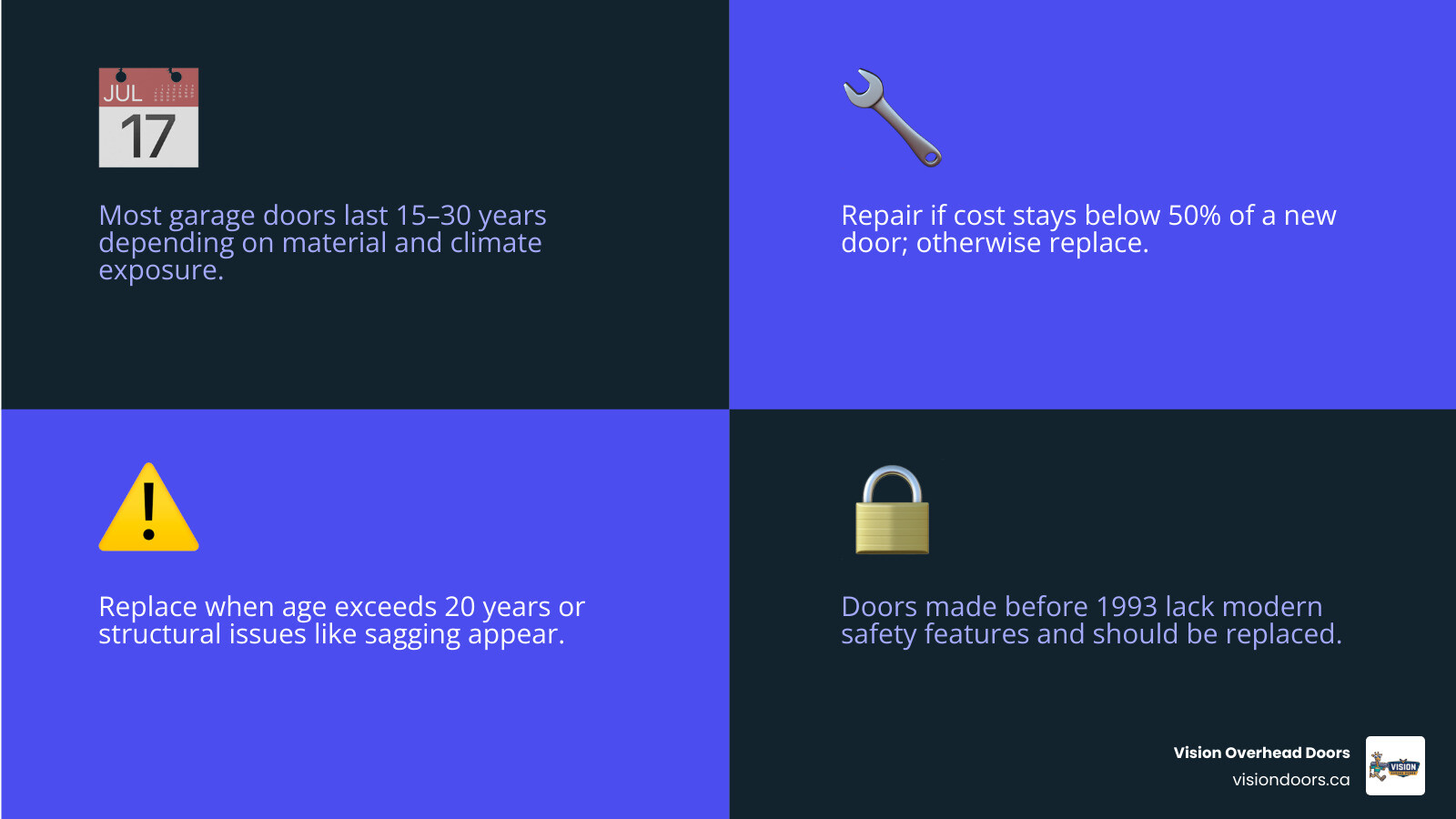
- Age over 15–20 years with frequent repairs → replace
- Repair cost exceeds 50% of a new door’s cost → replace
- Structural sagging, severe rust, or multiple damaged panels → replace
- Missing modern safety features (pre-1993 doors) → replace
- Three or more repairs in the past two years → replace
- Under 10 years old with a single component failure → repair
Your garage door is the largest moving part of your home — and for many homeowners, it’s the entry point they use every single day. Yet most people don’t give it a second thought until something goes wrong. By then, the decision is rushed, stressful, and sometimes costly.
Here’s something worth knowing: garage doors open and close roughly 1,500 times a year. That’s a lot of wear on springs, cables, rollers, and panels — and it adds up fast. A door that looks fine on the outside may be quietly wearing out where you can’t see it. And when a door fails, it’s not just an inconvenience. It’s a security gap, a safety risk, and often a bigger repair bill than if you’d caught it earlier.
Whether you’re noticing strange noises, slower movement, or a door that just doesn’t look the way it used to, this guide will walk you through exactly what to watch for — and when it makes more sense to repair versus replace.
I’m Daryl Rands, owner of Vision Overhead Doors, and with 26 years of experience in the garage door industry across the Okanagan Valley, I’ve helped countless homeowners figure out when should you replace your garage door before a small problem becomes a major one. Let’s walk through everything you need to know to make a confident, informed decision.
When should you replace your garage door terms you need:
Understanding the Lifespan of Your Garage Door System
Like any hardworking mechanical system, your garage door has a natural lifespan. Under normal operating conditions and with regular preventative maintenance, a high-quality residential garage door typically lasts between 15 and 30 years. However, this is a broad window, and several key variables determine where your door will fall on this spectrum.
The material of your door plays a major role in its longevity. Steel doors are incredibly versatile and durable, often pushing past the 20-year mark with minimal fuss, provided they are kept clean and free of rust. Wood doors, while offering unmatched natural beauty and high-end curb appeal, require diligent maintenance to prevent rotting, warping, and moisture damage. If neglected, a wood door’s lifespan can drop significantly, especially when exposed to the intense weather patterns we experience here in the Okanagan Valley.
Climate is another major factor. From hot, dry summers in Kelowna and Vernon to freezing, snowy winters in Salmon Arm and Enderby, our local weather puts immense physical stress on garage door materials. The constant freeze-thaw cycles cause materials to expand and contract, which can warp panels, degrade weather seals, and accelerate the wear on moving hardware. To dive deeper into how your door holds up over the long haul, check out our insights on Will Your Garage Door Outlive Your Car?
Lifespan of Garage Door Openers
While the physical door panels might last a quarter of a century, the automatic opener has a shorter service life. On average, a garage door opener lasts between 10 and 15 years.
The longevity of your opener is directly tied to usage frequency and the health of the door’s balance system. The opener doesn’t actually do the heavy lifting—that is the job of the torsion or extension springs. If the springs are worn out or improperly tensioned, the door becomes heavy and unbalanced. This forces the opener’s motor to work twice as hard, leading to premature motor burnout, stripped gears, and snapped belts or chains.
To help you track the health of your motor, we have put together The Ultimate Checklist for Garage Door Opener Lifespan.
Types of Garage Door Openers and Their Durability
When evaluating your system, the mechanism of your opener dictates how long it will last and how quietly it will run:
- Chain-Drive Openers: These are the classic workhorses of the industry. They use a metal chain to pull the door along a track. While incredibly strong and long-lasting, they are also the noisiest option. Over time, the chain can slacken and require tension adjustments.
- Belt-Drive Openers: Utilizing a reinforced rubber, polyurethane, or fiberglass belt, these systems operate almost silently. They are highly durable and perfect for homes with bedrooms adjacent to or directly above the garage.
- Screw-Drive Openers: These systems use a threaded steel rod to move the trolley. Because they have fewer moving parts, they are historically reliable, though they can struggle in regions with extreme temperature fluctuations as the lubricating grease thickens in the cold.
- Jackshaft (Wall-Mount) Openers: Mounted on the wall beside the garage door shaft rather than overhead, these systems are incredibly durable and free up valuable ceiling space. They are ideal for high-lift doors or garages with cathedral ceilings.
- Torsion Springs: While not an opener type, these are the mechanical muscles of your system. Typically rated for 10,000 cycles (one cycle is a single opening and closing), they generally last 6 to 10 years based on average daily use. High-durability springs can last up to 25,000 cycles.
When Should You Replace Your Garage Door vs. Repair It?
Deciding whether to call for a repair or invest in a full replacement is a common dilemma for homeowners. To make an objective, stress-free decision, we recommend using the 50% Rule.
If a technician provides a repair quote that exceeds 50% of the cost of a brand-new garage door system, replacement is almost always the smarter long-term investment. Sinking significant funds into an aging door is often like putting a temporary patch on a sinking ship; once one old component fails, the next one is usually not far behind.
Beyond the numbers, structural issues should guide your choice. Visible structural sagging when the door is disconnected from the opener is a clear sign of systemic fatigue. Similarly, if multiple panels are dented, warped, or rusted through, the structural integrity of the entire door is compromised, and a replacement is required. For a quick diagnostic look, review our guide on Five Signs You Need Garage Door Repair.
When to Choose Repair for Your Garage Door
Many common garage door issues look and sound terrible but are actually simple, routine repairs. You do not need to replace your entire door for isolated hardware failures.
Standard components like broken torsion springs, snapped lift cables, worn-out rollers, and bent hinges are designed to be replaced independently. If your door panels are in great structural shape and the door is under 15 years old, replacing these moving parts will quickly restore smooth, safe operation. Even a single damaged panel can often be swapped out if the door manufacturer still produces that specific model. To understand the balance between fixing individual parts and investing in a new system, read The Real Cost of a New Garage Door.
Key Indicators for When Should You Replace Your Garage Door Entirely
There are times when a repair is simply delaying the inevitable. If your garage door is pushing past 20 years of daily service, it has officially reached retirement age.
Other clear signs that a full replacement is necessary include severe bottom-rail rust, structural warping that prevents the door from sealing flat against the floor, and obsolete hardware that is no longer sourced by manufacturers. Additionally, if your garage door lacks modern safety mechanisms, upgrading is the only way to protect your family and pet. When you are ready to explore your options, our team is here to guide you through a seamless Garage Door Installation.
Warning Signs Your Garage Door Opener Needs Replacement
Your garage door opener rarely fails without warning. It will usually drop hints—sometimes very loudly—that its working days are numbered. Recognizing these warning signs early can prevent you from getting stuck inside (or outside) your garage at the worst possible moment.
- Unusual Noises: While no opener is completely silent, a sudden onset of grinding, squealing, or heavy rattling indicates worn-out internal gears or motor strain.
- Slow Movement: If your door takes significantly longer to open or close than it used to, the motor winding may be failing, or the internal gears are slipping.
- Constant Vibration: If the opener housing vibrates violently while operating, the motor brackets may be warping or the internal shaft is bent. This vibration can eventually shake the unit loose from its ceiling mounts.
- Unpredictability: A door that reverses direction halfway through a cycle, opens on its own, or ignores remote commands is a major security and safety hazard. This often points to failing circuit boards or degraded wiring.
- Safety Sensors: If your door does not automatically reverse when an object blocks the photo-eye sensors, your system is unsafe.
- Pre-1993 Safety Standards: Any opener manufactured before 1993 lacks mandatory auto-reverse safety sensors. If you have one of these legacy systems, it should be replaced immediately to comply with modern safety standards.
The Dangers of DIY Garage Door Repairs and Replacements
In the era of online video tutorials, it is tempting to try and tackle garage door repairs yourself. However, we cannot emphasize this enough: garage door repair and replacement is not a safe DIY project.
Your garage door is the heaviest moving object in your home, often weighing between 150 and 250 pounds. What makes it truly dangerous, however, is the immense tension stored within the spring system. Torsion springs are wound under extreme mechanical force to counterbalance the door’s weight. One slip of a winding bar or the wrong turn of a wrench can release that energy instantly, causing severe, life-altering injuries or death.
Nationwide statistics show that garage door accidents result in 20,000 to 30,000 injuries every year. From crushed fingers and lacerations to falling doors caused by snapped cables, the risks are incredibly high. Professional technicians undergo years of training and use specialized, heavy-duty tools to handle these high-tension components safely. For peace of mind and guaranteed safety, always trust the experts. Learn more about choosing the right team in our guide on the Best Garage Door Installation in Vernon BC.
Maximizing Your Investment: Maintenance and Upgrades
Replacing an old, worn-out garage door is not just a maintenance expense—it is a high-yield investment in your home. In fact, real estate data consistently ranks garage door replacement as one of the top home improvement projects for return on investment (ROI), often returning nearly 94% (and sometimes over 100%) of its cost in added home value. Because your garage door can make up to 30% of your home’s street-facing facade, upgrading it completely transforms your property’s curb appeal.
Beyond aesthetics, a modern insulated door pays immediate dividends in comfort and energy efficiency.
| Feature | Old, Non-Insulated Garage Door | Modern Insulated Garage Door |
|---|---|---|
| Energy Efficiency | High thermal loss; drafts and cold air drafts | R-value insulation (R-12 to R-18); lowers utility bills |
| Noise Level | Loud mechanical rattling and vibration | Smooth, whisper-quiet operation |
| Security | Vulnerable lock mechanisms; easily bypassed | Rolling code tech; smart monitoring & alerts |
| Durability | Prone to warping, denting, and rust | Multi-layer steel; weather-resistant coatings |
Upgrading to a modern insulated door can reduce thermal loss through an attached garage by up to 20%, keeping your home warmer in the winter and cooler during our hot Okanagan summers. Plus, modern smart openers allow you to monitor, open, and close your door from anywhere in the world using your smartphone. To see how a new door impacts your property value, read Why a New Garage Door is Your Best Bet for Resale Value.
Essential Maintenance Tasks to Extend Lifespan
You do not have to sit back and watch your investment degrade. Performing simple, regular maintenance checks twice a year will keep your system running smoothly and safely:
- Annual Lubrication: Apply a high-quality, silicone-based garage door lubricant to the rollers, hinges, tracks, and springs. Avoid grease, which attracts dust and abrasive grit.
- Balance Testing: Disconnect your opener by pulling the red emergency release cord. Manually lift the door halfway and let go. A perfectly balanced door should stay in place. If it falls or shoots upward, the springs need professional adjustment.
- Sensor Alignment: Clean the photo-eye lenses with a soft cloth and ensure they are pointed directly at each other.
- Hardware Tightening: Because of the constant vibration of the door, track bolts and hinge screws can back out over time. Take a wrench and tighten any loose hardware.
For a comprehensive walkthrough on keeping your door in top shape, check out The Easiest Way to Extend the Life of Your Garage Door.
How Often to Schedule Professional Service and When Should You Replace Your Garage Door Components
While DIY maintenance is fantastic for day-to-day care, your garage door system should be professionally serviced once a year.
During an annual service visit, our experienced technicians perform an in-depth safety inspection. We check for frayed lift cables, inspect rollers for flat spots, test the automatic reversal system, and verify the tension of the springs. If we find a failing component, we can replace it on the spot before it snaps and causes an emergency breakdown. Regular service extends the life of your door and operator, saving you from costly emergency repairs down the road. Read more on why this service is essential: All About Annual Garage Door Maintenance Is It Worth It?.
Frequently Asked Questions about Garage Door Replacement
Can I replace just one damaged panel of my garage door?
Yes, you can absolutely replace a single damaged panel if the rest of the door is in structurally sound condition. However, there are two main challenges to keep in mind: manufacturer availability and sun fading.
If your door is older, the manufacturer may have discontinued that specific panel design, meaning a full replacement is your only option. Furthermore, because your existing door has been exposed to the intense Okanagan sun, a brand-new replacement panel will likely be a slightly different shade due to natural UV fading over the years.
Should I replace my garage door opener at the same time as the door?
If your garage door opener is more than 10 years old, we highly recommend replacing it at the same time as your door.
Installing a brand-new door on an old, tired opener can cause calibration issues and put unnecessary strain on the new system. By replacing both together, you save on labor costs by having our team complete the entire installation in a single visit. Plus, you immediately benefit from modern safety features, whisper-quiet operation, and smart home connectivity.
How does local climate affect the lifespan of my garage door?
Our beautiful Okanagan Valley climate is notoriously tough on exterior home components. The dramatic shift from freezing winter temperatures to blistering summer heat creates a constant cycle of expansion and contraction.
This thermal movement can warp wood doors, degrade vinyl weather seals, and cause metal tracks and springs to bind if they are not properly lubricated. Additionally, high humidity during seasonal transitions can accelerate rust on non-galvanized hardware. To learn more about selecting a door built to withstand our local climate, check out our Garage Door Installation Vernon BC Guide.
Conclusion
Determining when should you replace your garage door does not have to be a guessing game. By keeping an eye out for warning signs like excessive noise, structural sagging, and frequent breakdowns, you can proactively upgrade your home before an emergency failure catches you off guard.
At Vision Overhead Doors, we are proud to serve our local communities across the Okanagan Valley—including Kelowna, Vernon, Salmon Arm, Lake Country, Coldstream, Enderby, and Armstrong. We provide same-day service, exceptional local expertise, and industry-leading products tailored to our unique climate. Whether you need a quick spring repair, a routine maintenance check, or a beautiful new custom installation, our family-owned team is here to help.
Do not wait for your garage door to make the decision for you. Contact us today at Vision Overhead Doors to schedule your professional on-site assessment and discover how easy upgrading your home can be!