
Does an Insulated Garage Door Qualify for Rebates in BC?
Does an insulated garage door qualify for rebates in BC? The short answer is: it depends on the program – but yes, it can.
Here’s a quick breakdown to address your question directly:
| Program | Garage Door Eligible? | Key Requirement |
|---|---|---|
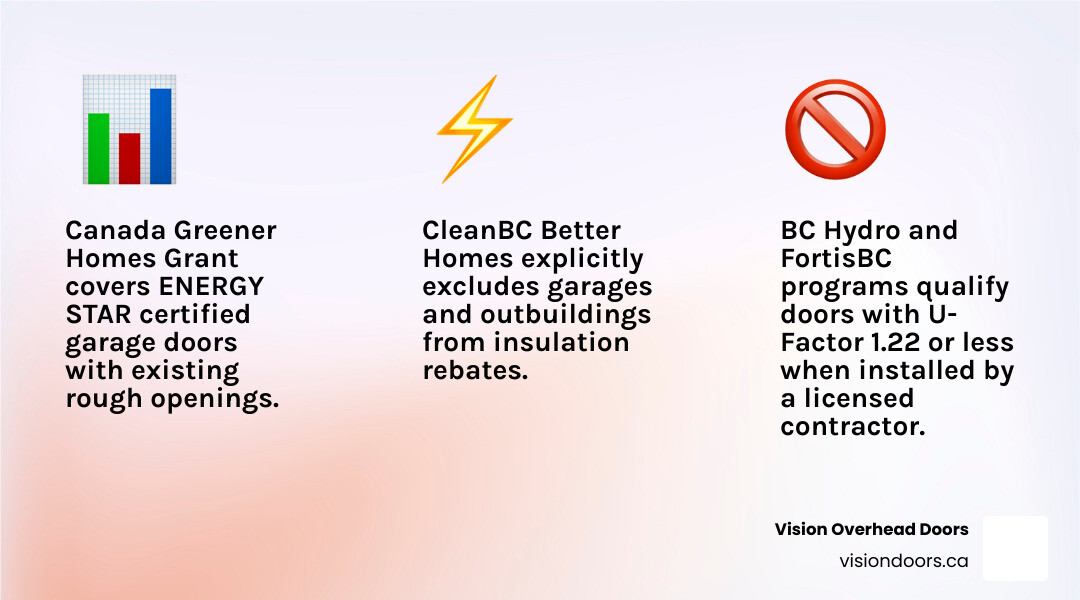
| Canada Greener Homes Grant | Yes | ENERGY STAR certified, existing rough opening |
| BC Hydro / FortisBC Window & Door Rebate | Potentially | U-Factor 1.22 or less, licensed contractor |
| CleanBC Better Homes Energy Savings Program (insulation rebates) | No | Garages and outbuildings are explicitly excluded |
| CleanBC Income-Qualified Window & Door Rebate | Potentially | Must meet certification and U-Factor standards |
The catch is that most BC rebate programs are designed around windows and exterior doors on the primary living space – not garage doors specifically. Whether your insulated garage door qualifies comes down to how it’s categorized, where it’s installed, and whether it meets specific certification standards.
If you’ve been searching for a clear answer on this, you’re not alone. Many Okanagan homeowners are surprised to find that the rules vary significantly depending on which program they apply to – and that the wrong assumption can mean a missed rebate or a rejected application.
I’m Daryl Rands, owner of Vision Garage Doors, and after 26 years in the garage door industry across the Okanagan Valley, I’ve helped countless homeowners navigate the question of does an insulated garage door qualify for rebates in BC – including what to look for before you buy. Let me walk you through exactly what each program covers and how to position your upgrade to maximize what you’re eligible for.
Does an insulated garage door qualify for rebates in bc?
Yes, sometimes – but not as a general “garage door insulation” rebate.
That distinction matters.
In BC, rebate programs usually treat garage doors in one of two ways:
- As a qualifying window-and-door replacement, if the product meets strict performance and certification rules
- As part of a garage or outbuilding upgrade, which is often excluded
So if you are asking whether adding insulation to your existing garage door qualifies, the answer is usually no. If you are replacing an old garage door with a new high-performance insulated model, the answer may be yes, depending on the program.
For the former Canada Greener Homes Grant, garage doors could qualify under the windows and doors category when they were:
- ENERGY STAR certified
- Installed in an existing rough opening
- Part of an eligible retrofit to an existing home
Under that structure, grants were tied to each rough opening, with amounts commonly listed at $125 or $250 depending on the product category and performance. The windows-and-doors portion of the program had an overall cap across all openings.
That does not mean every insulated garage door automatically qualified. A steel door with foam inside is not enough on its own. The product had to meet the federal program’s actual efficiency requirements and certification rules.
This is where homeowners often get tripped up. “Insulated” is a product feature. “Rebate-eligible” is a program status. Those are not the same thing.
If your garage is attached to the home and the door is part of the building envelope, an insulated upgrade can absolutely make comfort and efficiency sense. We explain the practical side of that in Why You Might Want to Pay More for an Insulated Door.
A quick reality check for May 2026:
- The Canada Greener Homes Grant is widely known for its past retrofit incentives, but homeowners should always verify current intake status and eligibility before purchasing
- Provincial programs in BC are still more commonly focused on windows, exterior doors, insulation in living areas, and heating systems
- A garage door is more likely to qualify when it is treated as an exterior door replacement rather than a stand-alone insulation project
If you want the safest path, assume nothing until the exact product specs, opening, and application rules line up. Rebate programs love fine print almost as much as garages love collecting mystery boxes.
Federal vs. Provincial: Comparing Greener Homes and CleanBC
The biggest source of confusion is that federal and provincial programs do not define eligible upgrades the same way.
At a high level:
- Federal programs have historically allowed some garage doors if they met certified door-replacement criteria
- Provincial insulation rebates in BC generally do not treat garage doors as an insulation category
- Provincial window-and-door rebates may allow some garage doors, but only if they satisfy the same technical requirements as eligible exterior doors
For a broader overview of BC rebate strategy, see How to Get Paid for Your Reno with BC Energy Rebates.
| Program | What it focused on | Garage door outlook | Main conditions |
|---|---|---|---|
| Canada Greener Homes Grant | Deep energy retrofits, including windows and doors | Often possible | ENERGY STAR certification, existing home, existing rough opening, required evaluations where applicable |
| BC Hydro / FortisBC window and door rebates | Energy-efficient windows and exterior doors | Possible, but case-specific | Product certification, U-Factor 1.22 or less, eligible home, contractor installation, application on time |
| CleanBC Better Homes insulation rebates | Added insulation in building assemblies | Not for garage doors | Garages and outbuildings excluded from insulation eligibility |
| CleanBC income-qualified window and door rebates | Support for qualifying households replacing windows and doors | Potentially possible | Income eligibility, product performance, home eligibility, required documentation |
A few key differences matter.
1. Federal programs looked at certified retrofit products
Under Natural Resources Canada guidance for eligible retrofits, garage doors in a garage could qualify under the windows-and-doors stream if they were ENERGY STAR certified and installed in existing openings. Documentation and photos were especially important because a garage door may not be obvious to an energy advisor after installation.
2. CleanBC insulation rebates are about insulated assemblies, not insulated doors
CleanBC’s insulation streams focus on areas like:
- Attics
- Exterior walls
- Basements
- Crawlspaces
- Other approved insulated sections between conditioned and unconditioned space
Those programs calculate rebates by added R-value and square footage. They are not written around replacing a garage door panel or adding foam to a garage door.
Even more importantly, program requirements note that garages, workshops, and outbuildings are not eligible housing types for certain insulation rebates. That makes a garage-door-only insulation claim a poor fit.
3. BC Hydro and FortisBC care about product performance numbers
For standard BC window-and-door rebate streams, the common threshold in the research is a U-Factor of 1.22 W/m2-K or less. Products also generally need recognized certification and professional installation by an eligible contractor.
That is why the product data sheet matters so much. If the manufacturer cannot show the required tested performance, the rebate application has very little chance.
4. New additions and rebuilds are a problem
Across both federal and provincial programs, new construction, new additions, and substantially reconstructed homes are often excluded.
In plain English:
- Replacing an existing garage door in an older, occupied primary residence may qualify
- Installing a garage door on a brand-new addition usually does not
- Rebuilding most of the home and calling it a renovation may still fail the eligibility test
That answer alone saves a lot of people from buying a “rebate-ready” door for a project that was never eligible in the first place.
Eligibility and Documentation for Garage Door Replacements
Before choosing a door based on rebate hopes, we recommend checking whether the door is actually part of the home’s thermal boundary.
That sounds technical, but the question is simple:
Is this garage door separating inside conditioned space from the outdoors, or is it just enclosing an unconditioned garage that the rebate program does not count?
That distinction affects both comfort and eligibility.
If the garage is attached and shares walls or ceilings with heated living areas, an insulated garage door can help reduce heat loss and temperature swings. If the garage is detached, the odds of rebate eligibility usually drop fast.
A few general requirements show up repeatedly across programs:
- The home must be an existing primary residence
- The home usually must be at least 12 months old
- The upgrade must be installed in Canada and typically purchased from a Canadian supplier or distributor
- The installation usually must be completed by a licensed or program-approved contractor
- Self-installation is often not eligible
- The rebate cannot exceed what is shown on the paid invoice
- The application must be submitted by the deadline, often within six months of the invoice date
You should also pay attention to code and life-safety issues, especially if the garage is attached to the home. These do not create rebate eligibility by themselves, but they can affect whether the installation is compliant. For background, see The Essential Guide to BC Building Code Requirements for Garage Doors.

How to check: does an insulated garage door qualify for rebates in bc?
Here is the step-by-step way we suggest homeowners in the Okanagan approach it.
Step 1: Confirm the project is a replacement, not a new opening
Most relevant programs are for retrofits. That means:
- You are replacing an existing garage door
- You are not creating a brand-new garage bay opening
- You are not installing the door as part of a new addition
If it is a new addition, stop there and verify first. Many rebate programs exclude products installed in additions.
Step 2: Verify the home type is eligible
Programs usually require:
- A year-round primary residence
- An existing detached home, row home, duplex, or other eligible residential type
- No exclusion for outbuildings, garages-only structures, or substantially reconstructed homes
If the upgrade is on a workshop, detached garage, or outbuilding, it is often not eligible.
Step 3: Check whether the garage door is part of the building envelope
This is the sneaky but important part.
A rebate program is more likely to recognize a door when it is reducing heat loss from the home itself. Attached garages connected to conditioned spaces make a stronger case than detached structures.
If your garage is heated, bonus points for comfort – but not every program requires the garage itself to be heated. What matters more is whether the door forms part of the thermal separation relevant to the home’s energy use.
Step 4: Review the product performance data
Look for:
- ENERGY STAR certification where required
- U-Factor values where provincial window-and-door rebates apply
- Manufacturer specification sheets
- Any listing or certification accepted by the program
- Clear model information that matches the invoice
Also review construction details that improve actual performance, such as:
- Polyurethane insulation
- Thermal breaks
- Better perimeter seals
- Multi-layer construction
- Higher effective R-value
These features improve efficiency, but the rebate still depends on documented compliance. A high R-value brochure alone is not enough if the program is asking for U-Factor or ENERGY STAR proof.
Step 5: Ask whether an energy advisor or evaluation is required
Federal retrofit programs often relied on pre- and post-retrofit evaluations, depending on the program stage and stream. Provincial utility rebates may not always require an EnerGuide evaluation for windows and doors, but some bonus programs do.
If an evaluation is needed, do not install first and ask questions later. That is the rebate version of locking your keys in the car.
Eligible door types may include
Depending on the program wording and product specs, eligible door categories can include:
- Insulated garage doors replacing an existing door in the same rough opening
- Exterior doors between conditioned living space and outdoors
- Garage doors with recognized efficiency certification
- Products installed by licensed contractors with matching documentation
Less likely to qualify:
- Detached garage doors
- New-construction garage doors
- DIY retrofits
- Add-on insulation kits for an old existing door
- Doors without performance certification
Final documentation: does an insulated garage door qualify for rebates in bc?
Documentation is where many valid projects still fail.
Even if your door qualifies on paper, a missing label photo or incomplete invoice can sink the application.
Typical documentation includes:
- Paid invoice
- Installation date
- Homeowner name and installation address
- Contractor business details
- Product manufacturer and model number
- Quantity and description of units installed
- Proof of certification or performance rating
- Photos of the installed door
- Photos of labels or stickers before they are removed
- Any required evaluation files or reference numbers
For federal garage-door claims, photos were specifically recommended because garage doors can be harder to verify later than windows or front entry doors. Taking “before,” “during,” and “after” photos is a smart move.
For many BC rebate streams, the application deadline is six months from the invoice date. Miss that window and the rebate can disappear, no matter how good your paperwork is otherwise.
We also recommend keeping:
- Product brochures or technical data sheets
- Copies of all emails and approvals
- Permit records if applicable
- Proof that the home is your primary residence if requested
And while it is a different issue from energy rebates, attached garages may also need to satisfy fire separation requirements depending on the home layout. If your project touches those concerns, review The Homeowner’s Guide to Fire-Rated Garage Door Requirements in BC.
Frequently Asked Questions about Garage Door Rebates
Can I combine federal and provincial rebates for my garage door?
Sometimes, but only if both programs allow stacking and the same expense is not being claimed in a prohibited way.
Historically, homeowners have often tried to combine federal and provincial support across broader renovation projects. Whether you can stack rebates for the same garage door depends on the exact rules in force at the time you apply.
The safe approach is:
- Read each program’s current stacking rules
- Confirm whether the rebate is for the same product or different aspects of the project
- Keep all paperwork separate and complete
- Get written clarification if the rules are unclear
Do not assume stacking is allowed just because both programs mention doors.
Does the garage need to be a heated space to qualify?
Not always, but it helps to think in terms of the building envelope rather than simply whether the garage has a heater.
A garage door is more likely to matter for rebate purposes when it affects the energy performance of the primary residence. An attached garage next to conditioned living space generally makes a stronger case than a detached shed-style garage.
So the better question is often:
- Is the door part of an existing home retrofit?
- Is it attached to the principal dwelling?
- Does the product meet the required certification and efficiency standard?
If the answer to those is yes, the garage itself may not need to be fully heated.
What documentation is required for the CleanBC program?
For CleanBC and utility-backed BC rebates, documentation commonly includes:
- A complete paid invoice
- Product model details
- Certification or rating information
- Photos of labels and installed products
- Proof the contractor was eligible or licensed if required
- Application submitted before the deadline
- Any income qualification documents for income-based streams
For insulation-specific CleanBC rebates, garage doors are generally not the target category. Those programs usually want insulation details such as area upgraded, added R-value, insulation type, and location in the home. That is one reason a garage door usually does not fit the insulation stream.
Conclusion
So, does an insulated garage door qualify for rebates in BC?
Our best plain-English answer is this:
- Yes, it can under some window-and-door style rebate programs
- No, it usually does not as a stand-alone insulation rebate
- It is most likely to qualify when it replaces an existing garage door in an eligible home and meets all certification and documentation requirements
- New additions, detached garages, and undocumented installs are where rebate hopes often go to die
For homeowners across the Okanagan Valley, the smartest move is to verify eligibility before ordering the door, not after it is already installed and the labels are in the recycling.
If you are planning a garage door upgrade and want help choosing an insulated model that makes sense for comfort, performance, and possible rebate compliance, we can help you sort through the details. At Vision Overhead Doors, we work with homeowners across our service area to install garage doors that suit the home, the climate, and the real-world rules that come with renovation projects.
Explore our garage door options here: https://visiondoors.ca/garage-doors/