

Understanding Thermal Resistance: What is R-Value for Garage Doors?
What is r value for garage doors comes down to one simple idea: it measures how well your garage door resists heat moving through it. The higher the number, the better the door holds temperature — keeping warmth in during Okanagan winters and heat out during scorching summers.
Quick Answer:
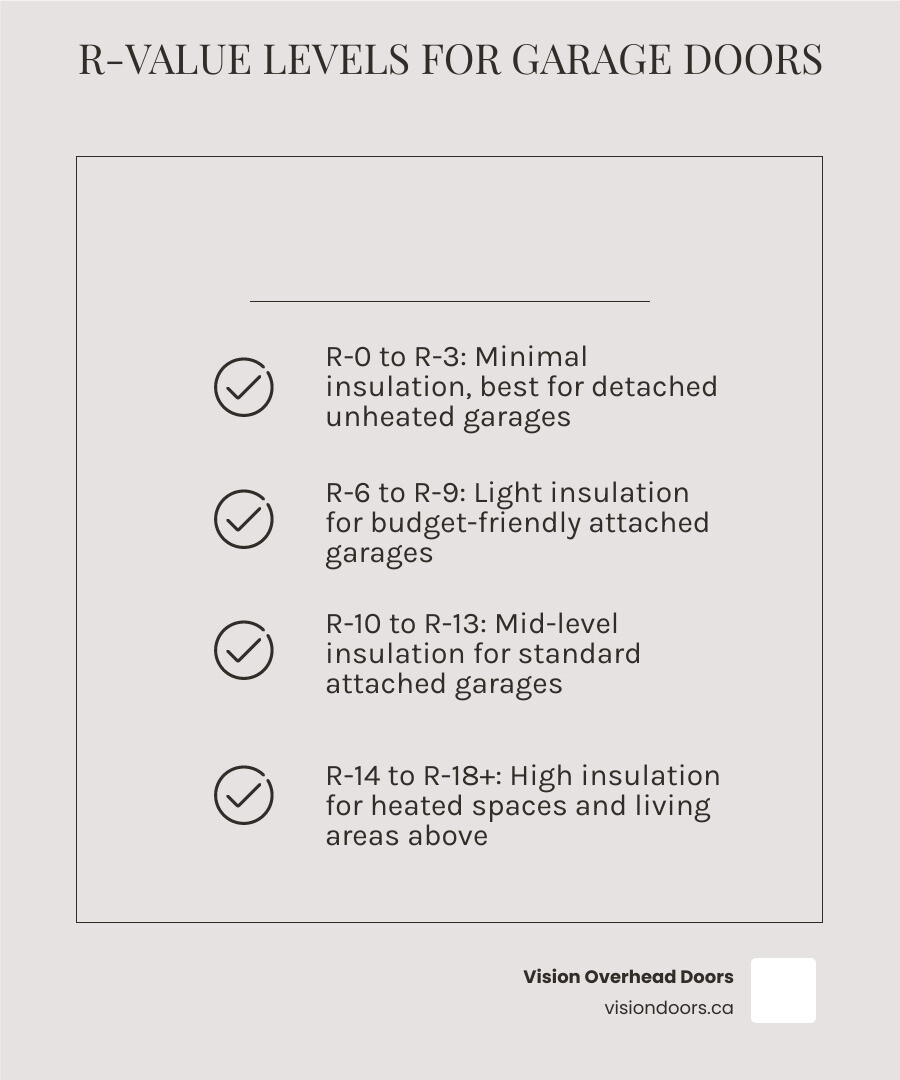
| R-Value Range | Insulation Level | Best For |
|---|---|---|
| R-0 to R-3 | None to minimal | Detached, unheated garages |
| R-6 to R-9 | Light | Budget-friendly attached garages |
| R-10 to R-13 | Mid-level | Standard attached garages |
| R-14 to R-18+ | High | Heated garages, living spaces above, workshops |
A few key facts worth knowing upfront:
- R-value measures thermal resistance — higher numbers mean less heat escapes or enters
- An R-8 door blocks roughly 90% of heat flow, while R-16 blocks around 95%
- Insulated garage doors can reduce overall energy loss by up to 70% compared to non-insulated models
- Your garage door is often the largest opening in your home’s exterior, making insulation far more important than most homeowners realize
For most homes in the Okanagan Valley, the garage door is also one of the most overlooked sources of energy loss. If your garage is attached to your living space, an uninsulated or poorly insulated door can quietly drive up your heating and cooling bills month after month — without you ever connecting the two.
This guide walks you through everything you need to know: how R-value is measured, which insulation types perform best, what level is right for your specific situation, and why the number on the label is only part of the story.
I’m Daryl Rands, owner of Vision Overhead Doors and a Red Seal Carpenter with 26 years of experience in the Okanagan garage door industry — and questions about what is r value for garage doors are among the most common I hear from homeowners looking to make a smart, long-lasting upgrade. In the sections below, I’ll break it all down so you can choose with confidence.
How R-Value is Calculated for Garage Doors
When we talk about the math behind your door, it’s not just about the foam inside. To get a “Calculated Door Section” R-value, manufacturers look at a specific cross-section of the door. This calculation includes the thermal resistance of the air films (the thin layers of air sticking to the inside and outside surfaces), the surface materials (like steel or wood), and the insulation core itself.
According to ASHRAE data, these air films contribute about 0.85 to the total R-value. While a steel skin has a negligible impact on heat resistance, the thickness and density of the insulation core do the heavy lifting. However, it is important to remember that this calculated value is often a “best-case scenario” for the center of the door panel. It doesn’t always account for the edges where heat might leak out. Understanding these nuances is a big part of Why You Might Want to Pay More for an Insulated Door, as higher-quality doors use better construction methods to ensure that the calculated R-value translates to real-world warmth.
The Difference Between R-Value and U-Factor
In energy audits and professional building codes, you’ll often hear the term “U-factor” alongside R-value. While R-value measures resistance to heat, the U-factor measures thermal transmittance—or how much heat actually moves through the door.
Think of them as two sides of the same coin:
- R-value: Higher is better (more resistance).
- U-factor: Lower is better (less heat escaping).
The biggest difference is how they are tested. While R-value is often calculated for a single section of the door, the U-factor is typically tested using the ANSI/DASMA 105 standard. This involves placing a complete, installed door assembly in a controlled chamber to measure actual heat loss. The U-factor is often considered a more accurate reflection of performance because it accounts for “thermal shortcuts” like the joints between sections, the hardware, and the seals. When you’re looking at what is r value for garage doors, a high R-value is great, but a low U-factor for the whole assembly is the ultimate goal for energy efficiency.
Comparing Insulation Materials: Polyurethane vs. Polystyrene

Not all insulation is created equal. Most modern garage doors use one of two materials: polystyrene or polyurethane.
Polystyrene (often called Styrofoam) is usually inserted as rigid sheets between the steel skins of the door. It’s a reliable, budget-friendly option. However, because it is a pre-cut sheet, there can be small air gaps between the insulation and the door frame.
Polyurethane is a “spray-in” foam that expands to fill every nook and cranny of the door panel. This material offers approximately double the thermal performance of polystyrene for the same thickness. Because it bonds to the steel skins, it also makes the door significantly stronger and quieter.
| Feature | Polystyrene | Polyurethane |
|---|---|---|
| R-Value per Inch | Lower (approx. R-4 to R-5) | Higher (approx. R-7 per inch) |
| Application | Rigid sheets | Injected expanding foam |
| Structural Integrity | Moderate | High (bonds to steel) |
| Noise Reduction | Good | Excellent |
Determining What is R-Value for Garage Doors in Attached vs. Detached Spaces
The “right” R-value depends heavily on where your garage is located. If you have a detached garage that you only use for parking or storing lawn equipment, a low R-value (R-0 to R-6) is often sufficient. In these cases, you’re mostly looking for a door that is durable and keeps the rain out.
However, for attached garages, the stakes are much higher. Your garage shares one or more walls with your home. If that garage is freezing in the winter, those shared walls act like a giant ice pack against your living room or kitchen. For an attached garage, we typically recommend a minimum of R-10 to R-12. This helps maintain a “buffer zone” of temperature, preventing your home’s furnace from working overtime. If you’re curious about the legal requirements for your next renovation, check out The Essential Guide to BC Building Code Requirements for Garage Doors.
High R-Value for Living Spaces Above the Garage
One of the most common complaints we hear from homeowners in places like Kelowna or Salmon Arm is that the bedroom above the garage is always the coldest room in the house. This happens because heat rises, but cold also penetrates through the garage ceiling (the bedroom floor).
If you have a living space above your garage, a high R-value door is a necessity, not a luxury. We recommend an R-16 rating or higher for these scenarios. By keeping the garage significantly warmer, you create a thermal barrier that protects the comfort of the rooms upstairs. It can mean the difference between needing slippers all winter and having a cozy, livable space.
Beyond the Rating: Why Weatherstripping and Thermal Breaks Matter
You could have a door with an R-value of 30, but if there’s an inch-wide gap at the bottom, it won’t matter. This is why we tell our customers that what is r value for garage doors is only half the battle. The other half is air infiltration.
Proper weatherstripping around the perimeter and between the door sections is critical. It blocks drafts that can bypass the insulation entirely. Furthermore, high-quality insulated doors feature a thermal break. This is a separator placed between the interior and exterior steel skins so that the cold from the outside skin doesn’t “bridge” directly to the inside skin. Without a thermal break, the steel itself acts as a conductor, bringing the Okanagan chill right into your home. When evaluating The Real Cost of a New Garage Door, always look for these structural details that ensure the insulation actually works.
The Real-World Benefits of High-Efficiency Garage Doors
Investing in a high R-value door offers more than just a lower heating bill. Here are the primary benefits we see for homeowners in the Okanagan:
- Energy Savings: Upgrading to an insulated door can lower heating and cooling costs by 10-20%, especially in extreme climates. For a $200 monthly heating bill, an R-16 door could save you between $20 and $40 every month.
- Noise Reduction: If you live on a busy street in Vernon or near a highway in Salmon Arm, you’ll notice the difference immediately. Polyurethane-insulated doors act as a massive sound dampener, making your garage (and your home) much quieter.
- Structural Durability: Insulated doors are “sandwich” style, meaning they have two layers of steel with foam in the middle. This makes them much more resistant to dents from basketballs or accidental bumps.
- Curb Appeal: Since garage doors can account for up to 30% of your home’s visible exterior, a high-quality door is a major style statement. Plus, you might even be eligible for financial incentives—learn How to Get Paid for Your Reno with BC Energy Rebates.
Maximizing Performance: What is R-Value for Garage Doors in Extreme Climates?
The Okanagan Valley is famous for its climate extremes—from -20°C winters to +40°C summers. In this environment, your garage door works hard all year round. In the summer, a high R-value door prevents the garage from becoming an oven, which in turn keeps the rest of your house cooler and reduces the load on your air conditioner. In the winter, it keeps your vehicles and stored items safe from freezing. The long-term ROI (Return on Investment) of a high-efficiency door in our region is excellent, as the energy savings and added home value quickly offset the initial investment.
Frequently Asked Questions about what is r value for garage doors
How much can I save on energy bills with a high R-value door?
Realistically, homeowners can save between 10-20% on their heating and cooling costs. While the door itself doesn’t “generate” heat, it drastically reduces energy loss. Because the garage is often the largest uninsulated space in the house, stopping that 70% of energy loss through the door makes a massive difference in how hard your HVAC system has to work.
Is a high R-value door worth it for a detached garage?
If the garage is unheated and strictly used for storage, a high R-value (R-12+) might be overkill. However, a “lightly” insulated door (R-6 to R-9) is still worth considering for the added durability and noise reduction. If you use your detached garage as a workshop, gym, or “man cave,” then a high R-value door is absolutely worth the investment to keep the space usable year-round.
What is the difference between ‘Calculated’ and ‘Tested’ R-values?
A calculated R-value is based on the materials used in a door section. A tested R-value (or U-factor) is measured in a lab with a fully installed door. The tested value is usually lower because it accounts for “thermal bridges” like the steel stiles and section joints where heat can escape. Always ask if the rating you’re looking at is for the “center of the panel” or the “installed assembly.”
Conclusion
Understanding what is r value for garage doors is the first step toward a more comfortable, energy-efficient home. Whether you are in Kelowna, Vernon, Salmon Arm, or anywhere in between, choosing the right insulation level is one of the smartest home improvements you can make.
At Vision Doors & Windows, we specialize in premium, custom architectural solutions that don’t just look beautiful but perform at the highest level. From high-R-value polyurethane doors to custom glass partitions and entry systems, our team brings 26 years of local expertise to every installation. We are proud to serve communities across the Okanagan, including Lake Country, Enderby, Armstrong, and beyond.
Ready to upgrade your home’s efficiency and style? Contact us today to explore our range of high-performance Garage Doors and find the perfect fit for your home.