The Real Differences Between Residential and Commercial Garage Doors (And Why They Matter)
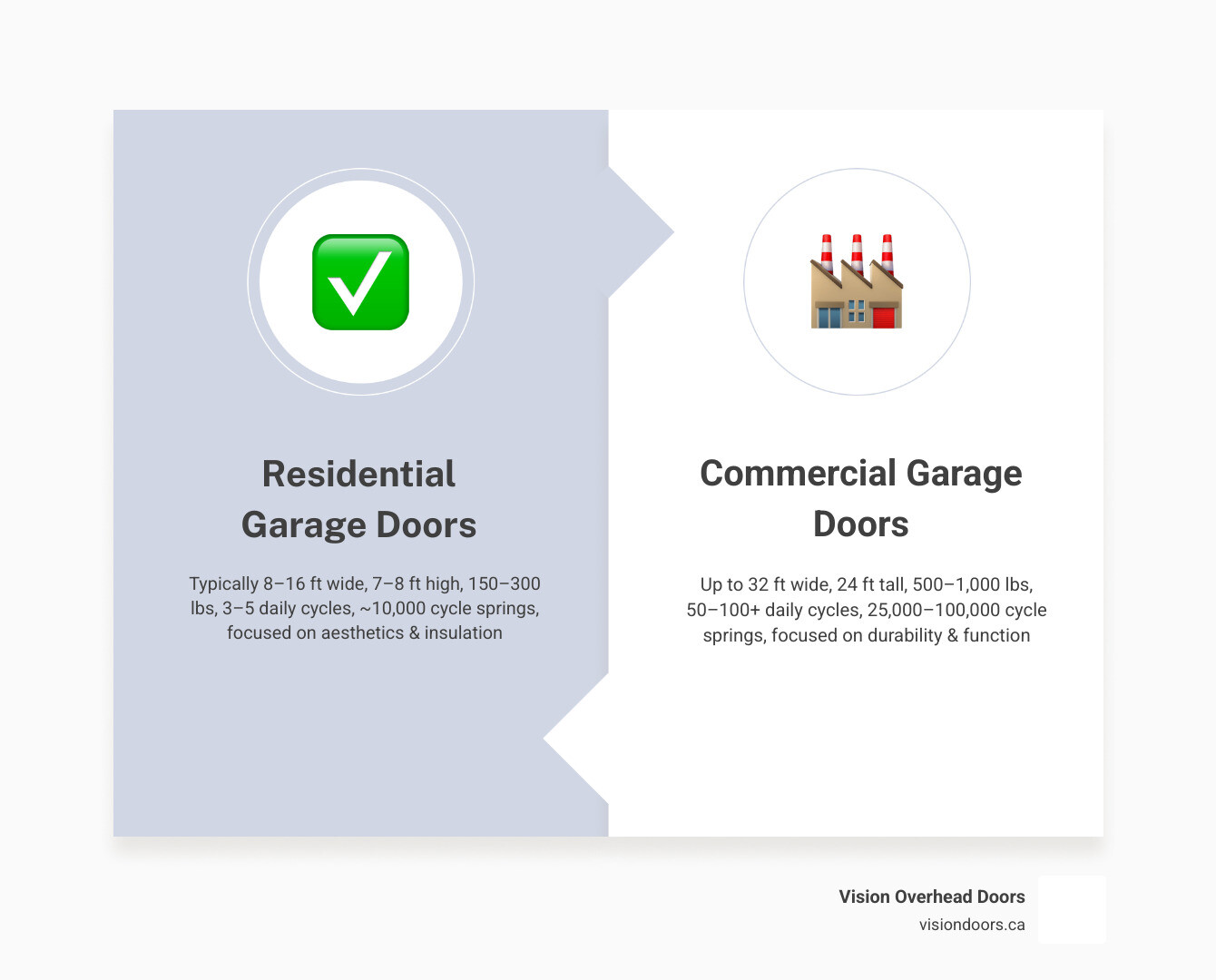
Understanding the residential vs commercial garage doors differences comes down to five core factors:
| Factor | Residential | Commercial |
|---|---|---|
| Size | 8–16 ft wide, 7–8 ft high | Up to 32 ft wide, 24 ft tall |
| Weight | 150–300 lbs | 500–1,000 lbs |
| Daily Cycles | 3–5 per day | 50–100+ per day |
| Spring Rating | ~10,000 cycles | 25,000–100,000 cycles |
| Primary Focus | Aesthetics & insulation | Durability & function |
At first glance, a garage door is just a garage door. But the moment you look closer, the gap between residential and commercial systems becomes significant — in size, construction, hardware, and how they’re built to perform day after day.
A residential door opens a few times a day to let a car in or out. A commercial door at a loading dock might cycle 50 to 100 times before noon — carrying the weight of an entire operation on its tracks. Using the wrong door type in the wrong setting isn’t just inefficient; it can lead to premature failure, safety hazards, costly downtime, and even code violations.
Whether you’re a homeowner in the Okanagan Valley deciding on a new installation, or a business owner trying to figure out what your facility actually needs, knowing these distinctions will save you time, money, and headaches down the road.
I’m Daryl Rands, owner of Vision Overhead Doors with 26 years of hands-on experience in the garage door industry — and helping clients understand the residential vs commercial garage doors differences is one of the most common and important conversations I have. Let’s break it all down clearly so you can make the right call for your property.
Size and Structural Integrity: Residential vs Commercial Garage Doors Differences
When we talk about the physical presence of these systems, size is the most obvious differentiator. In May 2026, as vehicles and industrial equipment continue to evolve, the demand for custom sizing has never been higher.
Dimensions and Scale
For most homes in Salmon Arm or Vernon, a standard single-car door sits at about 8 to 9 feet wide and 7 feet tall. Double doors usually stretch to 16 feet. However, once you step into Commercial Overhead Doors, those numbers skyrocket. Commercial doors are designed to accommodate everything from delivery vans to massive semi-trucks and agricultural machinery.
| Specification | Standard Residential | Standard Commercial |
|---|---|---|
| Width | 8 – 16 feet | 10 – 32 feet |
| Height | 7 – 8 feet | 8 – 24 feet |
| Material Gauge | 24-gauge or thinner | 20-gauge or thicker |
Weight and Material Strength
A typical Residential Garage Door is built to be light enough for manual operation if the power goes out, usually weighing between 150 and 300 pounds. Commercial doors, however, are absolute tanks. Because they use thicker 20-gauge steel or reinforced aluminum to withstand industrial environments, they can weigh up to 1,000 pounds.
This extra weight requires significant structural reinforcement. During a Commercial Overhead Door Installation, we often have to ensure the building’s framing is beefed up to handle the immense load and vibration of a door that is essentially a moving wall.
Performance, Durability, and High-Cycle Ratings
The “heartbeat” of a garage door is its cycle rating. One cycle equals the door opening and closing once. This is where the residential vs commercial garage doors differences become a matter of engineering survival.
The Power of the Spring
Residential doors are designed for moderate use—maybe four cycles a day. Their springs are typically rated for 10,000 cycles, which should last a homeowner about 7 to 10 years. In contrast, a commercial door at a busy Kelowna warehouse might hit 10,000 cycles in just a few months.
Commercial systems utilize high-cycle torsion springs rated for 25,000 to 100,000 cycles. If you try to use a residential spring in a high-traffic business, you’ll be calling us for Garage Door Spring Repair far more often than you’d like.
Lifespan Expectations
It’s a bit of a paradox: residential doors often last 15 to 30 years because they lead a “quiet” life. Commercial doors, despite being made of much tougher galvanized steel and heavy-duty components, usually have a lifespan of 10 to 20 years. This is simply due to the sheer intensity of their work. When a door is moving dozens of times an hour, parts wear down. That’s why consistent Commercial Overhead Door Repair and maintenance are non-negotiable for businesses to avoid the $500–$2,000 daily loss associated with operational downtime.
If your home door is making a racket or acting sluggish, don’t wait for it to fail. Our team provides expert Garage Door Repair across the Okanagan to keep your daily routine on track.
Hardware, Openers, and Operational Mechanisms
The heavy lifting isn’t just done by the springs; the tracks and the motor play a massive role in the residential vs commercial garage doors differences.
Tracks and Lift Types
Residential doors almost always use 2-inch tracks. Commercial doors upgrade to 3-inch tracks made of thicker steel to prevent bending under the weight of a 1,000-pound door. Furthermore, commercial buildings often have high ceilings, requiring “high-lift” or “vertical lift” track configurations that keep the door tucked up against the ceiling, out of the way of forklifts and shelving.
Opener Horsepower and Voltage
Garage Door Openers for homes are usually 1/2 to 3/4 horsepower (HP) and run on standard 115-volt power. They are designed to be quiet and efficient for a few uses a day.
Commercial operators are a different breed. They range from 1/2 to 1 HP (and sometimes more) and can run on 220 or even 575-volt systems. These motors are designed for continuous duty. We specialize in Garage Door Opener Installation for both types, ensuring that a residential “trolley” opener stays in the garage and a heavy-duty “jackshaft” operator—which mounts to the wall instead of the ceiling—is used for those big commercial jobs.
When these powerful motors need attention, our Garage Door Opener Repair services ensure that your safety sensors and drive systems are calibrated correctly to handle the intense workload.
Aesthetics, Insulation, and Safety Standards
While a business owner might only care if the door stays shut and keeps the heat in, a homeowner in Lake Country or Coldstream cares deeply about how that door looks from the curb.
Curb Appeal vs. Utilitarian Function
For residential properties, the garage door is a major architectural feature. We see a lot of requests for carriage-house styles, faux-wood finishes, and full-view glass panels that let in natural light. A new Garage Door Installation can significantly boost a home’s resale value.
Commercial doors are usually more minimalist—often standard white or gray—prioritizing function over form. However, we do install many “full-view” aluminum doors in restaurants and car dealerships across the Okanagan to create a modern, open-air feel.
Insulation and R-Value
Both types of doors benefit from insulation, but for different reasons.
- Residential: Focuses on energy efficiency for attached garages to lower heating costs by up to 20%. Many high-end doors use 2-inch Intellicore polyurethane insulation, reaching R-values over 20.
- Commercial: Insulation is often about climate control for sensitive inventory (like food or electronics). Polyurethane is preferred here not just for warmth, but because it makes the door panels stiffer and more resistant to impact.
Safety and Compliance
Safety is paramount, but the rules change depending on the setting. Residential doors rely on photo-eye sensors and auto-reverse mechanisms to protect kids and pets. Commercial doors must adhere to stricter standards, including NFPA 80 for fire-rated doors and OSHA regulations. Fire-rated commercial doors are engineered to close automatically in the event of an alarm to contain smoke and flames—a critical feature for industrial safety.
What are the primary residential vs commercial garage doors differences in size?
The size gap is substantial. A standard residential door is usually 7 to 8 feet high—perfect for your SUV or sedan. However, many homeowners in areas like Sorrento or Blind Bay are now opting for “RV garages” with 12-foot heights to accommodate boats and campers.
On the commercial side, “standard” doesn’t really exist. We regularly install doors that are 24 feet wide and 20 feet tall for warehouses. In extreme industrial or agricultural settings, doors can reach up to 32 feet in width. The clearance requirements (headroom) are also much higher in commercial settings to allow for overhead cranes or tall machinery.
How do residential vs commercial garage doors differences affect maintenance?
Because they work harder, commercial doors need a much more rigorous maintenance schedule.
- Residential Maintenance: Usually an annual check-up is enough. We look at the balance, lubricate the hinges, and check the weather stripping.
- Commercial Maintenance: Depending on the cycle count, these doors may need monthly or quarterly inspections.
Maintenance Priorities for High-Traffic Doors:
- Spring Tension: Heavy use causes springs to lose tension faster; they need regular adjustment to prevent motor burnout.
- Cable Inspection: Fraying cables on a 1,000-pound door are a major safety hazard.
- Roller Lubrication: To reduce friction and noise in busy environments.
- Track Alignment: Forklift “love taps” can knock tracks out of alignment, leading to a jammed door.
- Weather Seal Replacement: Worn seals can increase energy bills by 15–25%, a huge cost for large facilities.
Conclusion
Choosing between a residential and commercial system isn’t just about the size of the opening—it’s about matching the engineering to the expectation. Whether you need a stylish, insulated door for your home in Kelowna or a high-speed, fire-rated powerhouse for a warehouse in Armstrong, Vision Overhead Doors has the local expertise to get it done right.
We take pride in offering the Okanagan Valley premium custom solutions, competitive pricing, and the kind of same-day service that keeps your home secure and your business moving. Don’t risk an “expensive burden” by installing the wrong equipment.
Find the perfect solution for your property with our Commercial Overhead Doors or give us a call today to schedule a professional assessment. From Scotch Creek to Lake Country, we’re here to ensure your doors open every time, without fail.