Is an Insulated Garage Door Worth It? A Quick Answer for Okanagan Homeowners
The insulated vs non insulated garage doors comparison comes down to one core question: does your garage need to manage temperature, noise, or both — or is it simply a place to park?
Here’s a quick breakdown to help you decide at a glance:
| Factor | Insulated Door | Non-Insulated Door |
|---|---|---|
| Energy efficiency | High — reduces heat transfer | Low — no thermal barrier |
| Noise reduction | Significant — foam absorbs vibration | Minimal |
| Durability | Higher — multi-layer construction resists dents | Lower — single layer dents more easily |
| Best for | Attached garages, workshops, extreme climates | Detached garages, mild climates, basic storage |
| R-value range | R-9 to R-20+ (polyurethane) | R-3 to R-5 |
| Weight | Heavier — may require stronger opener | Lighter — less strain on opener |
| Upfront cost | Higher | Lower |
| Long-term savings | Yes — up to 20% reduction in annual energy bills | Minimal |
If your garage shares a wall with your home, sits in a region with hot summers and cold winters (like the Okanagan Valley), or doubles as a workspace or hobby area, an insulated door is almost always the smarter long-term choice. If you have a detached garage used purely for storage in a mild climate, a non-insulated door may serve you just fine.
Now, if you want the full picture — including which insulation materials perform best, how R-values translate to real-world energy savings, and exactly when each option makes sense — keep reading.
Think of your garage door as more than just an entry point. It’s often the largest single opening in your home, and without proper insulation, it can quietly drain your heating and cooling budget season after season. In the Okanagan, where summer temperatures regularly push past 35°C and winter nights can dip well below freezing, that thermal gap isn’t a minor inconvenience — it’s a measurable cost.
Whether you’re replacing an aging door, building a new space, or simply wondering if your current setup is costing you money, understanding the difference between insulated and non-insulated options puts you in a much better position to choose wisely.
I’m Daryl Rands, owner of Vision Overhead Doors and a Red Seal Carpenter with 26 years of hands-on experience in the Okanagan garage door industry — and the insulated vs non insulated garage doors comparison is one of the most common conversations I have with homeowners across the region. Let’s walk through everything you need to know to make the right call for your home.
Insulated vs Non Insulated Garage Doors Comparison: Key Differences
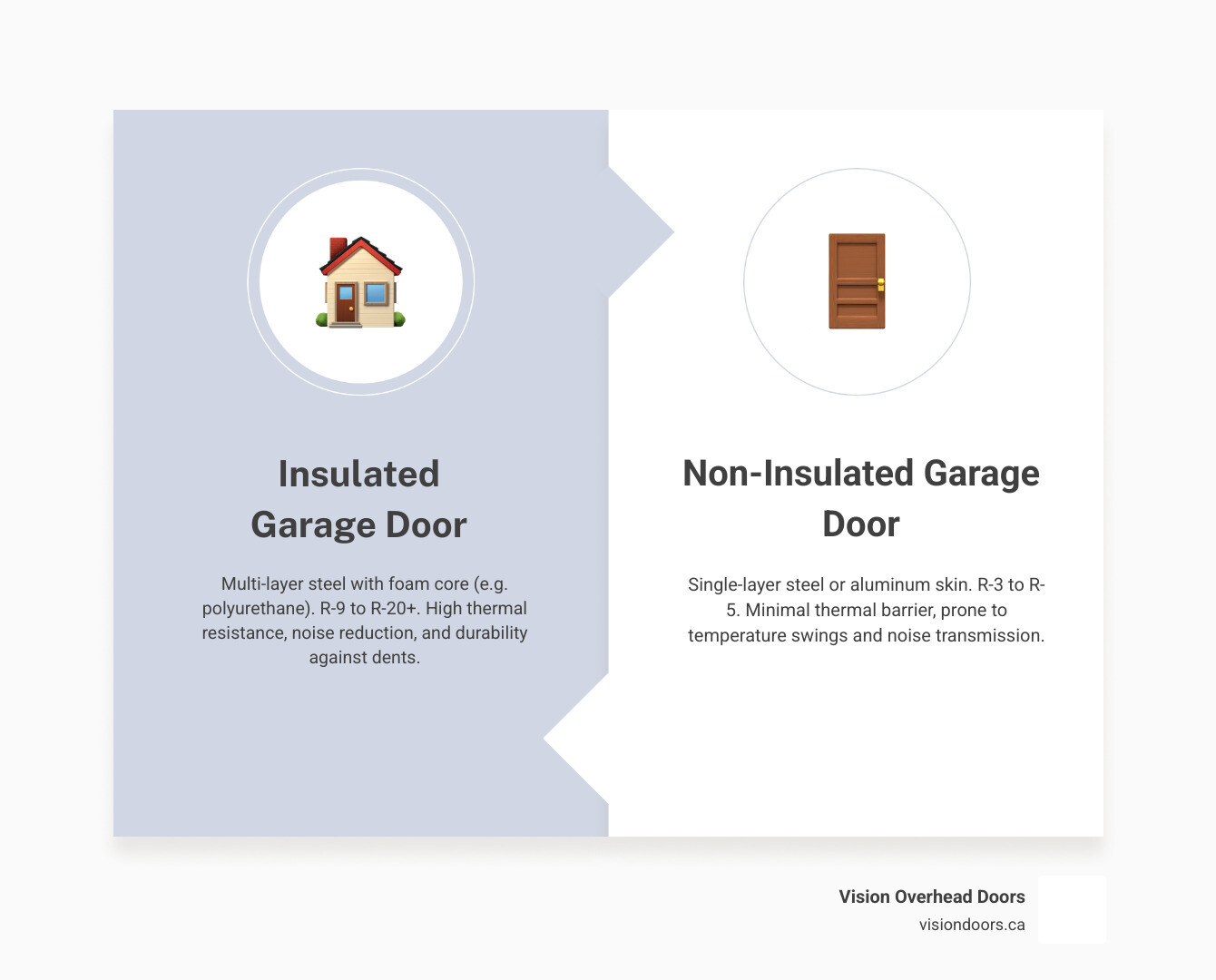
When we look at the core of the insulated vs non insulated garage doors comparison, we are really looking at how a door is built to handle the elements. A non-insulated door is typically a single layer of material—usually steel or aluminum. It’s essentially a thin “skin” that provides security and a visual barrier but offers almost zero resistance to heat or cold.
In contrast, Garage Doors that are insulated feature a multi-layer construction. This usually involves two layers of steel with a core of insulating material sandwiched in between. This “sandwich” design creates a thermal barrier that prevents the outside air from dictating the temperature inside your garage.
The Role of R-value and U-value
To understand the effectiveness of these doors, we use two primary metrics:
- R-value: This measures the thermal resistance. The higher the R-value, the better the door is at keeping heat in during the winter and out during the summer. While a non-insulated door might sit around R-3 to R-5 (mostly from the air pocket and thin steel), a premium insulated door can reach R-12, R-18, or even R-20+.
- U-value: This measures the rate of heat transfer. Unlike R-value, a lower U-value is better. It considers the entire assembly, including the frame and glass, giving a more holistic view of energy efficiency.
Insulation Materials: Polystyrene vs. Polyurethane
Not all insulation is created equal. We typically see two main types:
- Polystyrene: These are rigid foam panels inserted into the door sections. It’s a budget-friendly way to get a solid R-value (usually R-9 range) and provides decent noise reduction.
- Polyurethane: This is a foam-injected insulation that expands to fill every nook and cranny of the door’s interior. Because it bonds to the steel skins, it creates a much stronger, more rigid door with significantly higher R-values (R-12 to R-18+). It is the gold standard for Okanagan homes.
Performance Metrics in an Insulated vs Non Insulated Garage Doors Comparison
Beyond just temperature, the performance differences are striking. One of the most immediate benefits homeowners notice after a professional Garage Door Installation is the noise reduction.
Insulated doors act as a massive acoustic barrier. The dense foam core absorbs vibrations and muffles street noise, which is a godsend if you live near a busy road in Kelowna or Vernon. Furthermore, the added weight and rigidity of an insulated door mean it doesn’t rattle or “shiver” in high winds. It operates with a solid, quiet “thud” rather than a metallic “clang.”
From an energy perspective, an insulated door reduces the HVAC load on your home. If your garage is attached, a freezing garage in January acts like a giant ice cube pressed against your living room wall. By stabilizing the garage temperature, your home’s furnace doesn’t have to work nearly as hard to keep the interior comfortable.
Material Impact on an Insulated vs Non Insulated Garage Doors Comparison
The material of the door itself plays a huge role in the insulated vs non insulated garage doors comparison.
- Steel: The most common choice. In an insulated setup, the double-layer steel provides incredible dent resistance. A stray basketball or a bike handle that might leave a permanent “ding” on a single-layer non-insulated door will often bounce right off a reinforced insulated panel.
- Aluminum: Naturally lighter and rust-resistant, making it great for modern glass-heavy designs. However, aluminum is a great conductor of heat, so insulation is vital if you want any thermal performance.
- Wood and Composites: These offer natural insulating properties, but when combined with a foam core, they provide the ultimate blend of high-end aesthetics and modern efficiency.
One thing to keep in mind is hardware strain. Because insulated doors are heavier, they require high-quality tracks, rollers, and springs. We always ensure that the spring tension is perfectly balanced to handle the extra mass so your opener doesn’t burn out prematurely.
When Does an Insulated Garage Door Make the Most Sense?
In our experience serving the Okanagan Valley—from Salmon Arm down to Kelowna—we find that insulated doors are the “non-negotiable” choice for several specific scenarios:
1. Attached Garages If your garage shares a wall with your kitchen, laundry room, or living space, that wall is a major point of heat exchange. An insulated door creates a buffer zone, keeping your home’s “thermal envelope” intact.
2. Living Space Above the Garage Is there a master bedroom or a home office located directly above the garage? If so, an uninsulated garage will make that room feel like a freezer in the winter and a sauna in the summer. Insulation is the only way to keep those upstairs floors comfortable.
3. The Garage as a Multi-Purpose Space Are you using your garage as a workshop for woodworking? A home gym for morning workouts? A place for the pets to sleep? In 2026, we see more people than ever treating the garage as an extension of their living space. You can’t spend two hours on a treadmill in a 40°C garage in July without proper insulation.
4. Protecting Stored Items Extreme temperature swings are the enemy of many common household items. Paint, cleaning chemicals, car batteries, and even the fluids in your vehicle can degrade if they are subjected to the -20°C to +35°C swings we see in the Okanagan. An insulated Garage Doors setup keeps the interior within a much narrower, safer temperature range.
5. Increasing Resale Value Garage door replacements consistently rank as one of the highest ROI (Return on Investment) home improvement projects. Buyers in 2026 are savvy; they look for energy-efficient features. An insulated door signals that the home has been well-maintained and is built for comfort.
Evaluating the Benefits of Non-Insulated Options
While we often lean toward insulation for the performance benefits, there are absolutely times when a non-insulated door is the logical choice.
Detached Garages and Outbuildings If you have a detached shed or a separate garage used strictly for storing a lawnmower, garden tools, or a boat, and that space isn’t heated or cooled, insulation offers very little benefit. There is no “energy” to save if you aren’t paying to condition the air inside.
Mild Climates and Ventilation Needs In some rare cases, a garage might need constant airflow to prevent the buildup of fumes or moisture. A single-layer door is lighter and can sometimes be easier to integrate with specialized ventilation hardware.
Budget-Focused Projects For a rental property or a basic storage unit where upfront cost is the primary driver, a non-insulated door provides the necessary security and curb appeal at a lower entry point. It’s a lightweight operation that puts very little strain on the opener, often leading to simpler long-term maintenance for the mechanical parts.
However, keep in mind that a non-insulated door is much noisier. If your detached garage is right next to a neighbor’s bedroom window, they might appreciate the quiet operation of an insulated door every time you come home late at night.
Frequently Asked Questions About Garage Insulation
Are garage door insulation kits as effective as factory-insulated doors?
In a word: no. While you can buy DIY kits involving reflective foil or foam panels, they rarely live up to the performance of a factory-integrated door. Factory-insulated doors feature insulation that is permanently bonded to the steel, creating a “sandwich” that adds structural strength.
Retrofit kits often leave gaps at the edges where air can leak through, and they can add unexpected weight to the door. If you add 20 lbs of insulation to a door that wasn’t designed for it, you risk snapping a spring or stripping the gears in your opener. For a truly effective thermal seal, a professional Garage Door Installation of a factory-built door is always the better route.
Does an insulated garage door significantly reduce street noise?
Yes, dramatically. Because polyurethane is so dense, it acts as a massive dampener for sound waves. If you live in a high-traffic area of Kelowna or near a busy intersection in Vernon, switching from a single-layer “tin” door to a triple-layer polyurethane door can make your garage—and the adjacent rooms—feel much more peaceful. It’s the difference between hearing every car that passes and only hearing a faint hum.
How does the R-value affect my home’s energy bills in 2026?
By 2026, energy efficiency standards have become even more stringent. An insulated garage door can provide up to a 20% reduction in annual energy bills for homes with attached garages. By acting as a thermal “airlock,” it prevents the furnace or air conditioner from having to compensate for the massive temperature sink that an uninsulated garage creates. Over the lifespan of the door, the energy savings can often pay for the difference in the initial investment.
Conclusion: Making the Right Choice for Your Okanagan Home
Choosing between an insulated vs non insulated garage doors comparison really comes down to how you live in your home. If your garage is just a cold box for a car, non-insulated might work. But if you want a quieter, more durable, and energy-efficient home that stays comfortable through the Okanagan’s wild seasonal shifts, insulation is the way to go.
At Vision Overhead Doors, we’ve spent over two decades helping our neighbors in Salmon Arm, Vernon, Kelowna, and throughout the Shuswap and Okanagan regions find the perfect balance of style and performance. We know the local climate because we live here, and we understand exactly which R-values are needed to stand up to a cold winter night in Enderby or a scorching afternoon in Osoyoos.
Whether you need a quick repair to get your door back on track or you’re ready to upgrade to a premium, whisper-quiet insulated system, we are here to help. We offer same-day service, local expertise, and a personal touch that only a family-owned business can provide.
Ready to upgrade your home’s comfort and curb appeal?
Find the perfect solution for your home or give us a call today to chat with our friendly team. Let’s make your garage the best-performing part of your home!