The Loud Bang in the Garage: When a Snapped Cable Stops Everything
Dealing with the chain reaction of a snapped garage door cable on your opener’s gear sprocket usually starts with a sudden, startling noise that echoes through your home. At Vision Overhead Doors, our team often hears from homeowners who rushed out to the garage thinking a heavy shelf had collapsed. Instead of a fallen shelf, you find your standard 7-foot tall garage door hanging at an awkward, uneven angle, or completely stuck halfway up the track. This is the exact moment a critical decision must be made.
The immediate temptation is to reach for the wall button or click your remote again. You might think the system just needs a little extra push to close the door and secure the house for the night. However, pressing that button is the worst action you can take. Doing so triggers an immediate mechanical crisis, resulting in 150+ pounds of dead weight suddenly transferring to the opener motor. What began as a single broken cable quickly cascades into a much larger, more expensive failure.
Understanding why this happens requires a look at the hidden forces at play above your vehicle. Before you attempt to force the system to work, you need to know exactly what a home garage door repair entails when the entire balance of the system is compromised.
Recognizing the Immediate Symptoms of a Cable Failure
A snapped cable rarely happens silently. If you were not in the garage when it occurred, you will still notice several glaring warning signs before you even touch the opener button:
- The crooked hang: One side of the door sits noticeably lower than the other, making it look wedged in the frame.
- Slack or dangling wires: You might see a frayed 1/8-inch galvanized steel cable hanging loosely near the vertical tracks.
- Heavy resistance: If you pull the red emergency release cord and try to lift the door manually, it will feel impossibly heavy.
- The terrifying sound: The initial break sounds like a gunshot or a heavy metal pipe hitting a concrete floor.
Once you spot these signs, step away from the wall console. The true danger lies not just in the broken wire, but in what happens to the motorized equipment if you try to use it.
How Your Garage Door Opener Actually Works (It Doesn’t Lift the Door)
To understand the severity of a broken cable, we first need to clear up a very common misconception about automated garage systems. Most homeowners assume the motorized box mounted to the ceiling is a heavy-duty winch that pulls the door up and lowers it down. In reality, the opener does almost none of the actual heavy lifting.
We always explain to our customers that the true muscle of your garage setup is the counterweight system, which consists of heavy-duty springs (often rated for a standard 10,000 to 15,000 lift cycles) and high-tension steel cables. Whether you have a torsion spring mounted above the door or extension springs stretching alongside the horizontal tracks, these components store incredible amounts of kinetic energy. As the door lowers, the springs wind up or stretch tight. When you open the door, that stored energy is released, counterbalancing the heavy panels.
Because the springs and cables handle the burden, a properly balanced garage door only requires about 10 to 15 pounds of force to move. You should easily be able to lift it with one hand. The automatic opener is merely a guide—a small, low-torque motor designed to provide that gentle 10-pound push or pull to get the panels rolling along the track. If that balance is lost, you need professional Enderby garage opener repair to restore the system’s harmony.
The Physics of a Balanced vs. Unbalanced System
When everything works correctly, the motor barely breaks a sweat. But when a cable fails, the math changes instantly. Here is a breakdown of the forces at play:
| System Component | Normal Operation | After a Cable Snaps |
|---|---|---|
| Spring Tension | Fully supports the door weight evenly on both sides. | Support is entirely lost on one side, causing extreme imbalance. |
| Door Weight | Feels like 10-15 lbs to the motor or a human lifting it. | Reverts to its true, unassisted weight (150 to 300+ lbs). |
| Opener Motor Role | Gently guides the door along the track. | Forced to act as a heavy-duty winch, which it cannot do. |
This contrast highlights exactly why the motorized unit is so vulnerable. It was never built to handle 150+ pounds of dead weight suddenly transferring to the opener motor. When that massive burden hits, the internal components are pushed far beyond their design limits.
The Breaking Point: What Happens the Second a Cable Snaps
A garage door cable is typically woven from multiple strands of galvanized steel, commonly using a 7×19 strand configuration. Over 7 to 10 years of daily use, bending back and forth around the metal drums, these strands slowly fray and weaken. When the final strand gives out, the physical consequences are immediate and violent.
In our experience servicing local homes, here is the exact sequence of events the second that steel wire breaks:
- Instant loss of tension: The tight connection between the bottom bracket of the door and the overhead spring system vanishes in a fraction of a second.
- Counterweight failure: The door loses its lifting support on the broken side. Because the other side is still attached to its cable, the door is violently pulled upward on one side and drops on the other.
- Track jamming: This uneven distribution of weight causes the rollers to bind and wedge tightly against the vertical steel tracks.
- Mechanical burden shift: The entire mechanical load bypasses the spring system entirely. If the door is attached to the motorized trolley, 150+ pounds of dead weight suddenly transferring to the opener motor becomes an inescapable reality.
The Danger of the Uneven Drop
The jamming effect is actually a mixed blessing. While it damages the tracks and bends the hinges, it often stops the door from crashing down completely. However, this wedged position creates a false sense of security. The door looks like it just needs a little bump to get moving again. In truth, the panels are locked in place under extreme pressure, and the motorized trolley is still firmly attached to the top panel, waiting for a command it cannot safely execute.
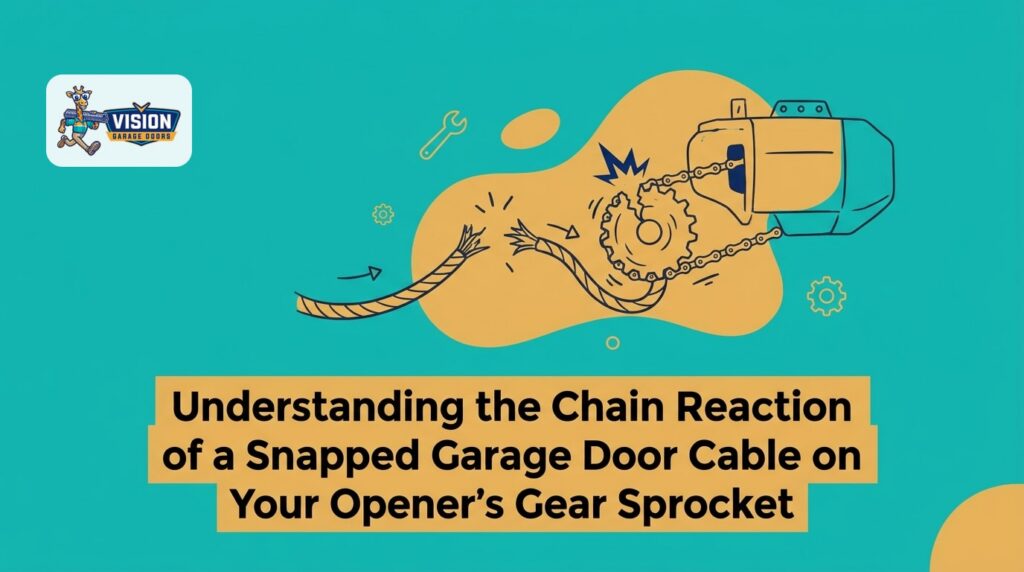
The Chain Reaction: Why the Opener’s Gear Sprocket Shears
The real damage happens a few minutes after the initial bang, usually when a frustrated homeowner presses the wall console button hoping to force the door closed. When you send electrical current to the motor, it obediently tries to pull the trolley along the rail.
Inside the motor housing, a small electrical engine turns a drive gear, which connects to a larger gear sprocket that moves the belt or chain. Because the motor is expecting a light 10-pound pull, it spins up quickly. But the door is wedged, and the counterweight is gone. The motor hits a literal wall of resistance.
To prevent the electrical motor from overheating, catching fire, or ripping the unit off the ceiling, manufacturers design the system with a built-in weak point. Standard chain or belt drive overhead opener internal nylon gears are used precisely for this reason. We frequently encounter this safety design in popular LiftMaster and Chamberlain models manufactured from the early 2000s up to today—they act as a sacrificial fail-safe.
Why Manufacturers Use Plastic Gears Instead of Steel
You might wonder why a heavy-duty appliance uses plastic parts for its primary drive mechanism. It is a deliberate engineering choice:
- Sacrificial protection: Nylon strips easily under extreme torque, saving the expensive electrical motor from burning out.
- Noise reduction: Plastic gears run much quieter than metal-on-metal components, keeping the system hushed during normal operation.
- Cost-effective repairs: Replacing a stripped gear assembly is significantly cheaper than replacing a fried logic board or a burned-out motor core.
When the motor tries to pull that unyielding, heavy door, the metal drive shaft grinds directly into the standard chain or belt drive overhead opener internal nylon gears. Within two or three seconds, the teeth on the plastic gear are completely sheared off, leaving behind a pile of white plastic shavings inside the housing. If you are diagnosing garage door grinding noises after a cable break, that horrible buzzing or whirring sound is the metal shaft spinning uselessly against a bald plastic gear.

How Enderby’s Climate Accelerates Component Fatigue
Mechanical failures rarely happen in a vacuum. As a local family business, we know firsthand how the environment your garage operates in plays a massive role in how quickly components degrade. In the North Okanagan, local weather patterns put unique stresses on overhead systems that homeowners in milder climates never experience.
Significant seasonal temperature fluctuations in Enderby BC cause rapid expansion and contraction in steel components. During hot summer afternoons, the metal cables expand slightly. When the temperature plummets at night, they contract. Over thousands of cycles, this constant shifting causes microscopic metal fatigue, making the cables brittle and prone to sudden snapping.
Winter brings its own set of problems. During the bitter cold snaps of January and February, when temperatures can easily drop below -15°C, the grease and lubrication inside the motor housing and along the tracks begin to thicken. Instead of a smooth, slippery coating, the grease turns into a thick, sticky paste. This thickened lubrication forces the standard chain or belt drive overhead opener internal nylon gears to work much harder just to complete a normal cycle.
The Compounding Effect of Environmental Stress
Because the gears are already straining against cold, stiff lubrication all winter, they develop micro-fractures in the plastic teeth. When a cable finally gives out under the stress of metal fatigue, those weakened gears stand no chance. The environmental stress makes the entire system incredibly vulnerable. If you need garage door repair in Enderby, it is vital to have a technician who understands how local weather impacts these specific materials.
The Hidden Danger of a Simple Cable Swap
When a cable snaps, many homeowners assume the fix is as simple as stringing up a new piece of wire. While replacing the cable is obviously required, treating it as an isolated problem is a dangerous half-measure.
If you pressed the button even once after the cable broke, the gear sprocket absorbed a massive shock. Even if the gear didn’t strip completely bald, the teeth are likely bent, partially sheared, or suffering from severe stress fractures. If a technician simply swaps the cable and leaves, the door might run fine for a few days. But those compromised 32-tooth drive gears will inevitably fail, usually right when you are rushing to leave for work, leaving your car trapped inside.
As local Enderby experts, our team at Vision Overhead Doors provides comprehensive mechanical inspections to catch secondary gear damage rather than just performing a quick, superficial cable swap. A proper evaluation looks at the entire ecosystem of the door.
What a Comprehensive Post-Break Inspection Covers
To ensure your system is actually safe to use, a thorough inspection after a cable failure must include:
- Motor housing check: Opening the chassis to inspect the standard chain or belt drive overhead opener internal nylon gears for white plastic shavings or bent teeth.
- Track alignment: Verifying that the violent drop didn’t bend the vertical tracks outward.
- Roller inspection: Checking the steel or nylon rollers to ensure they weren’t crushed when the door jammed.
- Spring balance test: Ensuring the torsion or extension springs still provide the correct lift after suffering a sudden shock.
What to Do When Your Opener Motor Hums But Won’t Move
If you have already pressed the button and are now hearing a persistent humming or a loud grinding noise without the chain or belt moving, the damage to the gears is already done. The most important thing now is preventing an electrical fire or further damage to the door panels.
Handling 150+ pounds of dead weight suddenly transferring to the opener motor requires emergency professional intervention, not DIY tinkering. We strongly advise our community against trying to handle garage door springs and cables manually, as standard 16×7 double doors can weigh upwards of 250 pounds and are under extreme tension, capable of causing severe injury if handled without the proper tools and training.
Safe Steps to Secure Your Garage
If you find yourself in this situation, follow these steps to secure the area safely while waiting for emergency garage door services:
- Stop pressing the button: Immediately take your finger off the wall console. Hide the remote controls so family members do not accidentally try to open the door.
- Unplug the motorized unit: Pull the power cord from the ceiling outlet. This completely disables the motor, preventing it from overheating if someone accidentally hits a remote button.
- Do not pull the red release cord: If the door is jammed halfway up, pulling the emergency release will disconnect it from the motor rail. Without the spring tension to hold it, the heavy door could come crashing down like a guillotine.
- Clear the area: Move vehicles, pets, and children away from the opening until a professional can safely release the tension and lower the panels.
Protecting Your Entire Garage Door System from Cascading Failures
A garage door is a carefully balanced ecosystem where every part relies on the others to function safely. The chain reaction of a snapped garage door cable on your opener’s gear sprocket is a perfect example of how one small failure can destroy a central component. By understanding that the motor is a gentle guide rather than a heavy lifter, you can make smarter decisions the moment you hear that loud bang.
Our family at Vision Overhead Doors wants to ensure you don’t face a preventable mechanical breakdown. Always remember that standard chain or belt drive overhead opener internal nylon gears are designed to break to save your motor, but they can only be saved if you resist the urge to press the button. If your system has suffered a sudden failure, or if you want to ensure your cables and springs are in good shape before the autumn frost hits in late October, reach out for a comprehensive, professional evaluation. Keeping your components properly inspected and maintained is the surest way to keep a small problem from turning into a major emergency.