Why Knowing How Often to Lubricate Your Garage Door Can Save You Money
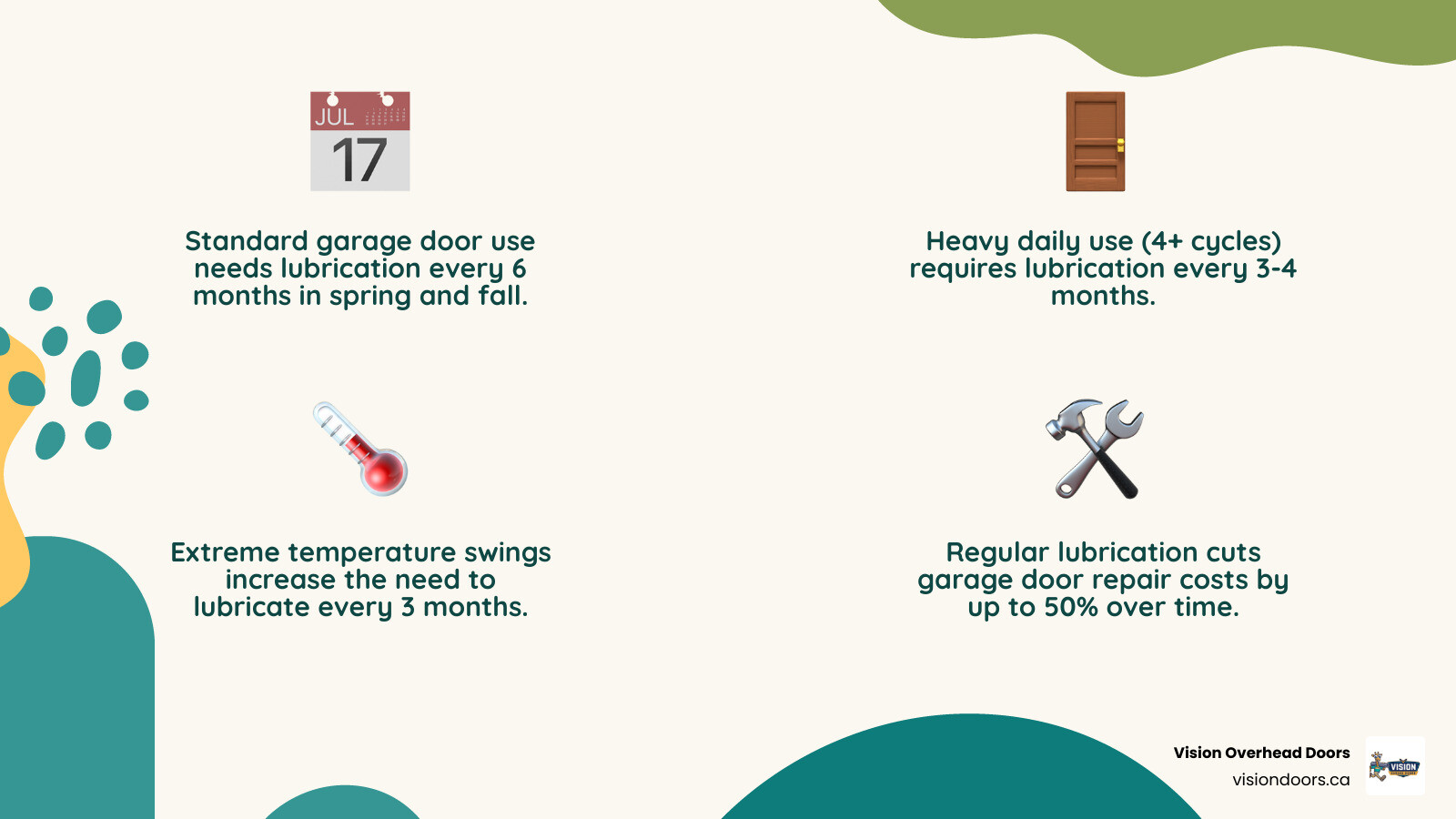
How often to lubricate your garage door depends on how much you use it and where you live — but for most Okanagan Valley homeowners, the answer is twice a year, ideally in spring and fall.
Here is a quick reference guide:
| Usage Level | Lubrication Frequency |
|---|---|
| Standard use (1–3 cycles/day) | Every 6 months (spring and fall) |
| Heavy use (4+ cycles/day) | Every 3–4 months |
| Harsh or extreme climate | Every 3 months |
| Opener rail only | Once every 3–4 years |
Your garage door is one of the largest moving objects in your home. It lifts hundreds of pounds of metal every single day, and the rollers, hinges, springs, and bearings doing that work are under constant mechanical stress. Skip the lubrication long enough, and that stress turns into friction, friction turns into wear, and wear turns into a breakdown that could have been avoided with a can of silicone spray and 20 minutes of your time.
Over 70% of garage door failures are linked to poor maintenance — and skipping regular lubrication is one of the biggest contributing factors. A simple twice-yearly routine can significantly minimize wear and tear over the life of the door. That is a meaningful return on a very small investment of time.
In the Okanagan Valley, temperature swings between hot summers and cold winters put extra stress on metal components, making a consistent lubrication schedule even more important than in milder climates.
I’m Daryl Rands, owner of Vision Overhead Doors and a garage door professional with 26 years of experience serving the Okanagan Valley — and one of the most common questions I get asked is how often to lubricate your garage door to keep it running quietly and safely for years. In this guide, I’ll walk you through everything you need to know, from the right schedule and the right products to a simple step-by-step process you can do yourself.
Glossary for how often to lubricate your garage door:
How Often to Lubricate Your Garage Door for Peak Performance
To keep your overhead system running quietly and efficiently, you should establish a reliable maintenance schedule. Many homeowners make the mistake of waiting until they hear an agonizing screech or a machine-gun rattling noise before reaching for a spray can. By the time your door is making those noises, structural wear is already occurring.
Applying a fresh coat of high-quality lubricant acts as a protective shield. It cushions metal-on-metal contact, prevents rust from eating away at structural integrity, and reduces the workload on your automatic garage door opener. When parts glide smoothly, the opener motor does not have to strain, which directly protects it from premature burnout.
To keep your system on track, we recommend checking out Don’t Wait for the Squeak Your Garage Door Service Timeline to understand how regular checkups prevent emergency failures.
Determining how often to lubricate your garage door based on daily usage
How hard does your garage door work every single day? In the garage door industry, we measure usage in “cycles.” One full cycle consists of the door opening completely and closing completely.
- Standard Residential Use (1 to 3 cycles per day): If you only open your door to pull your car out in the morning and park it at night, your system is under standard mechanical load. For these doors, lubricating all moving parts once every six months is perfectly sufficient. We generally suggest scheduling this in the spring and again in the autumn.
- Heavy Traffic Households (4 or more cycles per day): If you have a busy household where kids are constantly opening the door to grab bikes, or if you run a home business out of your garage, your system is working overtime. Residential garage door components are typically rated for 10,000 to 15,000 cycles. With high-frequency use, friction builds up rapidly. You should lubricate these high-use doors every 3 to 4 months to prevent accelerated component wear.
Adjusting how often to lubricate your garage door for the Kelowna climate
Our beautiful Okanagan Valley climate brings unique challenges for mechanical systems. We experience hot, dry, and dusty summers followed by freezing winters where temperatures in areas like Kelowna, Vernon, and Lake Country can plunge well below zero.
These extreme temperature swings cause metal to expand and contract. In the winter, cold steel becomes more brittle, and standard greases can thicken, making it significantly harder for the rollers to move. This is why we highly emphasize a thorough lubrication run in late September or October before the first frost hits.
Furthermore, if you live in dust-prone areas or close to the water where humidity is higher, moisture can settle on your torsion springs and cause rust. Rust weakens the structural integrity of the spring steel, which can cause them to snap prematurely. In these microclimates, checking and lubricating your springs every 3 months is the best way to keep them protected.
Essential Components That Require Regular Lubrication
Knowing where to spray is just as important as knowing how often to do it. Spraying the wrong parts can actually damage your system or cause safety hazards. To get a complete picture of how basic preventative steps keep your system healthy, read The Easiest Way to Extend the Life of Your Garage Door.
Parts to lubricate
When you perform your semi-annual maintenance, focus your attention on these key metal-on-metal pivot points:
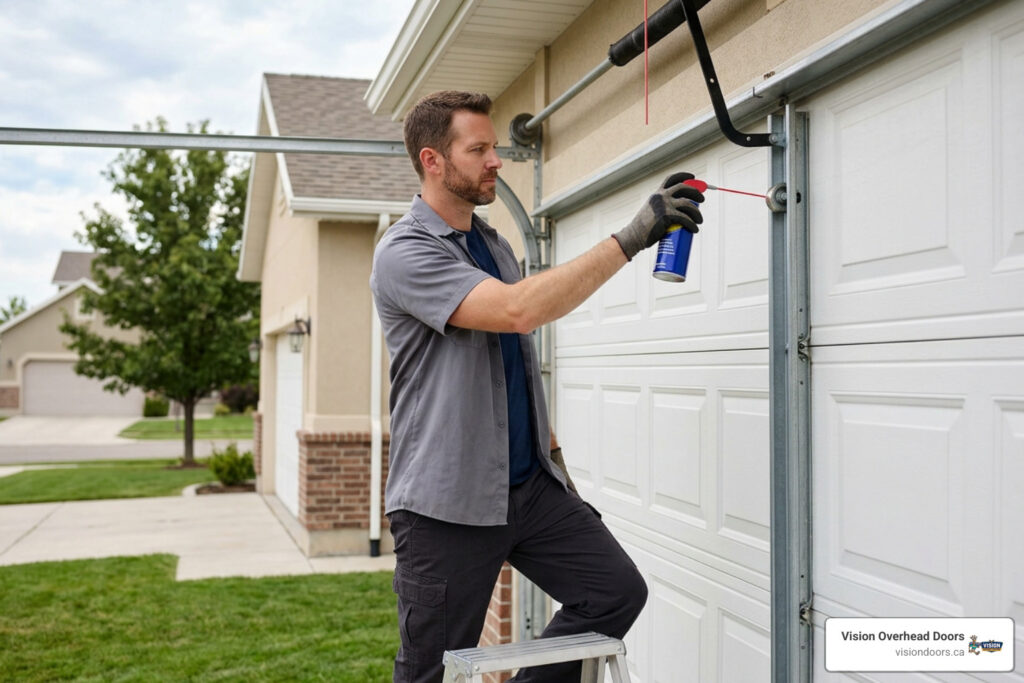
- Torsion Springs: Located on a metal shaft above your closed garage door, these springs do the heavy lifting. They store massive amounts of mechanical energy. You should spray the entire length of the spring with a light, even coat of lubricant to prevent the coils from binding and rusting.
- Hinge Pivots: Your sectional door is held together by metal hinges. Apply a small splash of lubricant directly to the pivot points of each hinge, but avoid coating the entire flat surface of the hinge, as this will only attract dust.
- Roller Bearings: If you have steel rollers, apply lubricant directly to the tiny ball bearings inside the center of the roller wheel. If you have nylon rollers, only lubricate the metal stem and the inner bearings; do not get lubricant on the outer nylon wheel itself.
- Bearing Plates: Located on both the far left and far right ends of your torsion spring shaft, these plates house the bearings that allow the shaft to spin smoothly. A quick spray here prevents the common “rattling” sound.
- Lock Mechanism and Key Cylinder: If your door has a manual lock bar, spray the sliding tracks. For the key cylinder itself, a quick puff of dry graphite or a light silicone spray will keep your key turning smoothly.
Parts to keep clean and dry
There are several areas of your garage door system that should never be lubricated:
- The Garage Door Tracks: This is the number one mistake homeowners make. Do not spray lubricant inside the vertical or horizontal tracks. Lubricant in the tracks turns rolling contact into sliding contact, causing the rollers to slip, slide, and potentially jump out of the track entirely. It also mixes with dust and dirt to create a thick, sticky sludge that clogs the system. Instead, simply wipe the inside of the tracks clean with a damp cloth.
- Nylon Roller Wheels: The outer plastic or nylon portion of nylon rollers is designed to be self-lubricating. Adding grease or oil to the outside of the wheel will cause it to degrade and slip along the track.
- Belt Drives: If your automatic opener uses a rubber belt drive, keep all lubricants away from it. Lubricant will cause the belt to slip on the drive gear, leading to operational errors.
- Safety Sensors: Located at the bottom of your tracks, these photo-eye sensors must remain completely clean and dry to maintain a clear infrared connection.
Choosing the Best Lubricant vs. What to Avoid
Using the wrong product can do more harm than good. To keep your garage door running smoothly, you need a lubricant that can withstand temperature extremes, resist dust accumulation, and stay in place without dripping onto your car or garage floor.
| Lubricant Type | Best Used For | What to Avoid | Why? |
|---|---|---|---|
| Silicone-Based Spray | Hinges, roller bearings, springs, rubber seals | Classic WD-40 | It is a solvent/degreaser; evaporates quickly and strips existing protective oils. |
| White Lithium Grease | Metal-on-metal weight-bearing areas, opener screw drives | Heavy Motor Oil / Engine Grease | Extremely sticky; acts as a magnet for dirt, hair, and grit, creating abrasive sludge. |
| Dry Graphite Powder | Keyed lock cylinders | Cooking Sprays / WD-40 | Cooking oil goes rancid, gums up mechanisms, and offers zero long-term protection. |
Silicone-based sprays are highly recommended for Okanagan homeowners because they maintain their slick viscosity across an incredibly wide temperature range (from -40°C up to extreme summer heat). They also repel moisture, which is excellent for rust prevention. White lithium grease is excellent for metal-on-metal contact points because it clings to the surface and handles heavy loads, though it should be used sparingly on parts exposed to heavy dust.
Step-by-Step Guide to Lubricating Your Garage Door
Ready to tackle your semi-annual maintenance? Grab a clean rag, a can of high-quality silicone-based garage door lubricant, a ladder, and safety glasses.
Before you begin, we highly recommend reading How to Maintain Your Garage Door Between Professional Service Visits for a complete checklist of basic safety inspections you can run at the same time.
Follow these 5 easy steps for a quiet, smooth-running door:
- Disconnect the Power and Secure the Door: Safety first! Close your garage door completely. Unplug your automatic garage door opener from the ceiling outlet or pull the red emergency release cord. This ensures the door cannot be opened automatically while your hands are near the moving parts.
- Clean the Tracks and Hardware: Take a damp rag or microfiber cloth and thoroughly wipe down the inside of both vertical and horizontal tracks. Remove all accumulated dirt, cobwebs, and old grease. If there is stubborn, sticky grime on the hinges or rollers, you can use a small splash of automotive brake cleaner on a rag to dissolve it before wiping it dry.
- Lubricate the Hinges and Metal Rollers: Using the straw attachment on your lubricant can for precision, apply a single drop of silicone spray to the pivot points of each hinge. Next, spray a small amount directly into the center ball bearings of your rollers. Wipe away any drips immediately with your rag to prevent excess lubricant from attracting dirt.
- Coat the Springs and Bearing Plates: Position your ladder safely to reach the torsion springs above the door. Spray a light, even coat of silicone lubricant along the entire length of the spring coils. Do not over-saturate them to the point of dripping. Give a quick spray to the bearing plates on both ends of the spring shaft.
- Test the Door and Clean Up: Plug your opener back in or re-engage the trolley. Open and close the door manually or automatically 3 to 4 times. This movement distributes the fresh lubricant evenly throughout all the internal bearings and pivots. Take your rag and wipe down any excess overspray from the door panels or tracks.
Frequently Asked Questions About Garage Door Maintenance
Can I use standard WD-40 to lubricate my garage door?
No, you should never use classic blue-can WD-40 as a long-term lubricant for your garage door. Standard WD-40 is primarily a solvent and a degreaser, not a true lubricant. While it is excellent for cleaning away rust or freeing up a rusted bolt, it evaporates within a matter of days.
Even worse, WD-40 actually strips away any existing grease or protective oils on your hardware, leaving the bare metal completely exposed to friction and moisture. Always use a dedicated silicone-based spray or white lithium grease designed specifically for overhead garage doors.
What are the signs that my garage door needs lubrication?
Your garage door will usually tell you when it is crying out for attention. Watch and listen for these common warning signs:
- Squeaking, Grinding, or Popping Noises: If your door sounds like a haunted house every time it opens, dry hinges and bearings are rubbing together.
- Jerky or Shaking Movements: When rollers lack lubrication, they stick and drag along the tracks rather than rolling smoothly, causing the door to shudder.
- Opener Straining: If your automatic opener sounds like it is working incredibly hard or moving slower than usual, excessive friction is forcing the motor to pull extra weight.
- Visible Rust: Rust on your torsion springs or hinges indicates that the protective barrier has worn away.
If you are performing spring maintenance and want to make sure you do not miss any other vital steps, check out 10 Tasks to Save Your Garage Door This Spring.
When should I call a professional for garage door maintenance?
While basic lubrication is a fantastic DIY project, there are several critical components that should only be handled by a trained professional.
If you notice frayed cables, a broken torsion spring, or if your door is visibly off-balance (sagging to one side when disconnected from the opener), do not attempt to repair it yourself. Torsion springs and cables are under extreme tension — enough to cause severe injury or property damage if they snap.
If your door remains incredibly loud or jerky even after you have thoroughly cleaned and lubricated it, the issue may be worn-out bearings, bent tracks, or an unbalanced door. For an in-depth look at what a professional checkup includes and why it is worth it, read All About Annual Garage Door Maintenance Is It Worth It?.
Conclusion
Keeping your garage door properly lubricated is the easiest and most effective way to protect your investment, ensure quiet operation, and prevent unexpected breakdowns. By taking just 20 minutes twice a year to clean your tracks and apply a high-quality silicone spray to your springs, hinges, and rollers, you can add years of life to your garage door system.
At Vision Overhead Doors, we have spent over two decades helping homeowners throughout the Okanagan Valley keep their homes safe, secure, and beautiful. Whether you need a professional tune-up, a spring replacement, or a brand-new custom door installation, our local team is dedicated to providing friendly, expert service.
If your garage door is still making unusual noises after lubrication, or if you would rather leave the heavy lifting to the experts, we are here to help. Schedule your professional garage door service in Vernon and the Okanagan Valley today and let our experienced technicians ensure your door operates perfectly in every season.