
Is DIY Garage Door Repair Worth It? Here’s What You Need to Know First
When making a diy vs professional garage door repair comparison, the short answer is this: some tasks are safe and straightforward for homeowners to handle, while others involve serious injury risks that make professional service the only sensible choice.
Here’s a quick breakdown to help you decide:
| Repair Task | DIY Safe? | Why |
|---|---|---|
| Lubricating hinges and rollers | Yes | Low risk, simple tools |
| Replacing remote batteries | Yes | No mechanical risk |
| Cleaning tracks | Yes | Easy, no tension involved |
| Replacing weatherseal | Yes | Minimal mechanical skill needed |
| Torsion spring replacement | No | Extreme tension, injury risk |
| Cable replacement | No | Connected to spring system, high risk |
| Track realignment | No | Requires precision and training |
| Opener motor repair | No | Electrical hazard, complex diagnostics |
| Panel replacement | No | Requires spring rebalancing |
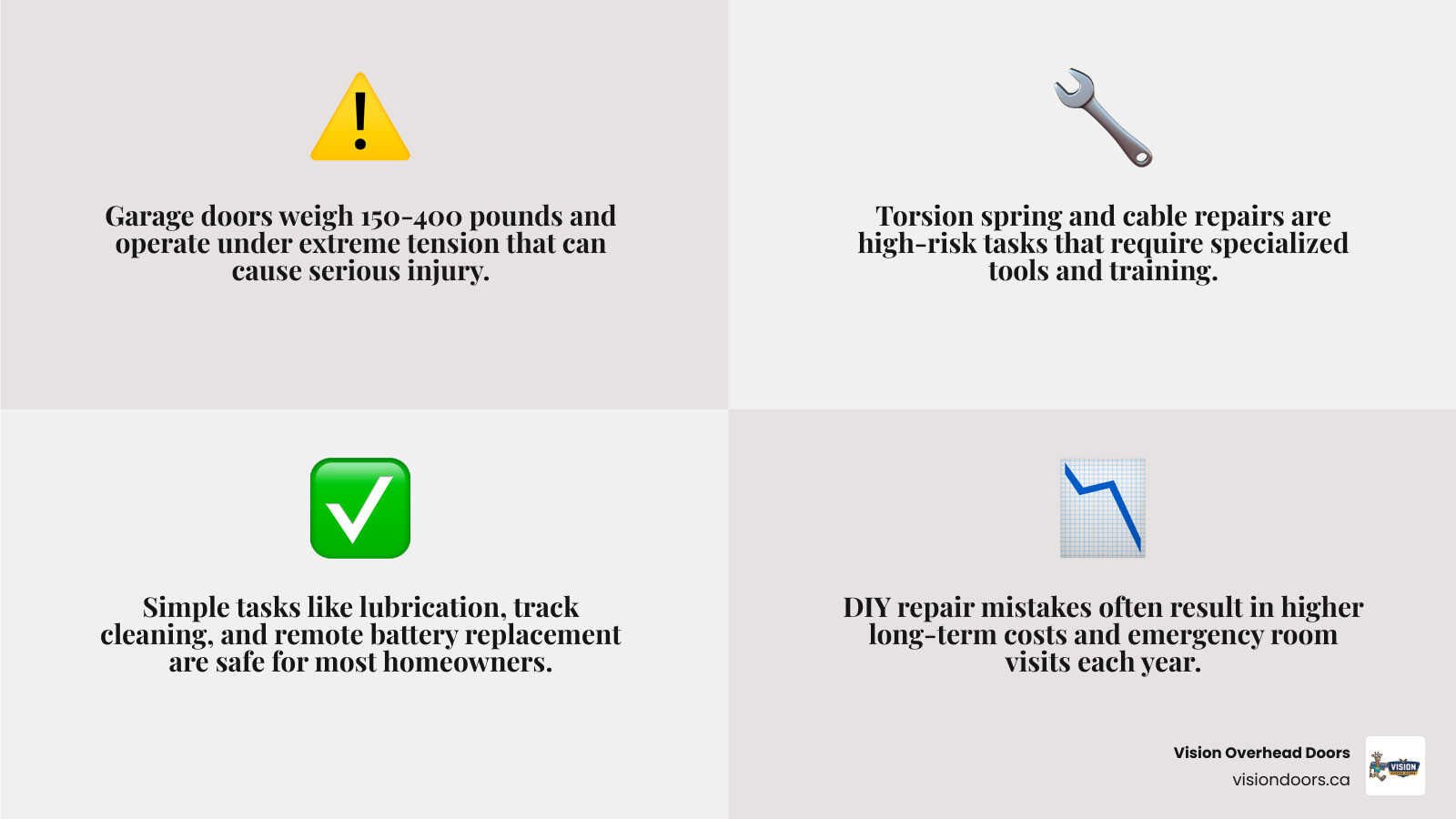
Your garage door is the largest moving object in your home — often weighing between 150 and 400 pounds — and it operates under forces that can cause serious injury if disturbed without the right training and tools. Every year, thousands of homeowners end up in emergency rooms after attempting repairs that looked straightforward in a YouTube tutorial but turned out to be anything but.
The gap between what DIY videos show and what actually happens in your garage can be significant. High-tension torsion springs, frayed cables, and misaligned tracks all carry real risks that aren’t always obvious until something goes wrong. And when something does go wrong mid-repair, the cost — in both dollars and safety — can far exceed what a professional service call would have run in the first place.
I’m Daryl Rands, owner of Vision Overhead Doors and a Red Seal Carpenter with 26 years of experience in the Okanagan Valley garage door industry — and the diy vs professional garage door repair comparison is one of the most common conversations I have with homeowners. In the sections below, I’ll walk you through exactly where the line is, so you can make a confident, informed decision for your home.
Easy diy vs professional garage door repair comparison glossary:
- Find local companies for garage door openers installation in Vernon.
- is it safe to repair a garage door yourself
DIY vs Professional Garage Door Repair Comparison: Key Factors
Deciding whether to tackle a garage door issue yourself or call in our expert team comes down to a few critical factors: mechanical skills, specialized tools, time commitment, and warranty protection.
First, consider the mechanical skills required. A garage door is not a static piece of hardware; it is a complex, counterbalanced system where every component relies on the next. If you adjust one part, you inherently affect the tension, balance, and alignment of the entire system. Without a deep understanding of these mechanics, a minor adjustment can quickly cascade into a major system failure.
Second, specialized tools are a major differentiator in this comparison. Many homeowners believe a standard household toolkit is enough. However, safe garage door repairs often require professional-grade equipment, such as winding bars designed specifically for high-tension springs, locking pliers with specific grip strengths, and precision tension gauges. Using makeshift tools — like using screwdrivers instead of proper winding bars — is one of the leading causes of severe injury during DIY attempts.
Time commitment is another overlooked element. What takes an experienced technician under an hour to complete can easily consume an entire weekend for a homeowner. This includes researching the problem, driving to local hardware stores in search of specialized parts, and troubleshooting when the initial fix doesn’t work.
Finally, warranty protection is a major safeguard for your investment. Most high-quality garage doors and automatic openers come with manufacturer warranties that explicitly require installation and repairs to be completed by certified technicians. Attempting a DIY repair can void these coverages instantly, leaving you fully responsible for any future component failures. Understanding how these elements connect is The Easiest Way to Extend the Life of Your Garage Door.
| Factor | DIY Repair | Professional Service |
|---|---|---|
| Tools Required | Standard household tools (often insufficient) | Specialized, professional-grade equipment |
| Time Investment | Several hours to multiple days | Typically completed in 1 to 2 hours |
| Safety Risk | High (risk of severe injury from high-tension parts) | Extremely low (handled by trained, insured pros) |
| Warranty Status | Often voids manufacturer warranties | Preserves and often adds service warranties |
| Long-Term Reliability | High risk of recurring issues or misalignment | Guaranteed precision and balanced operation |
Safe DIY Tasks in the DIY vs Professional Garage Door Repair Comparison
While we always advocate for safety first, there are several routine maintenance tasks that homeowners can comfortably and safely perform. These tasks are excellent for keeping your system running smoothly between professional tune-ups.
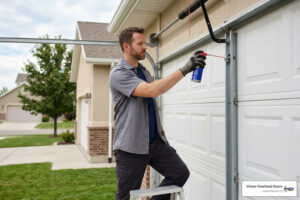
Track cleaning is a prime example of a safe DIY task. Over time, dust, pet hair, and debris can accumulate inside the metal tracks, causing the rollers to slip or bind. You can safely clean these tracks by wiping the interiors with a damp microfiber cloth. Avoid using heavy grease inside the tracks, as this actually attracts dirt and creates a sticky residue that hinders operation.
Hinge and roller lubrication is another highly effective task. Applying a high-quality silicone spray or white lithium grease to the hinges, roller stems, and metal rollers keeps the door operating quietly and reduces friction. However, remember to avoid WD-40; it acts as a solvent rather than a long-term lubricant and can strip away the essential grease your bearings need.
You can also safely replace worn weatherseals along the bottom and sides of your door to keep out drafty Okanagan winds, or reprogram your remotes and wall consoles when battery changes disrupt their signals. For a complete walkthrough on keeping your system in peak condition, check out our guide on How to Maintain Your Garage Door Between Professional Service Visits.
High-Risk Tasks in the DIY vs Professional Garage Door Repair Comparison
On the other side of the spectrum are tasks that carry significant danger and should never be attempted without professional training.
Torsion and extension springs head this list. These springs store immense potential energy to counterbalance the immense weight of the door. If a spring snaps or a winding bar slips during a DIY repair, that stored energy is released instantly, turning metal parts into flying projectiles.
Frayed cables are equally dangerous. Because they are directly attached to the spring system and the bottom brackets, they are under the exact same extreme tension. A snapping cable can whip through the air with enough force to cause severe lacerations or fractures.
Track realignment and opener motor repairs also fall firmly into the professional-only category. Realignment requires precise level testing to prevent the door from binding or falling out of its tracks entirely. Opener motor repairs involve complex electrical diagnostics and gear assemblies that, if improperly handled, can present shock hazards or ruin the unit’s safety reversing sensors. To understand why these systems require an expert touch, read our detailed article on Why You Should Leave Garage Door Springs to the Pros.
The Hidden Risks and Safety Hazards of DIY Repairs

When homeowners look at a malfunctioning garage door, it is easy to underestimate the sheer physical forces at play. A standard residential double garage door can easily weigh hundreds of pounds. The only reason you are able to lift it with one hand — or that a relatively small opener motor can move it effortlessly — is the engineering of the counterbalance system.
At the heart of this system are the torsion springs, which are wound tightly to store massive amounts of torque. This torque exerts continuous tension on the steel cables running down to the bottom brackets of the door. When you attempt to loosen a bolt, remove a bracket, or adjust a spring without the proper safety training and specialized winding bars, you are exposing yourself to an uncontrolled release of this stored energy.
The physical injury risks are real and well-documented. Every year, thousands of people suffer severe lacerations, broken fingers, facial fractures, and traumatic head injuries from DIY garage door mishaps. A slipping winding bar can strike with the force of a sledgehammer, and a snapping spring can release instantly with devastating consequences.
Beyond the immediate physical dangers, there is a high risk of severe property damage. If a door is released from its tracks or becomes unbalanced during a repair, it can come crashing down. This can crush vehicle hoods, damage garage floors, or buckle the door panels themselves beyond repair. What began as a simple attempt to fix a minor squeak can end up requiring a complete door and track replacement. To learn more about these hidden dangers, read our comprehensive warning on Why Your Garage Door Might Be a DIY Death Trap.
When to Call a Professional for Garage Door Service
Recognizing when a problem is beyond your skill level is the best way to protect your home, your family, and your wallet. There are several clear warning signs that indicate it is time to put down the tools and call our professional team.
First and foremost is a loud bang coming from the garage. This is the classic signature of a broken torsion or extension spring. If you look up at the metal shaft above your closed door and see a visible gap in the coils of the spring, do not attempt to open the door, either manually or with the automatic opener. Trying to force a door with a broken spring can burn out your opener’s motor gears and bend the top panels of your door.
Another clear sign is a crooked or off-track door. If your door is hanging unevenly, or if you can see that the rollers have popped out of the vertical or horizontal tracks, stop using it immediately. Operating a crooked door can cause it to jam completely, or worse, fall out of the tracks entirely.
Persistent grinding, squeaking, or scraping noises also point to mechanical issues that require expert diagnostics. These sounds often mean that your bearings are failing, your tracks are misaligned, or your hinges are binding. Finally, if your door exhibits electrical failures — such as reversing unexpectedly, failing to respond to wall buttons, or showing flashing diagnostic lights on the motor unit — it requires professional electrical troubleshooting to ensure the safety sensors are fully operational.
When you experience any of these issues, our team at Vision Doors & Windows is here to help with prompt, professional service. We specialize in safe, efficient diagnostics and repairs throughout the Okanagan Valley, ensuring your door is restored to perfect working order. Learn more about our comprehensive Garage Door Repair options and our specialized Garage Door Spring Repair services.
Frequently Asked Questions About Garage Door Repairs
Is it safe to replace a garage door spring myself?
No, we strongly advise against attempting to replace a garage door spring yourself. Torsion springs are wound under extreme tension to balance the heavy weight of the door. Adjusting or replacing them requires specialized winding bars, a precise understanding of the system’s torque requirements, and professional safety protocols.
Using improper tools, like screwdrivers or pliers, to wind a spring can result in the tool slipping or the spring releasing its energy violently, leading to severe injuries. For your safety, always leave this work to trained professionals who have the experience and safety gear to handle high-tension components. If you suspect your spring is broken, contact our team immediately for expert Garage Door Spring Repair.
Will DIY repairs void my garage door warranty?
Yes, in many cases, attempting DIY repairs on critical mechanical or electrical components will void your manufacturer’s warranty. Most major garage door and opener brands include strict warranty terms stating that any repairs, adjustments, or installations must be performed by certified, professional technicians.
If you attempt to replace parts yourself and cause further damage to the system, the manufacturer will likely deny any warranty coverage for replacement parts. Hiring a professional not only ensures the job is done safely and correctly, but it also preserves your warranty protection and gives you peace of mind. For reliable, warranty-compliant service on your automatic system, check out our Garage Door Opener Repair options.
How often should my garage door receive professional maintenance?
We recommend scheduling a professional garage door inspection and maintenance service at least once a year. Regular professional tune-ups include a comprehensive safety check, door balance testing, track alignment adjustments, and a thorough safety reversal test to ensure your photo-eye sensors are working perfectly.
Because of the intense temperature and humidity fluctuations we experience in the Okanagan Valley — from hot summers in Kelowna to snowy winters in Salmon Arm — the metal parts of your garage door expand and contract, which can gradually throw off its alignment. Annual maintenance prevents premature wear and tear, extending the lifespan of your entire system. To find out if this service is right for your home, read our guide: All About Annual Garage Door Maintenance: Is It Worth It?.
Conclusion
When evaluating a diy vs professional garage door repair comparison, the safest and most reliable choice for major repairs is always professional service. While cleaning your tracks and lubricating your hinges are excellent ways to keep your system running smoothly, any task involving high-tension springs, frayed cables, or complex electrical systems should be left to the experts.
At Vision Doors & Windows, we have proudly served homeowners across the Okanagan Valley — including Kelowna, Vernon, Lake Country, Salmon Arm, Enderby, Armstrong, and Sorrento — for decades. Our team brings local expertise, Red Seal craftsmanship, and a commitment to safety to every single job, ensuring your home remains secure and your family stays safe.
Whether you are looking to schedule your annual safety inspection, need an urgent repair, or want to explore custom architectural glass door solutions to elevate your home’s curb appeal, we are here to help. Contact us today to experience the peace of mind that comes with premium, professional installation and reliable service.
If your garage door is acting up or overdue for a safety tune-up, don’t take unnecessary risks. Get in touch with our local experts today and book your professional Garage Door Repair service.